

Drawings and documents
National Archives restored drawings: drawing
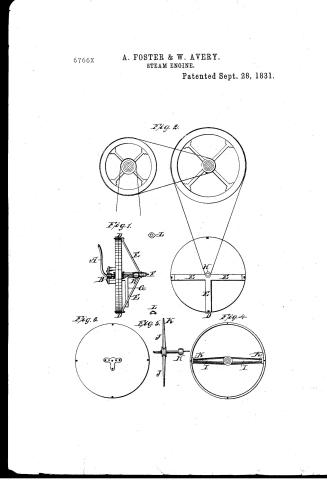
Foster and William Avery's Patent Drawing for a Reacting Steam Engine

National Archives, Restored Patent Drawings (Record Group 241) · Full-size scan at the National Archives · Catalog record
Text on the drawing
Words on the drawing as machine-read by the National Archives; not checked. Useful mainly for searching.
FOSTER & W.. AVERY / REACTING STEAM ENGINE. / no number / Patented Sept. 28ᵗʰ1831. / 121 STEAM ENGINES, / sept 28/83/ / Re / #2- / Rotary Impact / V,12.h. 5 / CLASSIFICATION / 6766.4 / DIVISION. / forma 1. / Fig. 2. / I.I. J.J. / L. / E. / -F. / 0x / E. / E. / G. / flat / E. Braer / Claim / L. / Stuttingbox / D. / D. / Fig 3. / Fig 4. / Fig. 5. / H. / J.
USPTO scan
The patent as scanned by the USPTO
-
 Page 1
-
 Page 2
-
 Page 3
-
 Page 4


U.S. Patent and Trademark Office · Google Patents
Published accounts: specification
Specification printed in the Journal of the Franklin Institute
Journal of the Franklin Institute, new ser., vol. 17 (1836), p. 279 · View the page
Text of the specification as printed in the Journal, from OCR; not proofread.
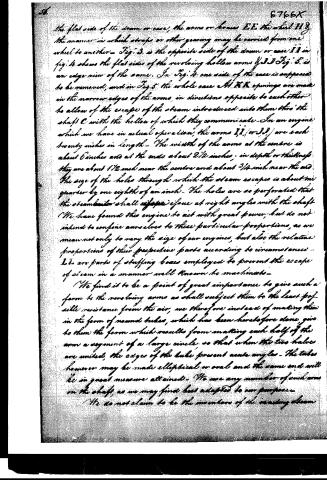
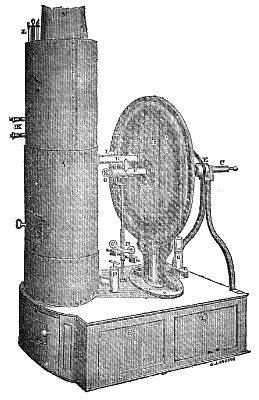
Specification of a Patent for an improvement in the Reacting Steam Engine. Granted to AMBROSE FOSTER, Brutus, Cayuga county, and WILLIAM AVERY, Salina, Onondaga county, New York, September 28th, 1831. To all whom it may concern, be it known, that we, Ambrose Foster, of Brutus, Cayuga county, and William Avery, of Salina, Onondaga county, in the state of New York, have invented a certain improvement in the steam engine, commonly called the reacting engine, and that the following is a full and exact description of our said improvement. Fig. 3 Fig.5 K C Fig.1 D H Fig.2 Fig. 4. T D K A E D H K E E E H G E K E D D Fig. 1, in the accompanying drawing, represents a side view of the engine, the revolving arms not being visible, in consequence of their being enclosed in a circular case, to be presently described. A is a steam tube, connected with a boiler, and forming a steam-tight joint, in the box B, where it opens into the shaft C, which is made hollow to the requisite depth. D is the edge, or periphery, of a case, or drum, within which the arms from which the steam is to issue, revolve. E, E, are braces, which may be attached to the case, or drum, and at their junction support a socket, containing a centre pin, or screw, F, against which the shaft C is to run. Gisa tube, through which the steam passing into the case from the revolving arms, is allowed to escape; a portion of this steam is employed to heat the water by which the boiler is to be supplied. His a whirl upon the shaft Progress of Practical and Theoretical Mechanics. C, a strap from which may be employed to drive machinery. Where the same parts occur in the other figures in the drawing, they are represented by the same letters. Fig. 2, shows the flat side of the drum, or case; the arms, or braces, E, E; the whirl, H, and the manner in which straps, or other gearing, may be carried from one wheel to another. Fig. 3, is the opposite side of the drum, or case. E, E, in Fig. 4, shows the flat sides of the revolving hollow arms; and J, J, Fig. 5, is an edge view of the same. In Fig. 4, one side of the case is supposed to be removed, and, in Fig. 5, the whole case. At K, K, openings are made in the narrow edges of the arms, in directions opposite to each other, to allow of the escape of the steam introduced into them through the shaft C, with the hollow of which they communicate. In an engine which we have in actual operation, the arms, E, E, (or J, J,) are each twenty inches in length. The width of the arms at the centre is about six inches, and at the ends about two and a half inches; in depth, or thickness, they are about one and a half inches near the centre, and about three-fourths of an inch near the end. The size of the holes through which the steam escapes, is about one-quarter, by one-eighth, of an inch. The holes are so perforated that the steam shall issue at right angles with the shaft. We have found this engine to act with great power, but do not intend to confine ourselves to these particular proportions, as we mean not only to vary the size of our engines, but also the relative proportions of their respective parts, according to circumstances. L, L, are parts of stuffing boxes, employed to prevent the escape of steam, in a manner well known to machinists. We find it to be a point of great importance to give such a form to the revolving arms, as shall subject them to the least possible resistance from the air; we, therefore, instead of making them in the form of round tubes, which has been heretofore done, give to them the form which results from making each half of the arm a segment of a large circle, so that, when the two halves are united, the edges of the tube present acute angles. The tubes, however, may be made elliptical, or oval, and the same end will be, in a great measure, attained. We use any number of such arms on the same shaft, as we may find best adapted to our purpose. We do not claim to be the inventors of the reacting steam engine, nor of the case, or drum, within which we intend the arms shall, in general, revolve; but what we claim as our invention, is, simply, the giving the oblate, or flat, form to the revolving arms, so that, in proportion to their capacity, they shall experience much less resistance from the air than that to which they have been heretofore subjected, thereby obtaining a greatly increased power. AMBROSE FOSTER, WILLIAM AVERY. Progress of Theoretical and Practical Mechanics. Lever and Spring Balances. By CHARLES T. COATHUPE. The public are already indebted to the ingenuity of many for various contrivances adapted to the purpose of weighing. Some have vastly improved Lever and Spring Balances. the convenience of the old-fashioned beam. Others have devoted their attention to supersede the employment of weights, by the use of oval or spiral springs, and have produced very effective and perfect instruments, with all the accuracy necessary for their intention, such as Marriott's Dial, and Salter's Spring Balance. But no person has yet availed himself of the effects which are to be derived from the union of the two principles already adopted. It is, then, with all due deference to the better judgment of others, that I propose a machine of very easy manufacture, and small expense, by combining the lever with the spring balances of Marriott, or Salter, which appears to offer many advantages over either used alone. Fig. 1 represents the arrangement for heavy weights, where we will suppose the distance from the fulcrum to the point of suspension to which the spring balance is attached, to be eight times the distance of the fulcrum from the point to which the weight is to be suspended. Salter's balances, graduated to weigh 24 lbs., and whose cost is about five shillings, will then weigh 192 lbs., and each 1 lb. division will indicate 2 lbs. Fig. 1. 1 Fig. 2. Fig. 2 is the reverse application, and may be used for light weights. Of course, each lb. division will then represent only oz. Fig. 3 is merely the conversion of the lever to a simple hook for supporting the spring balance, when used in the ordinary manner for immediate purposes. It is obvious that, with a combination of this kind, and using one of Marriott's dials, calculated to weigh 2 cwt., we may readily make it available for weighing a ton, and thus have not only the perfect use of the dial itself, when detached, but a machine Fig. 3. ++++++ capable of weighing very heavy packages without weights, thereby avoiding the expense of such weights, the trouble of removing them, and the risk of a false computation.-[Lond. Mech. Mag. Effect of the velocity of Air upon its use in Smelting Iron.-M. Teploff, one of the Russian Mining Corps, in an article on the improvements recently introduced into the smelting of iron in Russia, makes the following statement. In the smelting furnaces of the Ural, where the quantity and velocity of the blast are properly regulated, 1.4 of pig iron is obtained by 1 of charcoal fuel, while in other furnaces they obtain but .4 and .6 by the same consumption of fuel. 27* The velocity of the blast being increased, the heat within is increased, without a corresponding consumption of fuel. In an experiment made by order of the government, it was found that one hundred cubic feet of air, under a pressure of two inches of mercury, produced the same effect as two hundred cubic feet, under a pressure of one inch, with this difference, that, in the latter case, twice the fuel was consumed, which was required in the former case. In one furnace which is mentioned, 22,000 lbs. of iron were obtained in twenty-four hours, by 16,000 lbs. of charcoal. Previous to the due regulation of the draught, they consumed twice this amount of fuel for the same yield of iron. This economy is obtained by duly proportioning to each other the size of the blast pipe, and the pressure of the draught. The relation of these to each other, varies with the furnace. M. Teploff asserts that the results thus obtained exceed those with the hot air blast, but it does not appear that any comparisons have been made under his examination, and with the charcoal fuel. To regulate the draught, it is recommended to place two mercury or water gauges, one near the blast pipe, the other near the governor of the blowing machine. By varying the pressure, and the diameter of the nozzle of the blast pipe, making the latter smaller as the former is increased, and vice versa, the best proportion is to be ascertained.-[Annales des Mines, vol. vii. Preservation of Wood from Dry Rot. It is stated as the result of observations made in the German mines, that pine wood, which has been exposed to the action of water under pressure, is not subject to the dry rot. A stick of pine wood, placed in water in an iron pipe, absorbed, in thirty-six days, 27 per cent. of water. Subsequent exposure for thirteen days, in a warm room, evaporated 15 parts of the water. A similar stick of wood, exposed for the same time, but pressed, at intervals, by a force of nearly fifty atmospheres, absorbed 118 per cent. of water. Of this, when the wood was exposed as above stated for the other piece of timber, there evaporated 21 parts. The wood was not sensibly increased in bulk by the absorption of the water. The bulk of water absorbed in the second experiment having been nearly one-thirty-ninth that of the wood. [Ibid. Proportion of Ashes in different parts of Wood. A portion of heart wood, of sap wood, and of intermediate layers, of the trunk of an oak of sixty years of age, which had grown in a sandy loam, were separately burned. The heart yielded.27 per cent. of ashes, the middle layers .34 per cent., and the sap wood .532 per cent.-[Journ. of Pract. Chem. (Germ.) Ann. des Mines, vol. vii. Progress of Physical Science. Experimental researches in Electricity. Eighth Series. By MICHAEL FARADAY, &c. &c. Phil. Trans. Lond. 1835.* 1. Metallic contact is not necessary to the production of the voltaic curent. Decomposition of iodide of potassium is obtained by zinc and platinum Abstract made for this Journal.-[Сом. Рив.] * Experimental Researches in Electricity. plates, immersed in part in a diluted acid, and separated above the acid solution by a piece of paper moistened with the iodide. The iodine appears at the platinum wire terminating the platinum plate. 2. Metallic contact is effective by opening a path for the voltaic current without introducing any new affinities to oppose that of the exciting fluid. Such an opposition would occur, if compounds capable of being decomposed by the current, were used to connect one set of extremities of the plates, while the other extremities were dipped into a dilute acid. 3. A simple galvanic circle is capable of effecting chemical decompositions when the elements of compounds are united by a weak affinity, or by proportioning the affinities producing to the current to those of the compounds to be acted upon. The following compounds are placed in the order of facility of decomposition, the first requiring the lowest intensity of current. Iodide of potassium (solution). Chloride of silver (fused). Protochloride of tin (fused). Chloride of lead (fused). Iodide of lead (fused). Muriatic acid (solution). Water acidulated with sulphuric acid. 4. "The electricity of the voltaic pile is not dependent either in its origin or its continuance on the contact of the metals with each other. It is essentially due to chemical action, and is proportionate in its intensity to the intensity of the affinities concerned in its production; and in its quantity to the quantity of matter which has been chemically active during its evolution." 5. "Volta-electric decomposition is simply a case of the preponderance of one set of chemical affinities more powerful in their nature over another set which are less powerful; and if the instance of two opposing sets of such forces be considered, and their mutual relation and dependence borne in mind, there appears no necessity for using, in respect to such cases, any other term than chemical affinity (though that of electricity may be very convenient,) or supposing any new agent to be concerned in producing the results; for we may consider that the powers at the two places of action are in direct communication, and balanced against each other through the medium of the metals, in a manner analogous to that in which mechanical forces are balanced against each other by the intervention of the lever." 6. "All the facts show us that the power commonly called chemical affinity can be communicated to a distance through the metals and certain forms of carbon; that the electric current is only another form of the forces of chemical affinity; that its power is in proportion to the chemical affinities producing it; that when it is deficient in force it may be helped by calling in chemical aid, the want in the former being made up by an equivalent of the latter; that in other words, the force termed chemical affinity and electricity are one and the same." 7. Chemical action is not of itself sufficient to produce an electrical current, the substance acting chemically must be in combination, and in such a state of combination as to be capable of decomposition by electricity. Thus liquid chlorine will dissolve the zinc of a voltaic battery, but no electrical current will result. It is not sufficient that a body act chemically, and be a conductor of electricity, it must be decomposable. Thus, metallic tin acting on platinum plates evolves no electricity. It follows from this, that the sulphuric acid used in the battery evolves no electricity in combining with the oxide of zinc. It merely dissolves the oxide, exposing a fresh surface to oxidation. 8. Notwithstanding the extraordinary state which must be assumed by an electrolyte either during decomposition, when an enormous quantity of electricity must be traversing it, or in the state of tension which is assumed as preceding decomposition, still it has no power of affecting a ray of polarized light, and hence no peculiar structure is to be inferred in this way. 9. The state of tension just referred to may be rendered evident by immersing in dilute sulphuric acid a single pair of galvanic cylinders, provided with cups to contain mercury, making an electrical communication for the plates by means of an amalgamated wire. On dipping one end of the wire into one of the mercury cups, and bringing the other end near the other cup, a spark passes through the intervening air. 10. Mr. Faraday next examines fully by experiment the following questions. Can electrolytes (bodies capable of decomposition by electrical currents) resist an electrical current below a certain intensity? Is the intensity at which the current ceases to act the same for all bodies? Will electrolytes thus resisting decomposition conduct electricity or serve as insulators? (a.) A current excited by the action of dilute sulphuric acid on a pair of zinc or platinum plates was capable of decomposing iodide of potassium, but not water. The current evolved with the same plates, when nitric acid was added, decomposed water. A current which decomposes a solution of iodide of potassium may not be able to decompose one of sulphate of soda, the current being conducted in each of these cases. (b.) In similar experiments fused chloride of silver was decomposed by a current which was conducted, without decomposition, by fused chloride of lead, and by fused nitre. (c.) Water, whether pure or acidulated, seems to be equally decomposable by an electrical current, and has the same conducting power, whether pure or acidulated, for currents unable to decompose it. 11. A curious conclusion from the view of a certain electrical intensity being necessary to the decomposition of bodies is, that "we may arrange circumstances so that the same quantity of electricity may pass in the same time, in at the same surface, into the same decomposing body, in the same state, and yet differ in intensity, decomposing in one case and not in the other. For taking a source of too low an intensity to decompose, and ascertaining the quantity passed in a given time, it is easy to take another source having a sufficient intensity, and reducing the quantity of electricity from it by the intervention of bad conductors to the same proportion as the former current, and then all the conditions will be fulfilled to produce the result described. 12. In considering the effects of many alternations of simple galvanic circles, giving rise to the battery, Mr. Faraday gives the following view of the increase of intensity with the number of pairs of plates, while the quantity remains the same. "The electricity which passes across the acid from the zinc to the platinum in the first cell, and which has been associated with, or even originated by, the decomposition of a definite portion of water in that cell, cannot pass from the zinc to the platinum in the second cell without the decomposition of the same quantity of water there, and the oxidation of the same quantity of zinc by it." The quantity of electrolyte decomposed, and of electricity passed, must, as has been before shown, be the equivalents of each other. "The action in each cell, therefore, is not to increase the quantity set in motion in any one cell, but to aid in urging forward that quantity, the passing of which is consistent with the oxidation of its own zinc; and in this way it excites that peculiar property of the current which we endeavour to express by the term intensity, without increasTellurium and its Compounds with Oxygen. ing the quantity beyond that which is proportionate to the quantity of zinc oxidized in any single cell of the series." (a.) In proof of this position, ten pairs of amalgamated zinc and platinum plates were arranged with dilute sulphuric acid, forming a battery. When the circuit was completed, hydrogen was given off in each cell, and being collected, proved the same for each cell of the battery and chemically equivalent to the zinc dissolved. (b.) This fact has been proved "long ago, in another way, by the action of the evolved current on a magnetic needle; the deflecting power of one pair of plates in a battery, being equal to the deflecting power of the whole, provided the wires used be sufficiently large to carry the current of the single pair freely; but the cause of this equality of action could not be understood whilst the definite action and evolution of electricity remained unknown." (c.) "Whatever intensity may be," " there seems to be no difficulty in comprehending that the degree of intensity at which a current is evolved by a first voltaic element, shall be increased when that current is subjected to the action of a second voltaic element, acting in conformity and possessing equal powers with the first." Since the act of decomposition opposes a certain force to the electric current, and one which is of the same kind with this force, it is obvious that bodies may resist a current of one intensity, and give way to a more powerful one. Nor does this contradict the law of definite electrical action. (TO BE CONTINUED.) Tellurium, and its Compounds with Oxygen.-Pure tellurium may, according to Berzelius, be procured by mixing the ore with carbonate of potassa, or of soda and oil. The mixture is exposed to heat in a crucible. When the oil has been decomposed, the heat should be raised for a short time nearly to whiteness. Water passed through the subst
Published accounts: journal notice
Notice in the monthly list of patents, with remarks
Journal of the Franklin Institute, new ser., vol. 9 (1832), p. 171 · View the page
35. For an improvement in the Re-acting Steam Engine; Ambrose Foster, Brutus, Cayuga county, and William Avery, Salina, Onondaga county, New York, September 28.
Remarks. In this engine, the steam is to issue from the opposite sides of revolving arms, as the water does from the rotary trunk of Barker's mill. The oldest steam engine known, that of Hero of Greece, acted upon this same principle; and numerous others have been constructed in modern times, which were to operate in this way. The present patentees do not pretend to be the inventors of this kind of engine, but to have devised such improvements as they believe will render it more efficient than it has hitherto been. It is intended that the arms shall revolve within a drum or case; from this a tube is to conduct off the steam, a portion of which, when condensed, will serve, in part, to supply the boiler. The improvement relied on by the patentees consists in making the revolving tubes flat, instead of round, that they may be subjected to but little resistance from the atmosphere. They say that "in an engine which we have in actual operation, the arms are each twenty inches in length. The width of the arms at the centre is about six inches, and at the ends about two inches and a half. In depth, or thickness, they are about one inch and a half near the centre, and about three-fourths near the end. The size of the holes through which the steam escapes, is about one-fourth by one-eighth. The holes are so perforated that the steam shall issue at right angles with the shaft." "We find it to be a point of great importance to give such a form to the revolving arms as shall subject them to the least possible resistance from the air; we, therefore, instead of making them in the form of round tubes, which has been heretofore done, give to them the form which results from making each half of the arm a segment of a large circle; so that when the two halves are united, the edges of the tube present acute angles. The tubes, however, may be made elliptical, or oval, and the same end will be in a great measure attained. We use any number of such arms on the same shaft, as we may find best adapted to our purpose." "We do not claim to be the inventors of the reacting steam engine, nor of the case, or drum, within which we intend the arms shall in general revolve; but what we claim as our invention is simply the giving the oblate or flat form to the revolving arms, so that in proportion to their capacity they shall experience much less resistance from the air than that to which they have been heretofore subjected, thereby obtaining a greatly increased power." We have been induced to give more room to the notice of this engine than we should otherwise have done in consequence of the information contained in a letter recently received from one of the patentees, that it had been in continued use ever since the issuing of the patent, in a factory owned by him, and had fully justified all his anticipations.
Published accounts: journal notice
Notice in the monthly list of patents
Journal of the Franklin Institute, new ser., vol. 17 (1836), p. 278 · View the page
I lay a flat rail, which, however, may be grooved, if preferred, at the commencement of the curvature, and in a position to be centrally under the flanches of the wheels upon the outer track of the circle, so that no other part of the wheels which run upon the outer circle of the track rails, shall touch, or bear upon, the rails, but the peripheries of the flanches, they bearing the whole weight of the load and carriage; while the opposite wheels, which run upon the inner track of the circle, are to run and bear upon their treads, in the usual way, and their flanches run freely in a groove, or channel; which treads are, ordinarily, about three inches in diameter, less than the peripheries of the flanches. Were the bearing surfaces of the wheels, which are in contact with the rails, while thus turning the curve, to be connected by straight lines from every point, there would thus be formed the frustrums of two cones, if there be four wheels and two axles to the carriage; or, if but one axle, and two wheels, then but one cone; which frustrums for the wheels representing their extremities, will, if the wheels are thirty inches in diameter, and are coupled about three feet six inches apart, turn a curve of about sixty feet radius of the inner track rail. The difference in diameter between the flanches and treads, before stated, the tracks of the usual width, and the wheels coupled, as stated, would turn a curve of a somewhat smaller radius if the axles were not confined to the carriage in a parallel position with each other; but this being generally deemed necessary, the wheels run upon lines of tangents, and those upon the inner track being as wide apart in the coupling as the outer ones, keep constantly inclining the carriage outwards, and thus cause the carriage to tend to run upon a larger circle than the difference in diameters of the treads and flanches would otherwise give; but the depth of the flanches, and the couplings, may be so varied as to turn any other radius of a circle desired. What I claim as my invention, or improvement, is the application of the flanches of the wheels on one side of rail-road carriages, and of the treads of the wheels on the other sides, to turn curves upon railways, particularly such as turning the corners of streets, wharves, &c., in cities and elsewhere, operating upon the principles herein set forth. JAMES STIMPSON. Foster and Avery's Rotary Steam Engine. We made some remarks on the subject of this engine in the last number and as it has attracted considerable attention, we have determined to publish the specification entire, in order that the nature and amount of the part claimed may be fully understood. This, with some further remarks upon it, was crowded out of the last number of the Journal, and, upon reflection, we have determined to omit the said remarks, and to give the specification alone. The original notice of this engine may be found at p. 171, vol. ix.-[EDITOR. Specification of a Patent for an improvement in the Reacting Steam Engine. Granted to AMBROSE FOSTER, Brutus, Cayuga county, and WILLIAM AVERY, Salina, Onondaga county, New York, September 28th, 1831.
DATAMP: illustration
Illustrations from DATAMP

DATAMP (Directory of American Tool and Machinery Patents), via the Internet Archive · Archived DATAMP page
About this record
- Patentee
- DATAMP
- Date
- the Name and Date index of patents, DATAMP, USPTO records
- Invention
- DATAMP
- Listed in
- the Name and Date index of patents, DATAMP, USPTO records, Jim Shaw's X-patent list, the Journal of the Franklin Institute, Burke's List of Patents (1847)
- in_burke