

Drawings and documents
National Archives restored drawings: drawing
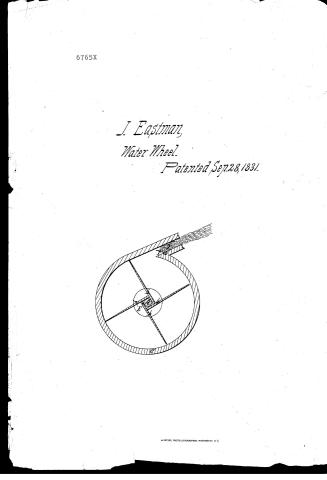
Joel Eastman's Patent Drawing for a Water Wheel

National Archives, Restored Patent Drawings (Record Group 241) · Full-size scan at the National Archives · Catalog record
Text on the drawing
Words on the drawing as machine-read by the National Archives; not checked. Useful mainly for searching.
188. HYDRAULIC MOTORS / Rotary. / CLASSIFICATION / 6765-X / DIVISION. / 10. [168 Soet @astman's Water Wheel / sep / $1. / 28th 28 1831. / [168] / WLA Palented St Sahr
USPTO scan
The patent as scanned by the USPTO
-
 Page 1
-
 Page 2
-
 Page 3


U.S. Patent and Trademark Office · Google Patents
Published accounts: journal notice
Notice in the monthly list of patents, with remarks
Journal of the Franklin Institute, new ser., vol. 9 (1832), p. 166 · View the page
18. For an improvement in the Water Wheel, and the application of Water thereto; Joel Eastman, Bath, Grafton county, New Hampshire, September 28.
Remarks. (See the specification.)
Published accounts: journal notice
Notice in the monthly list of patents, with remarks
Journal of the Franklin Institute, new ser., vol. 9 (1832), p. 178 · View the page
What I claim as new, and for which I ask a patent, is the delivering the earth from the plough, or excavator, as above described, on to an endless revolving apron, or aprons, forming an inclined plane; and by such apron, or aprons, to carry the earth up so that it may be delivered into a car, or other convenient receptacle, or deposit it upon the ground upon the principle hereinbefore described; that is, by the use of the said revolving endless aprons. DUDLEY MARVIN. Specification of a patent for an improvement in Water Wheels. Granted to JOEL EASTMAN, Bath, Grafton county, New Hampshire, September 28, 1831.
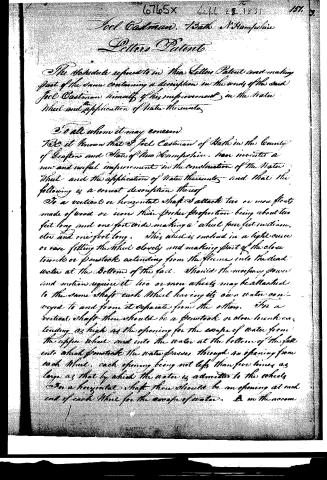
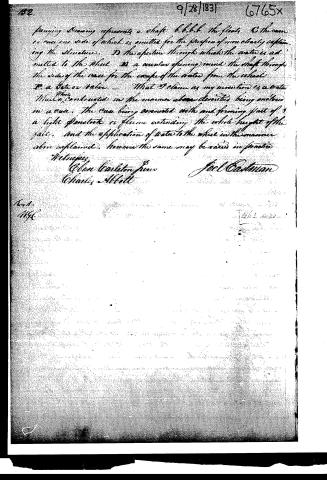
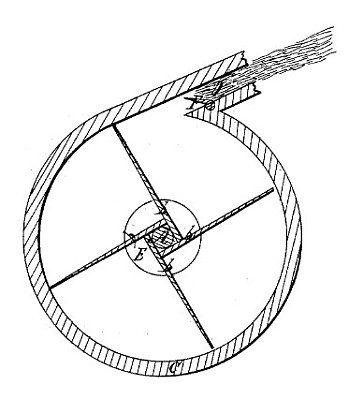
Remarks. (WITH A COPPERPLATE.) To all whom it may concern, be it known, that I, Joel Eastman, have invented a new and useful improvement in the construction of water wheels, and the application of water thereto, and that the following is a correct description thereof. To a vertical or horizontal shaft I attach two or more floats made of wood or iron, their proper proportions being about two feet long and one foot wide, making a wheel four feet in diameter and one foot long. This wheel is enclosed in a tight curve or case, fitting the wheel closely, and making part of a close trunk, or penstock, extending from the flume into the dead water at the bottom of the fall. Should the necessary power and motion require it, two or more wheels may be attached to the same shaft, each wheel having its water conveyed to and from it separate from the others. For a vertical shaft there should be a penstock or close trunk, extending as high as the opening for the escape of the water from the upper wheel, and into the water at the bottom of the fall, into which penstock the water passes through an opening from each wheel, each opening being not less than five times as large as that by which the water is admitted into the wheels. What I claim as my invention is a water wheel, or wheels, constructed in the manner above described, being enclosed in a case, the case being connected with, and forming part of, a tight penstock, or flume, extending the whole height of the fall, and the application of water to the wheel in the manner explained, however the same may be varied in practice. JOEL EASTMAN.
DATAMP: illustration
Illustrations from DATAMP

DATAMP (Directory of American Tool and Machinery Patents), via the Internet Archive · Archived DATAMP page
About this record
- Patentee
- DATAMP
- Date
- the Name and Date index of patents, DATAMP, USPTO records
- Invention
- DATAMP
- Listed in
- the Name and Date index of patents, DATAMP, USPTO records, Jim Shaw's X-patent list, the Journal of the Franklin Institute, Burke's List of Patents (1847)
- in_burke