

Drawings and documents
National Archives restored drawings: drawing
William Annesley's Patent Drawing for a Boat


National Archives, Restored Patent Drawings (Record Group 241) · Full-size scan at the National Archives · Catalog record
Text on the drawing
Words on the drawing as machine-read by the National Archives; not checked. Useful mainly for searching.
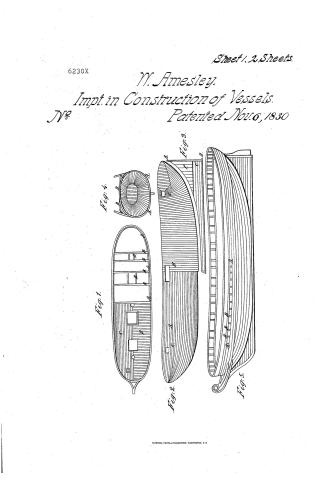
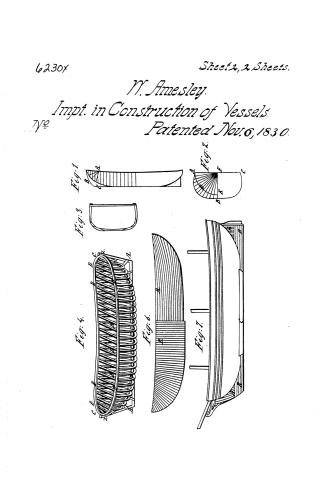
Sheet 1. CLASSIFICATION / 6230X / Nm annesley / DIVISION. / nov. 6- 1830 / PLATE II / Annesley Del. / FIG.1 / FIG. 5. / FIG 2 / OIR / FIG 4 / Turnbull Sc / FIG / 3.
Sheet 2. Explanation of the plates. / Plate I Figure I Represents the model as first made of word on a / proper proportional scale, which is then cut up into transe sections / which sections may he either vertical as or obhque AB to sint / the convernence of the buitder in making Latting up the frames ar moulds / on which the refsel is built. / Figure 2 Represents one of the trunsverse sections of the mosel / laid down paper, ABC being the outer line of the section: After / this is drawn accurately a cirite is described from the Centre F with / the radius FA upon the drawing Vis curcumference divided intoequal / parts, through which Radii are drawn to the outer edge fthe section, / From the plan thus laid down m/mper the moulds are laid out or / pertracted fther proper size an a monting floor. / Figure 3 Represents one of these mould panned together. / Figure 4 Represents He me mild frames for paly stup as / seen in perspective, XY, is the kelson an which the midship mouths not / YZVXZ represent fore faft moulds, being a temporary continuation / of the kelson an which the front soft mouths rest. DDD Deek clamps / BBB the moulds ZAY+ZAX the framing of the stem & / stern dead wood, which is fet up until the refael is entirely planked / Figure 6 shews the hull with A one of the horizentat or / fore of aft courses- B the next athwart wrapping Course / Figure 70 The Nefal complete / Ais the first course, of tumber companying the dead / wood B a strong fore α aft Course of plank spiked an it X mining the / tumber firmly- C one of the side keel, (when used) / Plate II. / Figure / Repasent a view of the deck of the refiel / described in Plate I. _A_A Deck clamps -BB Planks or car- / lines to support the deck & comeings near of at the hatchways / I the first or lowest course, or (when more than me) one of the lower / Causes of dark planking. Che upper a last Course of planking. / Figures 2.3.4x5. Exhibit another modification / in the form of the repel. in which the Nartical or wrapping.
Sheet 3. Figure 3 A Stern prit. B upright tumber or core fther / Jead Wood Conter Co Cause of planting / Hyne 4 AA Hull barrel, BB desk supported an / brackets / Figure Hull complete with a strenk of the plank off / at AA to shew supporting the deck. / Rub / Signed / Viany m Mary / for Annualey / PRESERVATION HISTORY / SERVICE ORDER NUMBER / PROCESS NUMBER / NNTS 81-11 / 10 / TREATMENT / TECHNIQUE/MATERIALS / WORKER / DATE / State State Now York New York / Surface Cleaned / Inks Tested / Removed Tape / lity Hounty of On this / Deacidified / Tears Mended / day f April in the / Flattened / Laminated / Encapsulated / year of on Lord Eighteen hundred Husty mine before me / BW / OTHER TREATMENT/COMMENTS / 10/23/88 / James M Hown Reinder of the City of allarg duly authorized / to administer oatho, personally appeared William annosly / GENERAL SERVICES ADMINISTRATION / GSA FORM 7276 (4-79) / to me known oath that he is the inventor of / an improved method nonvalar chitesture for which Letters / patent were grantah to hine dalet the sigh day Thromba / 1830- and that the annexed drawings are as he verily behivery / a true delivention of the inv entim described in the farl / Letters patent / Mm
USPTO scan
The patent as scanned by the USPTO
-
 Page 1
-
 Page 2


U.S. Patent and Trademark Office · Google Patents
Published accounts: journal notice
Notice in the monthly list of patents, with remarks
Journal of the Franklin Institute, new ser., vol. 7 (1831), p. 174 · View the page
The advantages which the apparatus with my improvements possesses over Neal's apparatus, are: that, requiring much less weight, the apparatus is worked with proportionably less power; that, as the roller may be made to traverse a greater or less space, the apparatus may be adapted to forms of different magnitude, and, that the machine may be applied to printing presses in common use. RICHARD WOOD. Specification of a patent for improvements on a mode of "Building Boats and Sea Vessels," patented on the 12th day of September, 1816. Granted to WILLIAM ANNESLEY, Albany, New York, November 6, 1830.
Remarks. To all whom it may concern, be it known, that I, William Annesley, of the city of Albany, in the state of New York, did, on the twelfth day of September, in the year one thousand eight hundred and sixteen, obtain letters patent of the United States, for a mode " of building boats and sea vessels, without the ordinary timbers, excepting stem, stern posts, transom, gangway beams, and knees, by three or more courses of planking, on moulds, with tarred paper between each course." And that after many experiments, I have succeeded in making several improvements in my said mode of building vessels of all kinds, whether intended for river, or sea service, and that the following is a full and exact description of my said improvements, and of the manner in which the same are practically employed. My former practice was to set up stem, stern post, and transom, with a fore and aft mould, outside from transom to stern, to give the fore and aft rake, and without kelson. My improvement in this part consists in laying a kelson, with the first fore and aft plank firmly attached to it, and projecting an inch, more or less, on which my vertical moulds rest, and using the interior fore and aft mould attached to the kelson. My improved method of planking is effected as follows. My first fore and aft plank being parallel, and fastened to the kelson, I tack my spiling lath to the moulds, its edge bearing on the centre plank for a few feet, as a guide, and passing it up without bias, to the bow deck clamp, (or harping,) where it strikes, gives the curve of the centre fore and aft plank; the spiling being taken from the centre of the fore and aft mould to the inner edge of the lath, and transferred to the plank, having a centre line struck, and the spiling set off on each side, gives the lines of the first fore and aft plank, where the vessel is an equal figure from the centre. Thus, by having the planks parallel in the waist, a straight edge will lie along every seam when planked; being without stealers, or irregular figures, and one spiling will exactly fit all round, having the strike of equal width where the figure is equal. If not, it will require one spiling forward, and one aft, for every strake. The greatest possible strength is thus preserved in the planking, as the fibre of the wood is unbroken on the straight side. This may be perfectly understood by reference to the accompanying drawings. When the first course is completed, it is payed over with a coat of pitch and oil, lime and tar, or some similar composition; and over this are placed sheets of tarred, or oiled, paper, as is likewise done between every course of planking; the process in this last particular being the same as in my former method of proceeding, is not claimed as making any part of my improvements. A transverse course of planking is next to be laid on, from gunwale to gunwale, as far as the waist extends, to the rise fore and aft, it may be laid on in parallel straight plank, but where it begins to rise, spaces should be left equal to the breadth of the plank designed for use, to allow the plank free liberty to incline to the centre, and lie flat. The spaces are afterwards to be filled up by tacking a narrow thin lath in the centre of the space, and marking the distance between the edges of the plank, and transferring them to a plank having a centre line struck lengthwise and athwart, correctly, where the lath and centre of the bottom of the vessel correspond. In vessels having an odd number of courses, as 3, 5, or 7, I place them alternately fore and aft, and athwart. For small boats, in two courses, I place the first outside, on the moulds, and bend in between the moulds the second, and remove the moulds as they interfere. When the moulds are removed the inner layer of planking is caulked, or wedged, and the outside may be caulked in the usual manner. But instead of caulking I have invented a mode of wedging, which I greatly prefer, and which I deem a very important improvement. The wedges which I use, are made of wood, and are a little longer than the thickness of the plank to be wedged, in order that the edges may bend, and thus key, when they come in contact with the planking beneath that to be wedged. The wedges, before they are driven, are dipped into white lead paint, which forms a perfect water proof cement. In order to give a practical idea of my mode of procedure, I present the following account and description of the building of the De Witt Clinton steam vessel, at Ithaca, on Cayuga lake, in the state of New York. This vessel having been recently built, will serve to exemplify the improvements on my former patent, for which I now claim an exclusive right. This vessel is 100 feet long on deck, her extreme breadth 18 feet 6 inches, her depth of hold 8 feet 10½ inches, and consists of four courses, as follows. First course, 14 inch thick, white oak plank. The second and third courses are each inch thick, placed transversely, in succession. The fourth, or outside course, is 14 inch in thickness, making altogether a thickness of 37 inches. The kelson, 65 feet in length, is of pine, 12 by 9 inches; with a centre plank 11 inches wide; it was laid on four uprights, sunk two feet, and rising three feet six inches above ground, and well braced. On each upright was placed 4 wedges, in two courses, all levelled fore and aft, and athwart; one pair to be driven out to permit the transverse planking to pass under, and then to be replaced to relieve the others. Her kelson was laid level, it being necessary to launch her broadside. Her fore and aft and vertical moulds being set up, the deck clamps, of two inch oak plank, 10 inches wide, in two courses, were fastened to the moulds by small iron clamps and screws, all being well braced. The perfect accuracy with which vessels can be built upon this plan, was evinced by the laying on of the first course of plank without the slightest alteration being required in the moulds. The first course was laid with 20d. cut nails, and hutchocks, or wood stops, to permit them to be drawn; it was then thoroughly coated with pitch and oil. The second course of plank was bent round transversely, from gunwale to gunwale; the plank used was inch thick, and was fastened with 6d. cut nails; the wood stops being split off, and the nails of the former course drawn, as they interfered. A layer, or coat, of pitch and oil, was applied as before, and upon this one of oiled paper. The third course of inch oak plank, was laid in the same manner as the last, observing to break joints therewith. The fourth and last course of planking, which was 14 inch thick, was fastened with cut nails, 4 inches in length, and having square heads. The nails were prepared by heating them to redness, carefully, and equally, and plunging them in that state into fish oil; a film is thus spread over them which forms an impervious varnish, protecting them against rust for an indefinite length of time. In laying this last course, after the centre fore and aft plank was first secured, its edges were then covered with a coat of stiff white lead paint, and every succeeding plank was treated in the same way; the whole outside seams being painted when the planking was finished; the moulds being then removed, the inside was caulked in the usual way. The next operation was the wedging of the outside, to which I have already referred. The wedges were made of poplar, (or white wood,) and cut by tools made for the purpose, by which they were all cut to the same size. Those used were 4 inches wide, 1½ inch long, 3-10 thick at the back, and 1-10 at the edge. The seams were opened in the usual manner, the points of the wedges dipped in stiff white lead paint, and driven nearly flush. When planed off, the whole surface exhibited an appearance of peculiar neatness, and of the most perfect solidity. Two engine sills of 60 feet in length, 12 by 10 inches, were placed on each side of the kelson, at a foot apart; they were screw bolted through the bottom; there being bridging pieces of 2 inch pine plank, at 2 feet apart. The bulk heads, four in number, were formed of two courses of inch pine plank, one course being upright, and the other horizontal. Their distance was such as to allow 65 feet for the length of the main cabin floor. This floor was also laid in two courses, the first athwart, and the second fore and aft. It was of 14 pine plank. The stem, or cutwater, was now bolted on, leaving a rebate to receive the first fore and aft planking of the gripe. The stern also was cut through, to receive the stern post, which measured 14 by 10 inches, and rebated to receive the fore and aft planking of the dead wood, astern. There are five beams athwart this vessel, three of which serve to support the boilers, which are carried on the wings. In sailing vessels I use no beams, or carlines, but place two additional plank athwart, at the openings, to receive the comeings of hatchways, cabin, &c. The decks of the De Witt Clinton were formed on the same prinVOL. VII.-No. 3.- MARCH, 1831. 23 ciple with the body, being in three courses. Fore and aft pieces were fixed temporarily to give the curve to the deck. The upper course of planking was wedged, in the way before described. When this vessel was completed, the vibration occasioned by the working of the engine, was scarcely perceptible. She was so tight, as to render it necessary to pump water into her to sweeten her; and three inches of water being kept in her, was, by absorption and evaporation, reduced to two, in 36 hours. In large vessels for sea, I now form my moulds from a model, (cut into sections) of a figure to permit my cross planking to pass entirely round the waist, as far as the harpings, fore and aft. Thus forming, internally, an eliptic barrel, between the forward and aft bulk heads. To give the outside form, I place brackets at proper distances, and I continue the outside planking up. I sometimes form solid water ways of pine wood, in two or more courses, into which I mortise for my stanchions, plank up with oak, and place an oak plank for a cap, and to project, forming a moulding entirely round the gunwale. Having thus given a description of my present mode of procedure in forming the hull of the vessel, I will now detail those particular improvements which I have made upon the methods used by me when my first patent was obtained; referring for a more perfect understanding thereof, to the drawings which accompany this specification, and to the explanatory references made thereto. I have also deposited a model in the patent office, built upon a scale of inch to the foot. In my former plan, a stern post and transom were set up. This mode is now rejected. In my improved mode I lay the kelson, with the first fore and aft plank laid on it, and projecting on each side an inch, more or less, on which the upright moulds rest. This I claim as new. are I now lay permanent deck clamps, in two or more courses, which continued all all round on the moulds, and attached to them by small iron clamps, and wood screws, to be drawn when the moulds are removed. I also lay my first course fore and aft with hutchocks, (or wood stops.) These methods I also claim as new. The continuing the planking entirely round the waist, into the fore and aft deck clamps, and placing brackets, or water ways to form the outside, as above described, I claim as new. I claim likewise my present method of planking in the fore and aft courses, whereby each plank has one straight edge, in consequence of which a flexible lath, the edge of which is straight, will lie to every seam. I claim also my manner of taking the spiling of the transverse courses, as explained in the account of the De Witt Clinton. Instead of my former manner of setting up the stern post, the inserting of it through the body of the vessel above the deep water line; and the fitting my stem after the body is planked, caulked, or wedged; and the building my keel, where great length and depth are required, in courses, and gripe, and dead wood, as before described, and shown in my drawings, are claimed by me as new. ANNESLEY'S mode of Uniting Timbers together. I likewise claim the substitution of wedging for the ordinary mode of caulking, in the manner and for the purposes herein described. The method of laying the deck for open vessels, (that is, those not continued round entire in the transverse courses,) I claim as new. This consists in employing three or more courses, the first two laid athwart, and the upper course fore and aft, upon the principles and in the manner hereinbefore set forth. WILLIAM ANNESLEY.
About this record
- Patentee
- Jim Shaw's X-patent list
- Date
- the Name and Date index of patents, USPTO records, Jim Shaw's X-patent list
- Invention
- the Name and Date index of patents
- Listed in
- the Name and Date index of patents, USPTO records, Jim Shaw's X-patent list, the Journal of the Franklin Institute, Burke's List of Patents (1847)
- in_burke