

Drawings and documents
National Archives restored drawings: drawing
A. Tiers' Patent Drawing for an Improved Wheel for Rail Road Cars

National Archives, Restored Patent Drawings (Record Group 241) · Full-size scan at the National Archives · Catalog record
Text on the drawing
Words on the drawing as machine-read by the National Archives; not checked. Useful mainly for searching.
106. / 10B, Railway Rofling Stock, / faul Budies / Whee! Bodies, / cast airstres / Cast in Tireg, / A. Tiers' imp? Wheel for Rail Road Cars. / rol 21 h 365 / CLASSITICATION / Patented Dec: 2nd 1835 / 9283X / 1A / 9283 X / Eig: 2. / Fig: 1. / Fig 3. / to / Chilled plange & wrought hl in hand shank oh / Copiese from patent
USPTO scan
The patent as scanned by the USPTO
-
 Page 1
-
 Page 2
-
 Page 3


U.S. Patent and Trademark Office · Google Patents
Published accounts: specification
Specification printed in the Journal of the Franklin Institute
Journal of the Franklin Institute, new ser., vol. 18 (1836), p. 47 · View the page
Text of the specification as printed in the Journal, from OCR; not proofread.
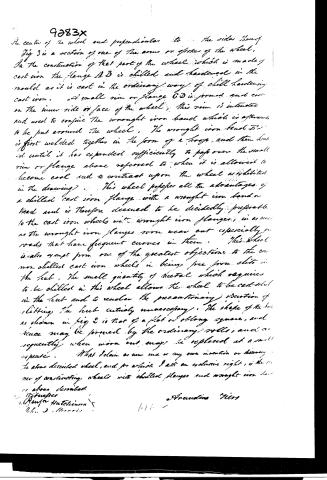
Specification of a patent for an improvement in the Wheels of Rail Road Cars. Granted to ARUNDIUS TIERS, Kensington, Philadelphia county, Pennsylvania, December 2d, 1835. To all to whom these presents shall come: Be it known, that I, Arundius Tiers, of the district of Kensington, in the county of Philadelphia, and state of Pennsylvania, have invented a new and useful improvement in the construction of wheels for rail road cars, and that the following is a full and exact description of the construction of said wheel as invented and improved by me. The wheel is to be made of cast iron, with a wrought iron band shrunk upon it, to form the tread of the wheel. The form and shape of the respective parts of the wheels which I most prefer, is exhibited in the drawing. In the construction of that part of the wheel which is made of cast iron, the flanch A, B, in the accompanying section, is chilled and hardened in the mould as it is cast, in the ordinary way of chill-hardening cast iron. A small rim or flanch C, D, is formed and cast on the inner side, or face E of the wheel; this rim is intended and used to confine the wrought iron band which is afterwards to be put around the wheel. The wrought iron band E, F, is first welded together in the form of a hoop, and then heated until it has expanded sufficiently to pass over the small rim, or flanch, above referred to, when it is allowed to become cool, and to contract upon the wheel as exhibited in the drawing. This wheel possesses all the advantages of a chilled, cast iron flanch, with a wrought iron band or tread, and is therefore deemed to be decidedly preferable to the cast iron wheels with wrought iron flanches, inasmuch as the wrought iron flanches soon wear out, especially on roads that have frequent curves in them. This wheel is also exempt from one of the greatest objections to the common, chilled cast iron wheels, in being free from slits in the hub, the small quantity of metal which requires to be chilled in this wheel allows the wheel to be cast solid in the hub, and renders the precautionary operation of slitting the hub entirely unnecessary. The shape of the band D is that of a flat, or oblong square, and hence it may be formed by the ordinary rolls; and consequently, when worn out may be replaced at a small expense. F B What I claim as new and as my own invention or discovery, in the above described wheel, and for which I ask an exclusive privilege, is "the manner of constructing wheels with chilled flanches and wrought iron bands, as above described." ARUNDIUS TIERS. Practical and Theoretical Mechanics and Chemistry. Davy's Safety Lamps. Evidence of Jonathan Pereira, Esq., F. L. S., Chemical Lecturer at the London Hospital, &c. What is your opinion of Sir Humphrey Davy's lamp, as a security against the effects of carburetted hydrogen gas?-I do not think it is a security, because the lamp will allow the passage of the flame through it. Will it allow the passage of the flame when suspended in the carburetted hydrogen gas, without motion? I have never seen the flame pass through the wire gauze when the lamp was at rest, and the gas not in notion. Under such circumstances the lamp may be safe, at least I have never seen it explode. Have you seen it explode under other circumstances? Repeatedly, when the lamp, or the gas, has been in motion. I was accustomed for years to show the Davy-lamp in my lectures, and by certain experiments to demonstrate, as I then thought they did, the security of the lamp. The experiments are those usually shown in the lecture room. I am now convinced they are fallacious. There are three methods mentioned by Sir Humphrey Davy, of proving the safety of the lamp: the first method (mentioned at p. 14, 15, of his work, on the "Safety-lamp for coal-miners,") is to plunge the lamp into an explosive mixture contained in a large vessel; the second method (mentioned at p. 16 of Davy's before-mentioned work,) is to hang the lamp in a large glass receiver, through which a current of explosive gas is made to pass; the third method adopted by Sir Humphrey Davy, was tried on a "blower" in a coal Davy's Safety Lamp. Of mine. He held the lamp in this blower, and though the wire-gauze soon became red hot, the flame did not pass until the gauze had reached a welding heat, and began to burn. (This is mentioned at p. 138 of his work.) course lecturers in London have no means of exposing it to a blower, and therefore they have usually employed, as class-room experiments, the first two mentioned methods of trying the lamp. I have never found the lamp explode by either of those methods; but, as I have already remarked they are fallacious experiments. You think the lamp, if exposed to a current of explosive gas, decidedly unsafe? Yes, certainly. I will not say it is absolutely safe when the lamp is not moved, and where there is no current; but under such circumstances, I have never seen it explode. I may perhaps mention in what way I became convinced of the insecurity of it. Mr. Roberts has been employe by me for some years as a manufacturer, &c. of lamps; and on several oc casions he told me that he was certain the Davy-lamp was not "a safetylamp." Although I was aware that Roberts had particularly directed his attention to this subject, and from having been a working miner for many years must have been practically well acquainted with the lamp, yet as he was not accustomed to the niceties requisite in conducting chemical experiments, as I and many others had tried the lamp, and as far as I then knew, it had always been found a security against the passage of flame, I confess I thought Roberts was labouring under an error. At his urgent and repeated request, I ultimately consented to attend at Upton and Roberts' manufactory, to see him prove, if he could, the insecurity of the lamp, though fully persuaded that I should be able to find some fallacy in his experiments. In a few minutes he showed me that flame might be made to pass through a Davy-lamp; but thinking that the lamp he employed might not be perfect, I sent for one which I had repeatedly tried, and which I knew to be a perfect instrument. The flame passed through this also. Subsequently I tried the Davy-lamps of some friends, and in every case they allowed the passage of the flame. I then undertook a series of experiments, the result of which is a firm conviction of the insecurity of the Davy-lamp when in motion, or when placed in a current of explosive gas. I think we may easily comprehend why the flame does not pass when both the gas and the lamp are at rest: it depends on two circumstances, namely, the less heat developed in consequence of less gas burning; and secondly, the carbonic acid formed not being got rid of, checks the passage of the flame through the wire gauze. I think, however, that the latter is the most efficient cause, since the gauze will allow the passage of the flame when it (that is the gauze) is not hot enough to be luminous, so that a great heat is not essential. Now when a Davy-lamp is plunged into a jar of explosive mixture, a quantity of carbonic acid is immediately formed, and this mixing with the unconsumed portion of the explosive mixture, diminishes its combustibility, and therefore its explosive powers. If, on the contrary, you expose the lamp to a current of an explosive mixture, the carbonic acid which is developed is immediately got rid of, (as well as the nitrogen of the portion of atmospheric air employed in carrying on the combustion,) and then the flame passes. A gentle motion of the lamp, combined with the current of the gas, very much promotes the passage of the flame. If, for example, a lamp be held before a jet of gas until it becomes hot (a red heat is not essential), and then gently moved, the flame will pass, and the experiment may be repeated successively a number of times in a minute. Sir Humphrey Davy was well acquainted with this fact, that carbonic acid diminishes the explosive power VOL. XVIII.-No. 1.-JULY, 1836. 5 of gaseous mixtures. At p. 10 of his work, he says:-"On mixing one part of carbonic acid, or fixed air, with seven parts of an explosive mixture of fire-damp, or one part of azote with six parts, their powers of exploding were destroyed." At p. 32 of his book, Sir Humphrey Davy states that "the consideration of these various facts led me to adopt a form of lamp in which the flame, by being supplied with only a limited quantity of air, should produce such a quantity of azote and carbonic acid as to prevent the explosion of the fire damp, and which, by the nature of its apertures for giving admittance and exit to the air, should be rendered incapable of communicating any explosion to the external air." It is evident, therefore, he endeavored to form a lamp which should be safe from the combined influence of the carbonic acid gas, of the azote or nitrogen gas, and of the wire gauze. State to the Committee in what way you think the lamp of Messrs. Upton and Roberts is an improvement on that of Sir Humphrey Davy? There are several points of view under which we may regard it as an improvement. In the first place, it is quite evident that the wire-gauze of the common Davy-lamp partially obstructs or impedes the passage of flame through it; and, therefore, if you employ two layers of wire-gauze, the obstruction is greater than that produced by one. Now in practice two layers of gaze are objectionable; first, because such lamps would give very little light, and secondly, because the gauze would soon become clogged up. But even if these objections could be overcome, there exists a still more weighty one, namely, that the lamp, even with a double layer of wire-gauze, is not secure. I have repeatedly passed flame through lamps of this kind; the experiment occupies a little longer time, because the flame passes less readily through two than one; but it does pass, and therefore such a lamp is insecure. Now in Upton and Robert's lamp only one layer of wire-gauze is employed, and therefore there is little impediment to the light. To prevent the effects of lateral currents, they use a cylinder of glass placed external to the gauze. This is one improvement over the common Davy-lamp; it must be admitted, however, that Davy, at p. 136 of his work, proposed, screens to increase the security of his lamp; but neither the screens of Davy, nor the cylinder of glass employed by Upton and Roberts, would of itself be sufficient to make the lamp secure. Hence, therefore, we come to the next part of the improvement made by Upton and Roberts, and which consists in the manner they admit the external air, or the explosive mixture, to the interior of the lamp. Around the lower part of the lamp is a number of apertures, through which the air passes into a chamber, the ceiling of which consists of layers of wire-gauze. To increase the security of the lamp, any number of these layers may be employed; they are easily taken out and cleaned, and they offer no impediment to the light: whereas in Davy's lamp, any increase in the number of wire-gauzes diminishes the light. This then constitutes a most important improvement. I now pass on to another improvement in this lamp, and which in fact constitutes its superiority to all other safety-lamps that I have seen: when the air or gas has passed through the wire-gauzes, it does not pass immediately into the body of the lamp, but into a second chamber, bounded above by a conical piece of brass, having a central aperture about the size of a sixpence, in the middle of which is the wick; so that all the air passing into the lamp, is brought in contact with the wick, and thus increases the quantity of light evolved; and as the aperture is much smaller than the cavity of the wire-gauze cylinder, the latter cannot fill with flame when introduced into an explosive mixture, so that the flame can never touch the wire-gauze cylinder; and, indeed, beOn Impact and Collision. tween the flame and the cylinder there is no oxygen to support combustion, as may be shown by its extinguishing a taper; we have, therefore, the very condition Sir Humphrey Davy wanted, since no taper will burn in the space between the flame and the wire-gauze; so that you observe we have three impediments to the lateral passage of the flame, a layer of carbonic acid, a wire-gauze cylinder, and a cylinder of glass. The safety of the bottom consists in any number of wire-gauzes the maker may choose to employ, and therefore if the lamp is not safe it is his fault. Then how is the top of the lamp secured? It is made safe by layers of wire-gauze, and also by having a contracted aperture to the glass, by which the draught is increased; and all the carbonic acid gas that is formed below, by the combustion of the fire-damp, or of the oil of the lamp, as well as the nitrogen of the atmospheric air, contribute to prevent the combustion of a body in this situation, for if you put a lighted taper here, it is extinguished immediately. Thus then this lamp is made safe at the sides, at the bottom, and at the top, by different methods. If the glass should break, the lamp is then a common Davy-lamp. Have you made experiments on that lamp in the explosive mixture?-I have submitted this lamp to every experiment I have submitted the Davylamp to, and I could never get this to explode; indeed, I have submitted this lamp to a test (oxy-hydrogen gas) which it is not likely to be put to in actual practice. This lamp then is safe in a draught or current of explosive gas? Yes, it is perfectly safe in any current of carburetted hydrogen gas, or of this gas and oxygen, or of this gas and air. I have repeatedly tried it, and the flame will not pass. When the explosive mixture was blown in gently, the flame increased in size; if passed in with violence, the flame was extinguished, but no passage of it will take place through the gauze. Lond. Mech. Mag. On Impact and Collision. By EATON HODGKINSON. -Mr. Hodgkinson reported to the Section the results of certain experiments made by him on impact and collision, in continuation of those communicated to the Association in the year 1834, on the collision of imperfectly elastic bodies. The results were, First, That cast-iron beams being impinged upon by certain heavy masses or balls of metal of different kinds, were deflected through the same distance, whatever were the metals used, provided that the weights of the masses were equal. Secondly, That the impinging masses rebounded after the stroke through the same distances, whatever was the metal of which they were composed, provided that the weights were the same. Thirdly, That the effect of the masses of different metals impinging upon an iron beam were entirely independent of their elasticities, and were the same as they would give if the impinging masses were inelastic. Mr. Hodgkinson also gave the result of some interesting experiments on the fracture of wires under different states of tension, from which it appeared that the wire best resisted fracture and impact when it was under the tension of a weight which, being added to that impinging upon it equalled one third of the force that was necessary to break it. Proceedings Brit. Assoc. &c. Lond. and Ed. Phil. Mag. Jan. Marine Steam Engine. Extracts from the evidence given by Joshua Field, Esq., of the house of Messrs. Maudslays and Field, before the Select Committee on Steam Navigation to India. 4 You have had much experience in the manufacture of engines for steam vessels, have you not? Yes, I have. What do you consider the proper measurement and power of a steamer for a long sea-voyage? The relative proportion of power and tonnage fluctuates between two tons per horse power and four tons per horse power, depending upon the purposes for which the vessel is intended, as well as the length of the voyage. What do you say as to the measurement? By measurement, I understand tonnage. I have prepared a table which shows at one view the probable speed to be obtained by the application of engines of four different powers in vessels of the same tonnage, also the length of time for which they would be able to carry coal with each power on board. This table, if the committee desire it, I will put in. AN APPROXIMATE TABLE, Showing, at one view, the Tonnage of Steam Vessels with the power usually applied to such Vessels; the Number of Days of Twenty-four Hours' Coals they will carry, and the probable Speed they will go with smaller Powers and greater Quantity of Coal. Tonnage Power Power Power Power of of Days Coal of Days Coal Vessel. Engines. Engines. Engines of DaysCoal of Days Coal Engines 252 100 5 80 64 60 84 40 12 290 100 6 80 7 60 10 40 15 332 120 7 100 84 80 10 60 14 375 120 8 100 9 80 12 60 16 425 140 9 120 10 100 12 80 15 480 140 10 120 11 100 14 80 16 534 160 11 140 12 120 14 100 17 597 160 12 140 13 120 16 100 19 665 200 13 160 16 140 18+ 120 22 736 200 14 160 18 140 20 120 23 810 220 15 200 16 160 20 140 24 892 220 16 200 17 160 22 140 26 980 240 17 220 18 200 20 160 25 240 18 220 19 200 21 160 27 1,073 10 miles per hour. 9 miles per hour. 8 miles per hour. 7 miles per hour. Will you explain to the Committee the object of this calculation; is it a comparison of tonnage with the consumption of coals and days, and the rates of going? It is to show about how many days' fuel steam vessels will carry with larger and with smaller engines on board, as well as the average speed to be expected from each. Such a table can only be an approximation. Will you first state what you consider the proper measurement and power of a steamer to go a long sea-voyage? I should recommend a vessel of from 700 to 800 tons, having an engine of 180 or 200 horse-power. How long would such a vessel run, and at what rate would she go She would carry coal for 14 or 15 days, and have a speed, in still water, of 9 1 Durability of Copper. or 10 miles per hour, and would realise in all weathers at sea, an average of 8 miles while under weigh. What is the greatest proportion in tonnage and power for a steamer going a long voyage? The greatest proportion of tonnage for vessels going long voyages may be stated at 4 tons per horse-power. For short seavoyages 3 tons per horse-power; and for river vessels, as Margate or Gravesend, 2 tons per horse-power. What results does the power give to a vessel of the same tonnage with different powers as to the rate of going? Great power in small vessels gives great speed, but they carry a small quantity of coal and are soon exhausted, while larger vessels being able to carry a greater quantity of coals, work longer and perform greater distances. Then you draw this inference the longer the voyage the less the speed? The smaller the power the greater capacity there is left for coal, and, therefore, the greater number of days' coal it would carry. And the less speed? And less speed, having less power. And the smaller proportion of power would, of course, consume less fuel in an equal time? Exactly so. Would not the greatest proportion of power consume the least fuel in equal distances? Against winds or tides it is so, but in calms and fair winds it is not. What is the greatest distance you suppose a sea-going steamer to run without changing? The same steamer should not go more than 2,000 or 3,000 miles without a relay, or time to put the machinery in order. Does that also include without taking in coals? A voyage of 2,000 or 3,000 miles may be performed in one stage, but it would b
Published accounts: journal notice
Notice in the monthly list of patents
Journal of the Franklin Institute, new ser., vol. 17 (1836), p. 144 · View the page
738. Rail road car wheels. Arundius Tiers, Kensington, Penna.
Published accounts: journal notice
Notice in the monthly list of patents, with remarks
Journal of the Franklin Institute, new ser., vol. 18 (1836), p. 36 · View the page
4. For Wheels for Rail Road Cars; Arundius Tiers, Kensington, Philadelphia county, Pennsylvania, December 2.
Remarks. (See the specification.)
About this record
- Patentee
- the Journal of the Franklin Institute, Journal
- Date
- the Name and Date index of patents, USPTO records, Jim Shaw's X-patent list
- Invention
- the Name and Date index of patents
- Listed in
- the Name and Date index of patents, USPTO records, Jim Shaw's X-patent list, the Journal of the Franklin Institute, Burke's List of Patents (1847)
- The patentee's full name comes from the Franklin Institute's journal.
- in_burke