

Drawings and documents
National Archives restored drawings: drawing
Rufus Porter's Patent Drawing for an Improvement in the Floating Dry Dock


National Archives, Restored Patent Drawings (Record Group 241) · Full-size scan at the National Archives · Catalog record
Text on the drawing
Words on the drawing as machine-read by the National Archives; not checked. Useful mainly for searching.
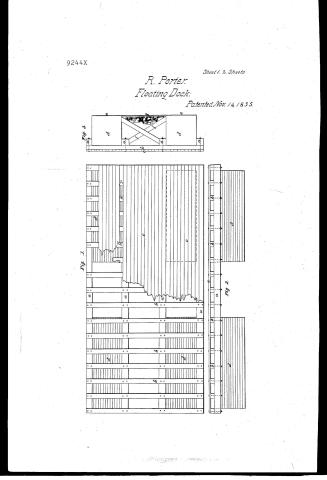
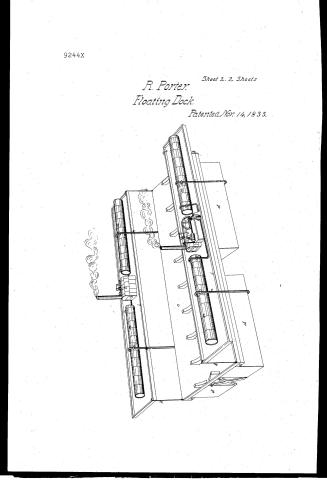
Sheet 1. sb / Rufers Porter Improvement in the floating dry dock. / Intented Noo. th. 1835 Vel.22.7g.241. / classicio ATION / 9244.4 / M.I / DIVISION. / OLASS 114. SHIPS, / 51, Camels & Ficating Dacks. / 244X / Preference / a.a.a.a. large timbers. / ff / Fig:1 / at / cock plank floor / ddd form square trunks / ceee. apening of the bottom / f.f traces. / g.ve iron zods. / h. stones. / i.i. scows. / h.K.K K. copes / l.l. steam engines. / m.m.mmair cylinder / n.n.n.n leather Hose / o-anpump. / Glate IT Y 1. Sopview of the elevator Hig.L. Side view of tig.t. Higz / Eatent affect Fannay s? 1843. / of fatint in conformity with actof mach / And under the direction of the Commitie / Commission of Extent
Sheet 2. confusionation day / Estented is
USPTO scan
The patent as scanned by the USPTO
-
 Page 1
-
 Page 2
-
 Page 3
-
 Page 4


U.S. Patent and Trademark Office · Google Patents
Published accounts: specification
Specification printed in the Journal of the Franklin Institute
Journal of the Franklin Institute, new ser., vol. 17 (1836), p. 420 · View the page
Text of the specification as printed in the Journal, from OCR; not proofread.
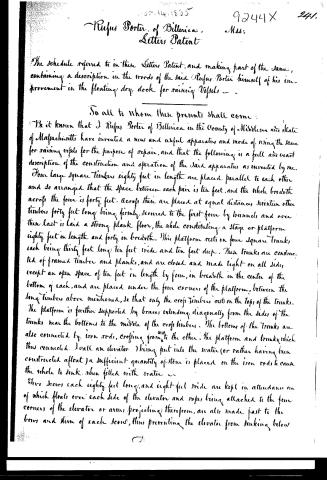
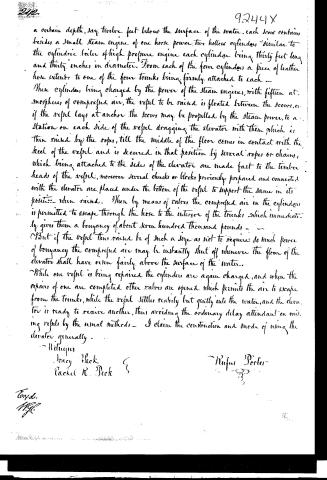
Specification of a Patent for an Apparatus, and Mode of Using the same, for Raising Vessels for the purpose of Repair. Granted to RUFUS PORTER, Bellerica, Middlesex county, Massachusetts, November 14th, 1835. Four square timbers, eighty feet in length, are placed parallel to each other, and so arranged that the space between each pair is ten feet, and the whole breadth across the four is forty-feet. Across these are placed, at equal distances, seventeen other timbers, forty feet long, being firmly secured to the first four by tree-nails, and over these last is placed a strong plank floor; the whole constituting a stage, or platform, eighty feet in length, and forty in breadth. This platform rests on four square trunks, each being thirty feet long, ten feet wide, and ten feet deep. These trunks are constructed of framed timbers and plank, and are closed and made water tight on all-sides, except an open space of ten feet in length, by four in breadth, in the centre of the bottom of each, and are placed under the four corners of the platform, between the long timbers above mentioned, so that only the cross timbers rest on the tops of the trunks. The platform is further supported by braces extending diagonally from the sides to the trunks, and also connected by iron rods crossing from one to the other. The platform and trunks, which thus connected I call the elevator, being put into the water, or rather having been constructed afloat, a sufficient quantity of stone is placed on the iron rods to cause the whole to sink when filled with water. Two scows, each eighty feet long, and eight feet wide, are kept in attendance, one of which floats over each side of the elevator; and ropes being attached to the four corners of the elevator, or to arms projecting therefrom, are also made fast to the bow and stern of each scow, thus preventing the elevator from sinking below a certain depth, say twelve feet below the surface of the water. Each scow contains, besides a small steam engine, of one horse power, two hollow cylinders similar to the cylindrical boilers of high pressure engines, each cylinder being thirty feet long, and thirty inches in diameter. From each of the four cylinders a piece of leather hose extends to one of the four trunks, being firmly attached to each. These cylinders being charged, by the power of the steam engines, with fifteen atmospheres of compressed air, the vessel to be raised is floated between the scows, or if the vessel lays at anchor, the scows may be propelled by the steam power, to a station on each side of the vessel, dragging the elevator with them, which is then raised by the ropes until the middle of the floor comes in contact with the keel of the vessel, and is secured in that position by several ropes or chains, which being attached to the sides of the elevator, are made fast to the timber heads of the vessel. Moreover, several chucks, or blocks, previously prepared and connected with the elevator, are placed under the bottom of the vessel to support the same in its position when raised. Then, by means of valves, the compressed air in the cylinders is permitted to escape through the hose into the interior of the trunks, which immediately gives them a buoyancy of about seven hundred thousand pounds. But if the vessel thus raised be of such a size as not to require so much power of buoyancy, the compressed air may be instantly shut off, whenever the floor of the elevator shall have risen fairly above the surface of the water. While one vessel is being repaired, the cylinders are again charged; and when the repairs of one are completed, other valves are opened, which Ambler's Machine for Hulling Cotton Seed. permit the air to escape from the trunks, while the vessel settles readily, but gently, into the water, and the elevator is ready to receive another; thus avoiding the ordinary delay attendant on raising vessels by the usual method. I claim the construction and mode of using the elevator generally. RUFUS PORTER.
Editor's remarks. We have been induced to publish the foregoing specification entire, because it describes the thing patented with a directness and clearness which may serve as an example to others. There is nothing extraneous about it, and we could scarcely, therefore, have done any thing like justice to it had we epitomized it in the ordinary monthly list. There is nothing new in the principle of raising vessels by means of air forced into hollow trunks, but the whole arrangement set forth gives a distinct and special character to the plan before us, by which it can undoubtedly be sustained.
Published accounts: journal notice
Notice in the monthly list of patents
Journal of the Franklin Institute, new ser., vol. 17 (1836), p. 144 · View the page
701. Floating dry dock.-Rufus Porter, Bellerica, Massachusetts,
Published accounts: journal notice
Notice in the monthly list of patents, with remarks
Journal of the Franklin Institute, new ser., vol. 17 (1836), p. 407 · View the page
Dose for an adult, half a table spoonful, &c. 20. For Raising Vessels from the Water for the purpose of Repair; Rufus Porter, Bellerica, Middlesex county, Massachusetts, November 14.
Remarks. (See the specification.)
About this record
- Patentee
- the Journal of the Franklin Institute, Journal
- Date
- the Name and Date index of patents, USPTO records, Jim Shaw's X-patent list
- Invention
- the Name and Date index of patents
- Listed in
- the Name and Date index of patents, USPTO records, Jim Shaw's X-patent list, the Journal of the Franklin Institute, Burke's List of Patents (1847)
- The patentee's full name comes from the Franklin Institute's journal.
- The residence comes from the Franklin Institute's journal.
- in_burke