

Drawings and documents
National Archives restored drawings: drawing
Charles Peters and Benjamin Dean's Patent Drawing for a Rotary Pump

National Archives, Restored Patent Drawings (Record Group 241) · Full-size scan at the National Archives · Catalog record
Text on the drawing
Words on the drawing as machine-read by the National Archives; not checked. Useful mainly for searching.
the / ex / /2 / reference / OR
USPTO scan
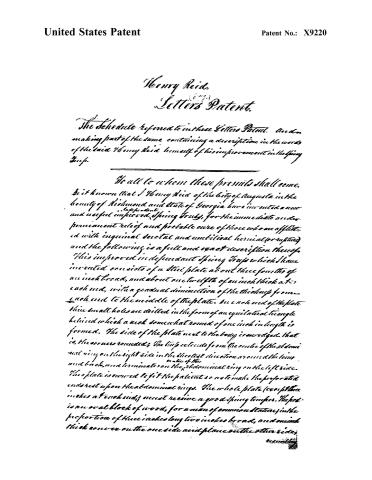
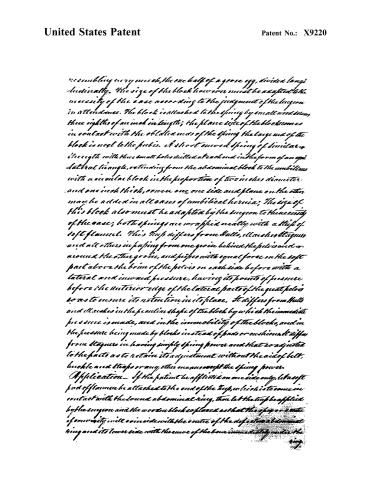
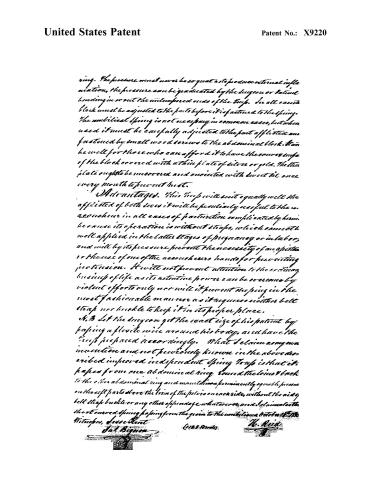
The patent as scanned by the USPTO
-
 Page 1
-
 Page 2
-
 Page 3
-
 Page 4


U.S. Patent and Trademark Office · Google Patents
Published accounts: journal notice
Notice in the monthly list of patents, with remarks
Journal of the Franklin Institute, new ser., vol. 17 (1836), p. 348 · View the page
89. For a Truss for Hernia; Henry Reid, Augusta, Georgia, October 31.
Remarks. We suppose, from the manner in which the application and use of this truss are described, that the patentee is a practitioner of medicine, as it displays both knowledge and judgment upon the subject to which it relates. The truss spring is, in all cases, to extend entirely round the body, and is to be furnished with two pads, one at each end, that which presses on the abdominal ring on the sound side being soft, whilst that on the ruptured side is to be of wood, adapted to the size of the patient, and in the form of a half egg, supposing it to be divided longitudinally. There is no claim made, but the patentee evidently proceeds upon the idea that springs passing round the body, and having a pad at each end, are novelties. The patentee says that this truss "differs from Hull's and Marshe's, in the peculiar shape of the block by which the immediate pressure is made, and in the immobility of the blocks, and in the pressure being made by blocks, instead of pads, or cushions. It differs from Stagner's in having simply spring power, and that so adjusted to the parts as to retain its adjustment without the aid of belt, buckle, and straps, or any other means, except the spring power." "What I claim as my own invention, and not previously known in the above described improved independent spring truss, is, that it passes from one abdominal ring, and maintains a permanently equable pressure on the soft parts above the brim of the pelvis on each side, without the aid of belt, strap, buckle, or any other appendages whatsoever; and I claim, also, the short curved spring passing from the groin to the umbelicus." The patentee is in error in supposing that a truss spring passing entirely round the body, and having a pad at each end, is new; we have seen more than one of this kind; that patented by D. Weaver, of Baltimore, is described at p. 327, vol. xiii., where it is expressly stated that "the double spring is to be used whether the hernia be only on one, or on both sides; this latter truss has also two small pads near the middle of the spring, one to bear on each side of the spine; there is a hinge joint at the middle, connecting the double spring, and calculated to give extra freedom to its motion, which is, we think, a manifest advantage.
About this record
- Patentee
- Jim Shaw's X-patent list
- Date
- the Name and Date index of patents, USPTO records, Jim Shaw's X-patent list
- Invention
- the Name and Date index of patents
- Listed in
- the Name and Date index of patents, USPTO records, Jim Shaw's X-patent list, the Journal of the Franklin Institute, Burke's List of Patents (1847)
- The National Archives' catalog gives the name differently.
- The residence comes from the Franklin Institute's journal.
- in_burke
- burke_date_differs
Shaw: lists Peters & Dean here as 9220½