

Drawings and documents
USPTO scan
The patent as scanned by the USPTO
-
 Page 1
-
 Page 2
-
 Page 3


U.S. Patent and Trademark Office · Google Patents
Published accounts: specification
Specification printed in the Journal of the Franklin Institute
Journal of the Franklin Institute, new ser., vol. 17 (1836), p. 352 · View the page
Text of the specification as printed in the Journal, from OCR; not proofread.
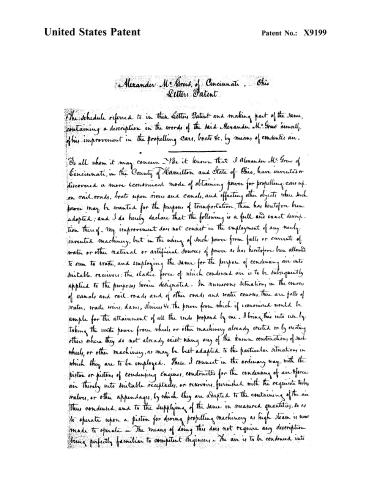
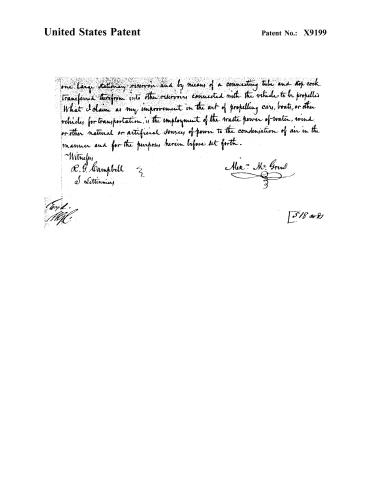
Specification of a Patent for Obtaining a Power for Propelling Cars, Boats, &c. Granted to ALEXANDER M'GREW, Cincinnati, Ohio, October 25th, 1835. To all whom it may concern, be it known, that I, Alexander M'Grew, of Cincinnati, in the county of Hamilton, and state of Ohio, have invented, or discovered, a more economical mode of obtaining power for propelling cars upon rail-roads, boats upon rivers and canals, and effecting other objects, where such power may be wanted for the purposes of transportation, than has heretofore been adopted; and I do hereby declare that the following is a full and exact description thereof. My improvement does not consist in the employment of any newly invented machinery, but in the using of such power from falls, or currents of water, or other natural or artificial sources of power, as has heretofore been allowed to run to waste, and employing the same for the purpose of condensing of air into suitable receivers; the elastic force of which condensed air is to be subsequently applied to the purposes herein designated. In numerous situations in the courses of canals and rail-roads, and of other roads and -water courses, there are falls of water, waste weirs, dams, sluices, &c., the power from which, if economized, would be ample for the attainment of all the ends proposed by me; I bring this into use by taking the waste power from wheels, or other machinery already erected, or by erecting others where they do not already exist, using any of the known constructions of such wheels, or other machinery, as may be best adapted to the particular situations in which they are to be employed; these I connect in the ordinary way with the piston, or pistons, of condensing engines, constructed for the condensing of air, and force air thereby into suitable receptacles, or reservoirs, furnished with the requisite tubes, valves, or other appendages, by which they are adapted to the containing of the air thus condensed, and to the supplying of the same in measured quantities, so as to operate upon a piston for driving and propelling machinery, as high steam is now made to operate. The means of doing this does not require any description, being perfectly familiar to competent engineers. The air is to be condensed into one large stationary reservoir, and by means of a connecting tube and stop cock, transferred therefrom into other reservoirs connected with the vehicle to be propelled. What I claim as my improvement in the art of propelling cars, boats, or other vehicles for transportation, is the employment of the waste power of water, wind, or other natural or artificial sources of power, to the condensation of air, in the manner, and for the purposes, hereinbefore set forth. ALEXANDER M'GREW.
Editor's remarks. It has been repeatedly proposed to drive railroad cars, &c., by means of condensed air, instead of by steam, and to erect stationary engines for the purpose of filling the requisite reservoirs, and we believe that the thing was attempted in England. Were there not serious practical objections to the plan, it would certainly present many advantages, but these are so weighty, that they are not likely to be removed. Among them is the perpetually diminishing power of the condensed air, as every stroke of a piston must lessen its elastic force; to graduate the quantity emitted from the reservoir, in proportion to this diminished force, would be very difficult; and, besides this, there ought, when the reservoir is STEELE'S Apparatus for Boiling Liquids. renewed, to be a pressure of several atmospheres above what is required in a steam boiler, or it will soon be so far exhausted as to be inadequate to the production of the intended effect, as they would have to be exchanged whilst under a pressure of two or three atmospheres. The present patentee does not propose to remove the foregoing, or any other objection to the use of condensed air, excepting it be the necessity of erecting stationary engines to effect the condensation; and to accomplish this, he depends upon the employment of means which would generally be more difficult, precarious, and expensive; in many places, the means of condensation proposed to be used would not be found within many miles of the stations where the reservoirs would be wanted, and there are, in fact, but few situations where the means of applying waste power would not be a costly undertaking.
Published accounts: journal notice
Notice in the monthly list of patents, with remarks
Journal of the Franklin Institute, new ser., vol. 17 (1836), p. 341 · View the page
62. For Obtaining a Power for Propelling Cars, Boats, &c.; Alexander M'Grew, Cincinnati, Ohio, October 27.
Remarks. (See the specification.)
About this record
- Patentee
- Jim Shaw's X-patent list
- Date
- the Name and Date index of patents, USPTO records, Jim Shaw's X-patent list
- Invention
- the Name and Date index of patents
- Listed in
- the Name and Date index of patents, USPTO records, Jim Shaw's X-patent list, the Journal of the Franklin Institute, Burke's List of Patents (1847)
- in_burke