

Drawings and documents
National Archives restored drawings: drawing
G. Gay's Patent Drawing for Hurdles for Silk Worms

National Archives, Restored Patent Drawings (Record Group 241) · Full-size scan at the National Archives · Catalog record
Text on the drawing
Words on the drawing as machine-read by the National Archives; not checked. Useful mainly for searching.
117. stt.k. / Not 24 page.73 / [140] / 117. SILK, / Cocooneries / $2- / CLA SIPICATION / 9138-4 / DIVISION. / G.GAY / Patentest. 6" Cutolen 1835 / Hurdles for SilkWorms / a. Frame / o a / b. Revolving aprou / . Hundles / di Rollen / e. crank / ON / Pater office June 1843 / Macle under the direction of the / she hland see / of Patents in comformity with red of 3 March 183y / W2 Elemath / Commission of Patents.
USPTO scan
The patent as scanned by the USPTO
-
 Page 1
-
 Page 2
-
 Page 3
-
 Page 4


U.S. Patent and Trademark Office · Google Patents
Published accounts: specification
Specification printed in the Journal of the Franklin Institute
Journal of the Franklin Institute, new ser., vol. 17 (1836), p. 349 · View the page
Text of the specification as printed in the Journal, from OCR; not proofread.
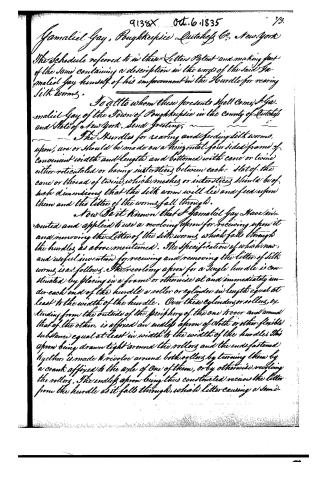
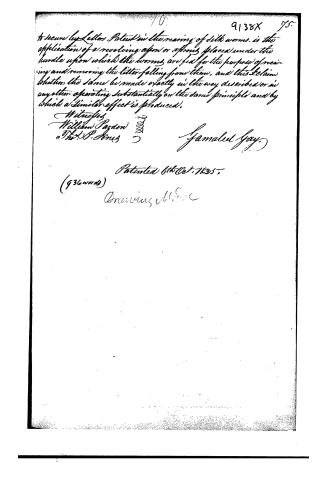
Specification of a Patent for an improvement in the Rearing of Silk Worms; Granted to GAMALIEL GAY, Poughkeepsie, Dutchess county, New York, October 6th, 1835. To all to whom these presents shall come, I, Gamaliel Gay, of the town of Poughkeepsie, in the county of Dutchess, and state of New York, send greeting. VOL. XVII.-No. 5.-MAY, 1836. 33 The hurdles for rearing and feeding silk worms upon, are, or should be, made on a horizontal, four sided frame, of convenient width and length, and bottomed with cane, or twine, either reticulated, or having interstices between each slat of the cane, or thread of twine; which meshes, or interstices, should be of such dimensions that the silk worm will lie and feed upon them, and the litter of the worms fall through. Now, be it known, that I, Gamaliel Gay, have invented, and applied to use, a revolving apron, for receiving upon it, and removing, the litter of the silk-worms, which falls through the hurdles, as above mentioned. The specification of which new and useful invention, for receiving and removing the litter of silk worms, is as follows. The revolving apron for a single hurdle is constructed by placing in a frame, or otherwise, at and immediately under each end of the hurdle, a roller, or cylinder, in length equal to the width of the hurdle; over these cylinders, or rollers, extending from the outside of the periphery of the one, over and around that of the other is affixed an endless apron of cloth, or other flexible substance, equal, at least in width, to the width of the hurdle. This apron being drawn tight around the rollers, and the ends fastened together, is made to revolve around both rollers, by turning them by a crank affixed to the axle of one of them, or by otherwise revolving the rollers. The endless apron being thus constructed, receives the litter from the hurdle as it falls through, which litter, by causing a semi-revolution of the apron, is removed from under the hurdles, and caused to fall in a heap at one and either end of the hurdles, and may be suffered to fall from the apron either upon the floor, or into a vessel placed at, and partly under, the end of the hurdle, and below the outer periphery of the roller. In case two or more hurdles be placed in tiers, one above the other, the same apron may be used, in which case an endless and separate apron is required for each hurdle; but the best method, the most convenient and least expensive form of apparatus, and which I claim as a constituent part of my invention, is constructed as follows. Let there be rollers, or cylinders, affixed under each end of each hurdle, the same as in case of a single hurdle; to one roller, below the lower hurdle, attach one end of an apron, of the kind and proportionate width first above specified; let this apron pass under the opposite roller, over the roller next immediately above that, under the roller next immediately above the first roller to which the apron is attached, over the next above roller, and under the next opposite one; and so on according to the number of hurdles in the tier, until the apron reaches the last roller to which the apron should be attached, after adding to the length of the apron at least the length of one of the hurdles, which should be rolled upon the last mentioned roller. The apron thus passing under each hurdle, receives all the litter falling from each, which litter is discharged, part at one end, and part at the other end of the hurdles, by turning the first mentioned roller so as to wind over and around it a quantity of the apron equal to the length of the above hurdle, which winding causes an equal quantity of the apron to unwind from the roller to which the other end of the roller is attached; after the litter is thus discharged from the apron, the apron is, in part, to be again wound around the upper roller, as first above mentioned, so as to remain until the litter is again discharged. What I claim as my improvement, and wish to secure by letters patent, in the rearing of silk worms, is the application of a revolving apron, or aprons, placed under the hurdles upon which the worms are fed, for the purpose of receiving and removing the litter falling from them; and this I PARKHURST's Improved Doffer. claim, whether the same be made exactly in the way described, or in any other, operating substantially on the same principle, and by which a similar effect is produced. GAMALIEL GAY. >
Published accounts: journal notice
Notice in the monthly list of patents
Journal of the Franklin Institute, new ser., vol. 17 (1836), p. 70 · View the page
595. Silk-worms, rearing. Gamaliel Gay, Poughkeepsie, New York,
Published accounts: journal notice
Notice in the monthly list of patents, with remarks
Journal of the Franklin Institute, new ser., vol. 17 (1836), p. 327 · View the page
7. For an improvement in the mode of Rearing Silk Worms; Gamaliel Gay, Poughkeepsie, Dutchess county, New York, October 6.
Remarks. (See the specification.)
Published accounts: journal notice
Notice in the monthly list of patents, with remarks
Journal of the Franklin Institute, new ser., vol. 17 (1836), p. 349 · View the page
Specification of a Patent for an improvement in the Rearing of Silk Worms; Granted to GAMALIEL GAY, Poughkeepsie, Dutchess county, New York, October 6th, 1835.
Remarks. To all to whom these presents shall come, I, Gamaliel Gay, of the town of Poughkeepsie, in the county of Dutchess, and state of New York, send greeting. VOL. XVII.-No. 5.-MAY, 1836. 33 The hurdles for rearing and feeding silk worms upon, are, or should be, made on a horizontal, four sided frame, of convenient width and length, and bottomed with cane, or twine, either reticulated, or having interstices between each slat of the cane, or thread of twine; which meshes, or interstices, should be of such dimensions that the silk worm will lie and feed upon them, and the litter of the worms fall through. Now, be it known, that I, Gamaliel Gay, have invented, and applied to use, a revolving apron, for receiving upon it, and removing, the litter of the silk-worms, which falls through the hurdles, as above mentioned. The specification of which new and useful invention, for receiving and removing the litter of silk worms, is as follows. The revolving apron for a single hurdle is constructed by placing in a frame, or otherwise, at and immediately under each end of the hurdle, a roller, or cylinder, in length equal to the width of the hurdle; over these cylinders, or rollers, extending from the outside of the periphery of the one, over and around that of the other is affixed an endless apron of cloth, or other flexible substance, equal, at least in width, to the width of the hurdle. This apron being drawn tight around the rollers, and the ends fastened together, is made to revolve around both rollers, by turning them by a crank affixed to the axle of one of them, or by otherwise revolving the rollers. The endless apron being thus constructed, receives the litter from the hurdle as it falls through, which litter, by causing a semi-revolution of the apron, is removed from under the hurdles, and caused to fall in a heap at one and either end of the hurdles, and may be suffered to fall from the apron either upon the floor, or into a vessel placed at, and partly under, the end of the hurdle, and below the outer periphery of the roller. In case two or more hurdles be placed in tiers, one above the other, the same apron may be used, in which case an endless and separate apron is required for each hurdle; but the best method, the most convenient and least expensive form of apparatus, and which I claim as a constituent part of my invention, is constructed as follows. Let there be rollers, or cylinders, affixed under each end of each hurdle, the same as in case of a single hurdle; to one roller, below the lower hurdle, attach one end of an apron, of the kind and proportionate width first above specified; let this apron pass under the opposite roller, over the roller next immediately above that, under the roller next immediately above the first roller to which the apron is attached, over the next above roller, and under the next opposite one; and so on according to the number of hurdles in the tier, until the apron reaches the last roller to which the apron should be attached, after adding to the length of the apron at least the length of one of the hurdles, which should be rolled upon the last mentioned roller. The apron thus passing under each hurdle, receives all the litter falling from each, which litter is discharged, part at one end, and part at the other end of the hurdles, by turning the first mentioned roller so as to wind over and around it a quantity of the apron equal to the length of the above hurdle, which winding causes an equal quantity of the apron to unwind from the roller to which the other end of the roller is attached; after the litter is thus discharged from the apron, the apron is, in part, to be again wound around the upper roller, as first above mentioned, so as to remain until the litter is again discharged.
About this record
- Patentee
- the Journal of the Franklin Institute, Journal
- Date
- the Name and Date index of patents, USPTO records, Jim Shaw's X-patent list
- Invention
- the Name and Date index of patents
- Listed in
- the Name and Date index of patents, USPTO records, Jim Shaw's X-patent list, the Journal of the Franklin Institute
- The patentee's full name comes from the Franklin Institute's journal.
- The residence comes from the Franklin Institute's journal.