

Drawings and documents
National Archives restored drawings: drawing
James Lombard's Patent Drawing for a Washing Machine

National Archives, Restored Patent Drawings (Record Group 241) · Full-size scan at the National Archives · Catalog record
Text on the drawing
Words on the drawing as machine-read by the National Archives; not checked. Useful mainly for searching.
C. LAUNDRY. / 91, / W bisch's / RECIPROCATING RUBSER. / JAMES LONBAR ID' / Washing Machine, / Patented Sepi 9th 1835. / GÉ / Be / c' / fig / fig1 / 1) / Me / OR
USPTO scan
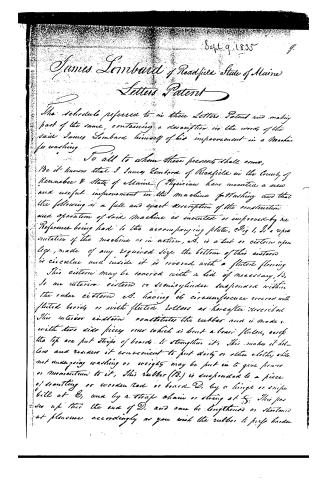
The patent as scanned by the USPTO
-
 Page 1
-
 Page 2
-
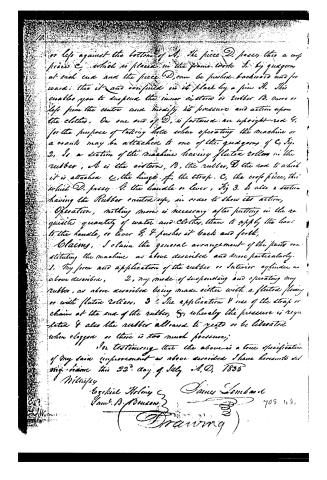 Page 3


U.S. Patent and Trademark Office · Google Patents
Published accounts: journal notice
Notice in the monthly list of patents, with remarks
Journal of the Franklin Institute, new ser., vol. 17 (1836), p. 258 · View the page
In this invention, the work heretofore requiring the use of two instruments, is to be performed by one. A very particular description of the tool is furnished, and explained by reference to the drawings, which show the peculiar form given to the cutting iron. The claim is to "the peculiar construction of the edge and angles of the cutting instrument, by which it supersedes the necessity of a separate howeling iron, and performs the work in less time. The moulding of the faced edge of the stock face, to conform to the cutting angles of said instrument; and the sliding gauge, as described, and delineated in the drawing.” 27. For a Washing Machine; James Lombard, Readfield, Kennebec county, Maine, September 9.
Remarks. The trough of this machine is a concave semi-cylinder, closed at the ends, and fluted along the semicircular part. The rubber, which is to act upon the clothes, is also a semi-cylinder, which passes into the trough, and is suspended by an axis at, or near, its centre. This rubber is either fluted, or covered with fluted rollers, passing from end to end on its curved surface. It is so hung, by means of a strap, or chain, as that it may recede from the trough, when too great a quantity of clothes may be between them, and also to admit of its continued pressure upon them. The rubber is to be made to vibrate by means of a handle. The claims are to "the form and application of the rubber, or interior cylinder. The mode of suspending and operating the rubber, and the application of the strap, or chain, whereby the pressure is regulated, and the rubber allowed to yield."
About this record
- Patentee
- the Journal of the Franklin Institute, Journal
- Date
- the Name and Date index of patents, USPTO records, Jim Shaw's X-patent list
- Invention
- the Name and Date index of patents
- Listed in
- the Name and Date index of patents, USPTO records, Jim Shaw's X-patent list, the Journal of the Franklin Institute, Burke's List of Patents (1847)
- The patentee's full name comes from the Franklin Institute's journal.
- in_burke