

Drawings and documents
National Archives restored drawings: drawing
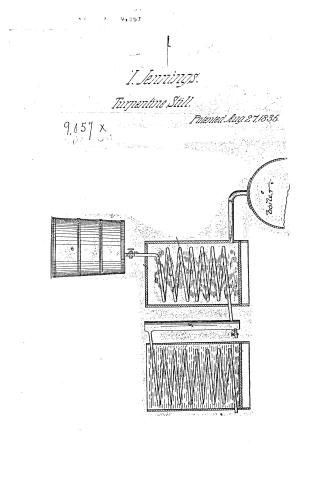
Isaiah Jennings' Patent Drawing for a Method of Distilling Spirits of Turpentine, Tar, Coal Tar, and Other Analogous Articles

National Archives, Restored Patent Drawings (Record Group 241) · Full-size scan at the National Archives · Catalog record
Text on the drawing
Words on the drawing as machine-read by the National Archives; not checked. Useful mainly for searching.
203. AMMONIA, W ATER and WOOD DISTILLATION. / Turpentine- / 12 / Apparatus, / CLS / 90577 / Issuah Jennings / Dutilling spirits of Jurpentine, tar, coaltar / Vol.ui ps.79 / and other analogous articles. / Intented ans 27th 1835. / Reference / Resservoir. / Tube leading into the / worm for the mixture. / steam-pine / large ver teal / day pipe for the / worm for refregerating / 22 1842 / madeunth the direction of th Corn pioner / of fatents comformity with rety shares / 183%
USPTO scan
The patent as scanned by the USPTO
-
 Page 1
-
 Page 2


U.S. Patent and Trademark Office · Google Patents
Published accounts: specification
Specification printed in the Journal of the Franklin Institute
Journal of the Franklin Institute, new ser., vol. 17 (1836), p. 275 · View the page
Text of the specification as printed in the Journal, from OCR; not proofread.
Specification of a patent for improvements in the process of, and apparatus for, Distilling Spirits of Turpentine and other articles. Granted to ISAIAH JENNINGS, city of New York, August 27th 1835. To all whom it may concern: Be it known, that I, Isaiah Jennings, of the city of New York, in the State of New York, have invented certain improvements in the process, and also in the apparatus employed, for the distillation of Spirits of Turpentine, the spirit from common tar, coal tar, and other analogous articles; and I do hereby declare that the following is a full and exact description thereof. My improvement in the process when turpentine is to be distilled, consists in the addition of a portion of spirits of turpentine to the crude turpentine from which the distillation is to be made; the addition being made in such proportion as shall bring the turpentine into such a state of fluidity as shall admit of the subsidence of all the foreign matter contained therein as may be sufficiently heavy to fall to the bottom, and of the rising of chips, and other light materials to the surface, whence they may be readily removed, and the clear turpentine poured off from the sediment. The quantity of spirits of turpentine to be added will depend, in part, upon the warmth of the weather, or of the place in which the mixture is made; and also upon the thickness of the turpentine to be operated upon, and the impurities which it may contain. The mixture and separation of the impurities may be promoted by artificial heat, care being taken that the temperature is not such as shall occasion a waste of the spirit by evaporation. The apparatus which I employ consists of two vessels within each of which a still worm of the usual construction is to be contained; or instead of the worm any kind of heater, or refrigerator, by which analogous effects are produced, may be employed; these vessels are to be connected together in a way to be presently described, and one of them is to answer the purpose of a still, whilst the other is to operate as a refrigerator, or condenser. The prepared turpentine is to be contained in any convenient reservoir whence it may descend through a tube into the worm which is to operate as a distillatory, its flow being regulated by a stop cock. The vessel containing this worm is to be closed at top, and the worm is to be heated by the introduction of steam, heated air, water, or other fluid; steam, however, being preferred; a sufficient degree of heat may be thus applied to separate the spirit from the rosin as the material descends from the top to the bottom of the worm. The lower end of this worm passes through the vessel, and into a large vertical tube which is placed between it and the refrigerator or condenser. This vertical tube rises as high as the top of the condenser, and descends several inches below the point at which the first named worm enters it, having below this point a tube for the discharge of the rosin, which, not being volatile, will descend and run out by its own gravity. Its flow may be regulated by a stop cock, and may be promoted, if necessary, by the application of heat to the bottom of the tube. The vapour of the spirit will rise towards the upper end of the tube.whence it will pass into the refrigerating worm contained in the condensing tube, down which it will pass, and be condensed in the usual way. I intend to apply the same apparatus to the distillation of common tar, coal tar, and other analogous articles, diluting them also, with a portion of their own spirit, or with any other which will produce a like effect. What I claim as my invention, is the preparing the turpentine for distillation by diluting it with distilled spirit, and separating, by this means, the foreign matter therefrom, thereby producing a bright clear rosin, and an improved spirit. I also claim the employment of the worm, or other analogous apparatus, to be heated in the way described, and arranged and connected in the manner, or upon the principle herein set forth, so that it may answer the purposes for which it is ordinarily employed. I also claim Golder's Art of Public Finance. the preparing and distilling of common tar, coal tar, and other analogous articles by dilution, and subsequent distillation in the same apparatus. ISAIAH JENNINGS. Specification of an improvement in the art of Public Finance, in loaning and actually employing credit. Granted to JOHN GOLDER, city of Philadelphia, September 26, 1835. To all to whom these presents shall come, be it known that I, John Golder, of the city of Philadelphia, in the State of Pennsylvania, have invented, discovered, and formed, a new and valuable accumulative or interest bearing check or credit chart, based upon a new principle in monetary negociations, as a useful improvement in the art of finance, to be used only in the negociation of loans upon contract with actual capitalists, or in the guarantee or transfer of bona fide deposites and investments to be made; a full and exact description of which impress, and drawing thereof, as invented by me, and hereafter is to be used as aforesaid, only excepting the names, sums, vignettes, which are at all times to be written and filled up in the own proper hand writing of the person or persons concerned, conformably to the contracts made, or to be made, with the party, or parties contracting therefor, is hereunto annexed. And the inventor and author claims as his invention. not only the design and writing of the chart, or check above described, and attached hereto; according to its specific form and definite advantages of creating and sustaining credit upon its peculiar solid principle of accumulative action, and the right and privilege of using it as an improvement in the negociation of loans, and investment of capital, upon permanent visible security, but also the operative principle upon which it is based, which will admit of numerous variations in its form or manner of wording, or constructing the same, whilst the principle upon which it is intended to operate will remain substantially the same, and would therefore be necessarily considered as an evasion of my right. JOHN GOLDER. MUTUAL CREDIT OFFICE CHECK, OR CHART, PAYABLE ON DEMAND, WITH INTEREST FROM DATE. No. Each check or chart is endorsed by the "Actuary, negociable on demand, in payment of instalments, or in purchase of stock. Golder's Accumulative Patented Interest bearing Check or Chart. Philadelphia Actuary of Golder's Mutual Credit of Loan and Deposit Office, pay to the order of dollars and or bearer, cents, with interest computed at per cent., from the entry hereof, the same being negociated for, and payment guaranteed by actual deposit at the Company's office this day. Entered 183 day of Secretary, JOHN GOLDER, [L. S.] Industry is Gain.
Editor's remarks. When wheels, levers, or pistons are in question, we feel as though we could talk familiarly and intelligibly about them; but when "Divitial inventions" and "Accumulative Checks" are upon the tapis, we are among foreigners and strangers whose language we do not underVOL. XVII.-No. 4.-APRIL, 1836. 27 stand. We have never had occasion to become learned in monetary matters, being entirely destitute of the organ of pecuniary acquisitiveness. Under these circumstances we must not be looked to for any explanation of the plan before us, but as some of our readers are versed in the business of stocks and loans, it is, therefore, presented to them for their consideration. Whether the foregoing is sustainable under a patent, does not depend upon its novelty merely, but more essentially upon the determination of the question whether the Art of Finance, can be classed among what are technically called "the useful arts."
Published accounts: journal notice
Notice in the monthly list of patents
Journal of the Franklin Institute, new ser., vol. 16 (1835), p. 287 · View the page
511. Turpentine, &c. distilling.-Isaiah Jennings, New York,
Published accounts: journal notice
Notice in the monthly list of patents, with remarks
Journal of the Franklin Institute, new ser., vol. 17 (1836), p. 213 · View the page
(See description at p. 100.) 69. For improvements in the process and Apparatus for Distilling Spirits of Turpentine; Isaiah Jennings, city of New York, August 27.
Remarks. (See the specification.)
Published accounts: journal notice
Notice in the monthly list of patents, with remarks
Journal of the Franklin Institute, new ser., vol. 17 (1836), p. 275 · View the page
Now what I claim as new and as the invention of the said James Lee, deceased, for which I solicit letters patent, is, the use of the hollow, inclined cylinder, cylinders, or prisms; and strikers, in connection with a chamber, or oven, heated by means of stoves, or flues, operating in the manner and for the purposes herein set forth and described. In testimony that the foregoing is a true specification of my late father's invention, or improvement, I have hereunto set my hand at the city of Washington, in the District of Columbia, this 3d day of August, 1835. JAMES A. LEE, Administrator. Specification of a patent for improvements in the process of, and apparatus for, Distilling Spirits of Turpentine and other articles. Granted to ISAIAH JENNINGS, city of New York, August 27th 1835.
Remarks. To all whom it may concern: Be it known, that I, Isaiah Jennings, of the city of New York, in the State of New York, have invented certain improvements in the process, and also in the apparatus employed, for the distillation of Spirits of Turpentine, the spirit from common tar, coal tar, and other analogous articles; and I do hereby declare that the following is a full and exact description thereof. My improvement in the process when turpentine is to be distilled, consists in the addition of a portion of spirits of turpentine to the crude turpentine from which the distillation is to be made; the addition being made in such proportion as shall bring the turpentine into such a state of fluidity as shall admit of the subsidence of all the foreign matter contained therein as may be sufficiently heavy to fall to the bottom, and of the rising of chips, and other light materials to the surface, whence they may be readily removed, and the clear turpentine poured off from the sediment. The quantity of spirits of turpentine to be added will depend, in part, upon the warmth of the weather, or of the place in which the mixture is made; and also upon the thickness of the turpentine to be operated upon, and the impurities which it may contain. The mixture and separation of the impurities may be promoted by artificial heat, care being taken that the temperature is not such as shall occasion a waste of the spirit by evaporation.
About this record
- Patentee
- Jim Shaw's X-patent list
- Date
- the Name and Date index of patents, USPTO records, Jim Shaw's X-patent list
- Invention
- the Name and Date index of patents
- Listed in
- the Name and Date index of patents, USPTO records, Jim Shaw's X-patent list, the Journal of the Franklin Institute, Burke's List of Patents (1847)
- in_burke