

Drawings and documents
National Archives restored drawings: drawing
J. P. Small's Patent Drawing for a Corn Sheller

National Archives, Restored Patent Drawings (Record Group 241) · Full-size scan at the National Archives · Catalog record
Text on the drawing
Words on the drawing as machine-read by the National Archives; not checked. Useful mainly for searching.
for taye / 130 / 130. THRASHING. / [59 / Corn Shellers. / Breast and Cylinder. / pr / I.Schmall / 8986-x / Patented 21 July 1835 / Corn sheller / DIVISION. / a. Boltom of Box / b. Cylaider / C. shell / d. steel springs / e Fan / f Crank / the / Patent office Nor 30 1842 / Madeunds the direction of the commency of Patrul in / strecklandives. / comformating with act of March 1837 / of Patient
USPTO scan
The patent as scanned by the USPTO
-
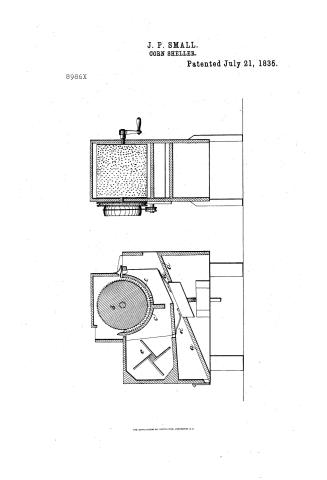 Page 1
-
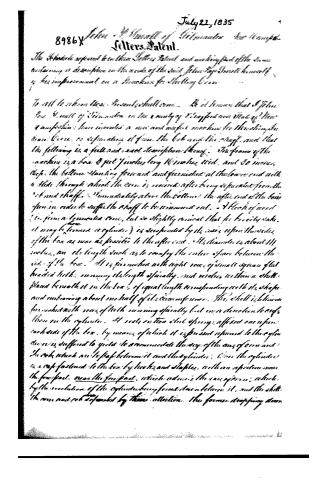 Page 2
-
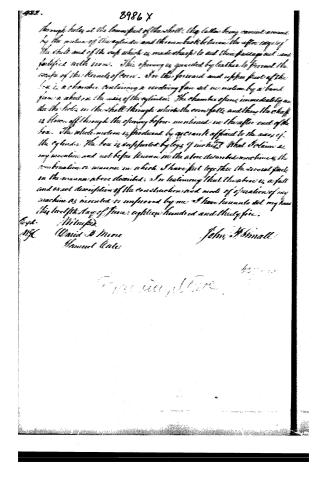 Page 3


U.S. Patent and Trademark Office · Google Patents
Published accounts: journal notice
Notice in the monthly list of patents
Journal of the Franklin Institute, new ser., vol. 16 (1835), p. 215 · View the page
425. Corn shelling.-John P. Small, Gilmanton, New Hampshire,
Published accounts: journal notice
Notice in the monthly list of patents, with remarks
Journal of the Franklin Institute, new ser., vol. 17 (1836), p. 128 · View the page
This, so called, improvement in the manufacture of cloth, is, it appears, an improvement in the napping apparatus, by substituting combs of brass for the teazles usually employed in that process. These combs are made of strips of elastic sheet brass; the teeth in them are to be about an inch in length, a fifteenth of an inch wide at their bases, and tapering regularly to a point. To these plates "a considerable curvature is to be given by swaying; that is by placing the plate thus cut over a concave mould so fashioned as to give the teeth and plate a proper curvature, and then placing a corresponding convex iron over them, and giving it a blow with a hammer. The metallic napper will then be complete, and will be a plate with a row of curved tapering elastic teeth, resembling the teeth of the teazle, and standing out from the uncut part of the plate at such an angle that the uncut part may be attached to slats of wood passing across [along] the face of a cylinder at suitable distances." "The invention for which, and for the use of which, the said Wolcot claims his patent, is for making from thin brass, a plate, with curved, tapering, and elastic teeth suitable for napping cloth." 37. For a Machine for Shelling Corn, John P. Small, Gilmarton, Strafford county, New Hampshire, July 21.
Remarks. This corn shelling machine has a cylinder set with teeth, and a concave against which it operates in the shelling process; it is, in fact, substantially the same with the first corn shelling machine ever invented. The corn falls through an opening at the lower part of the concave, and is cleaned by a revolving fan, in the way frequently practised. The claim is to "the combination or manner in which the several parts are put together, in the manner above described," which claim might as well have been altogether omitted, as it does not render that new which is actually old.
Published accounts: journal notice
Notice in the monthly list of patents
Journal of the Franklin Institute, new ser., vol. 17 (1836), p. 133 · View the page
15 may be required for the furnace. These rings are to be placed, or superimposed, upon each other to the required height; rims, or ledges, and corresponding grooves, or hollows, being cast upon their touching sides to keep them in their places. Holes are also to be cast in them, or ears formed on them, to receive rods, by which they may be confined together. The lower part of the stove, forming the ash pit, and its appendages, and also that part which is above the fire, may be constructed in any of the usual forms, or of any of the ordinary materials; the improvement made by me consisting entirely in the construction of that part which is formed of rings, or rims, in the way described. I intend usually to form these rings so that, when put together, the interior of the furnace shall, by their junction, have a uniform, continuous surface, either cylindrical, conical, or otherwise, whilst the outside shall be fluted, ribbed, or grooved, so as to expose a large surface to the action of the external air, as this mode of forming them will, by its extended radiation, tend to prevent their being over-heated. When used for gas retorts, their outsides will form one continuous surface, as best calculated to receive the action of the fire by which they are to be heated. When used in tubes for the conveyance, distribution, or management, of heat, they must, of course, be so formed as to adapt them to the particular purpose to which they are to be applied. What I claim as my invention, and desire to secure by letters patent, is the forming the exterior, or shell, of furnaces, or fire-places, for stoves of various kinds, the bodies of gas retorts, and other apparatus which are to be exposed to great alterations of temperature, by the combination of separate rings, rims, or frames, of metal, usually of cast-iron, by which means any difference of expansion in the respective parts may take place without the danger of breaking, whilst any portion which is defective may be easily removed, and its place supplied. JORDAN L. Мотт. Specification of a Patent for an improvement in the Combined Stove, for which a Patent was obtained on the 13th of December, 1833. Granted to JORDAN L. Moтт, city of New York, July 21st, 1835.
About this record
- Patentee
- DATAMP
- Date
- the Name and Date index of patents, DATAMP, USPTO records
- Invention
- DATAMP
- Listed in
- the Name and Date index of patents, DATAMP, USPTO records, Jim Shaw's X-patent list, the Journal of the Franklin Institute, Burke's List of Patents (1847)
- in_burke