

Drawings and documents
National Archives restored drawings: drawing
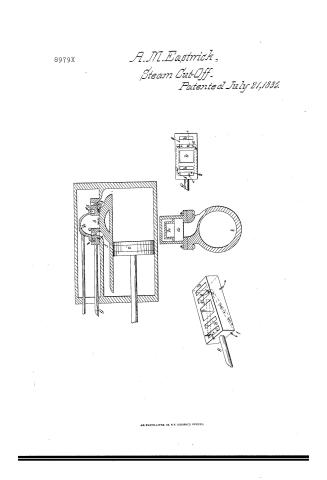
Andrews M. Eastwick's Patent Drawing for a Slide Valve or Reversing Shifting Valves

National Archives, Restored Patent Drawings (Record Group 241) · Full-size scan at the National Archives · Catalog record
Text on the drawing
Words on the drawing as machine-read by the National Archives; not checked. Useful mainly for searching.
STEAS VALVES, / slede valves wans - / #2 - / Doversing / Andrios M. Eastwick / CLASSIFICATION / 88.79x / Slide value 02 Preversing shifting value Patented July 11. 1835 / DIVISION / claims the reversing offering eyd / Eugen is Re we kg chronic / oncessing opening out of gand / formy ex Tra the every hit action / C. / st / afrange cvd able decending medically half three / the Water contanged laterally passing 5 two / of the dues openery 8 commate are the offere to face / 00 / thing / valve / seak / they / Top / Patrel office aug 10th,882 / References. / a the reversing shifting value seat. 1.2.38fe. / madeunder the direction of the / bbb opening passing through the value / Commissioner of Patents in conformity / e.d opening which do not years through / with act of Congrep 3rd march 183% / Termination a f terminationed / g the 20d. h common slide. i cylinders piston / "Lillmonth / Commitions of Eatents
USPTO scan
The patent as scanned by the USPTO
-
 Page 1
-
 Page 2
-
 Page 3


U.S. Patent and Trademark Office · Google Patents
Published accounts: specification
Specification printed in the Journal of the Franklin Institute
Journal of the Franklin Institute, new ser., vol. 17 (1836), p. 132 · View the page
Text of the specification as printed in the Journal, from OCR; not proofread.
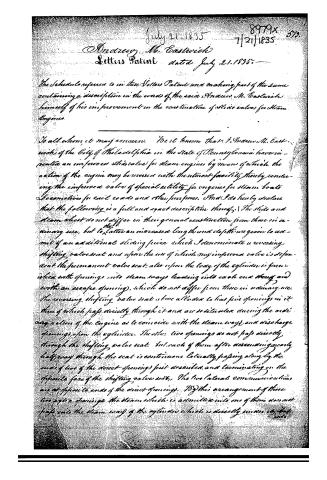
Specification of a Patent for an improvement in the Slide Valves for Steam Engines. Granted to Andrew M. EASTWICK, city of Philadelphia, July 21st, 1835. To all whom it may concern, be it known, that I, Andrew M. Eastwick, of the city of Philadelphia, in the state of Pennsylvania, have invented an improved slide valve for steam engines, by means of which the action of the engine may be reversed with the utmost facility, thereby rendering this improved valve of special utility in engines for steamboats, locomotives for rail-roads, and for other purposes; and I do hereby declare that the following is a full and exact description thereof. Morr's Improved Stove. The slide and steam chest do not differ in their general construction from those in ordinary use, but to the latter an increased length and depth are given, to admit of an additional sliding piece, which I denominate a Reversing shifting valve seat, and upon the use of which my improved valve is dependent; the permanent valve seat, also, upon the body of the cylinder, is furnished with openings into steam ways leading into each end thereof, and with an escape opening, which do not differ from those in ordinary use. The reversing shifting valve seat, above alluded to, has five openings in it, three of which pass directly through it, and are so situated during the ordinary action of the engine, as to coincide with the steam ways, and discharge opening upon the cylinder. The other two openings do not pass directly through the shifting valve seat, but each of them, after descending nearly half way through the seat, is continued laterally, passing along by the ends of two of the direct openings first described, and terminating on the opposite face of the shifting seat; the two lateral communications are at opposite ends of the direct openings. By this arrangement of these two extra openings, the steam which is admitted into one of them, does not pass into the steam way which is directly under it, but into that leading to the opposite end thereof. In consequence of constructing the shifting valve in this manner, all that is necessary to reverse the motion of the engine, is to slide the shifting seat so as to bring the reversing openings into action, and to throw the ordinary openings out of action. For this purpose, a rod connected with the shifting valve seat passes through a stuffing box in the steain chest, so that, by means of a lever, cam, or other contrivance, it may be instantaneously shifted in either direction; the steam chest must, of course, be made of such length as is necessary for this purpose. The openings which are not in action are closed by the divisions between the steam and discharge ways, and by the solid parts of the valve seat. What I claim as my invention, is the construction of the reversing shifting valve seat, containing the reversing openings, constructed upon the principle, or in the manner, herein set forth, whether the same be made precisely in the form described, or in any other which is substantially the same, producing a similar effect by analogous means. ANDREW M. EASTWICK.
Published accounts: journal notice
Notice in the monthly list of patents
Journal of the Franklin Institute, new ser., vol. 16 (1835), p. 215 · View the page
432. Slide valves. Andrew M. Eastwick, city of Philadelphia,
Published accounts: journal notice
Notice in the monthly list of patents, with remarks
Journal of the Franklin Institute, new ser., vol. 17 (1836), p. 130 · View the page
44. For an improvement in the Slide Valves for Steam Engines; Andrew M. Eastwick, city of Philadelphia, July 21.
Remarks. (See the specification.)
Published accounts: journal notice
Notice in the monthly list of patents, with remarks
Journal of the Franklin Institute, new ser., vol. 17 (1836), p. 132 · View the page
"It is now apparent that the change in the supply is produced by the compressibility of steam, and the non-compressibility of water made effec. tive by machinery; steam opposing no resistance to the descent of the plunger suffers the dog to descend and draws the supply rod away from the boiler, thus increasing the supply as aforesaid; but water resisting the descent of the plunger, and arresting the plunger in its descent for an instant, thereby makes the plunger a temporary prop, and a centre of motion for the lever which is made to work thereon, and lift up the dog, so that the spring shall throw its lower notch upon the catch, and thereby carry the air towards the boiler, and with it the rod, thereby diminishing the supply of water." SPECIFICATIONS OF AMERICAN PATENTS. Specification of a Patent for an improvement in the Slide Valves for Steam Engines. Granted to Andrew M. EASTWICK, city of Philadelphia, July 21st, 1835.
Remarks. To all whom it may concern, be it known, that I, Andrew M. Eastwick, of the city of Philadelphia, in the state of Pennsylvania, have invented an improved slide valve for steam engines, by means of which the action of the engine may be reversed with the utmost facility, thereby rendering this improved valve of special utility in engines for steamboats, locomotives for rail-roads, and for other purposes; and I do hereby declare that the following is a full and exact description thereof. Morr's Improved Stove. The slide and steam chest do not differ in their general construction from those in ordinary use, but to the latter an increased length and depth are given, to admit of an additional sliding piece, which I denominate a Reversing shifting valve seat, and upon the use of which my improved valve is dependent; the permanent valve seat, also, upon the body of the cylinder, is furnished with openings into steam ways leading into each end thereof, and with an escape opening, which do not differ from those in ordinary use.
Published accounts: journal notice
Notice in the monthly list of patents, with remarks
Journal of the Franklin Institute, new ser., vol. 17 (1836), p. 133 · View the page
The reversing shifting valve seat, above alluded to, has five openings in it, three of which pass directly through it, and are so situated during the ordinary action of the engine, as to coincide with the steam ways, and discharge opening upon the cylinder. The other two openings do not pass directly through the shifting valve seat, but each of them, after descending nearly half way through the seat, is continued laterally, passing along by the ends of two of the direct openings first described, and terminating on the opposite face of the shifting seat; the two lateral communications are at opposite ends of the direct openings. By this arrangement of these two extra openings, the steam which is admitted into one of them, does not pass into the steam way which is directly under it, but into that leading to the opposite end thereof. In consequence of constructing the shifting valve in this manner, all that is necessary to reverse the motion of the engine, is to slide the shifting seat so as to bring the reversing openings into action, and to throw the ordinary openings out of action. For this purpose, a rod connected with the shifting valve seat passes through a stuffing box in the steain chest, so that, by means of a lever, cam, or other contrivance, it may be instantaneously shifted in either direction; the steam chest must, of course, be made of such length as is necessary for this purpose. The openings which are not in action are closed by the divisions between the steam and discharge ways, and by the solid parts of the valve seat. What I claim as my invention, is the construction of the reversing shifting valve seat, containing the reversing openings, constructed upon the principle, or in the manner, herein set forth, whether the same be made precisely in the form described, or in any other which is substantially the same, producing a similar effect by analogous means. ANDREW M. EASTWICK. Specification of a Patent for an improvement in the Construction of Stoves for burning Anthracite, and other Fuel. Granted to JORDAN L. MOTT, city of New York, July 21st, 1835.
Remarks. To all whom it may concern, be it known, that I, Jordan L. Mott, of the city of New York, in the state of New York, have invented an improvement in the construction of stoves for burning anthracite, and other fuel, which improvement is applicable also to retorts for gas works, and to other instruments for the generating or applying of heat. And I do hereby declare that the following is a full and exact description thereof. For the purpose of description, I will suppose a vertical, cylindrical stove to be constructed, observing, however, that I do not intend thereby to limit myself as respects the form, position, or application, of the apparatus, but only to give an exemplification of a practical mode of carrying the principle of construction into effect. The body, or furnace part, of this stove, is to be of cast-iron, and consists of any required number of separate rings, of such internal diameter as VOL. XVII.-No. 2.- FEBRUARY, 1836.
About this record
- Patentee
- DATAMP
- Date
- the Name and Date index of patents, DATAMP, USPTO records
- Invention
- DATAMP
- Listed in
- the Name and Date index of patents, DATAMP, USPTO records, Jim Shaw's X-patent list, the Journal of the Franklin Institute, Burke's List of Patents (1847)
- The Franklin Institute's journal spells the name differently.
- in_burke