

Drawings and documents
National Archives restored drawings: drawing
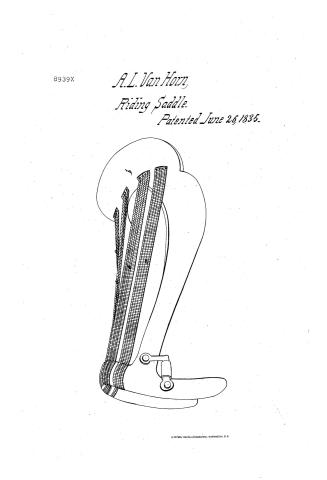
A. L. Van Horn's Patent Drawing for Riding Saddles with Gum Elastic Webbing

National Archives, Restored Patent Drawings (Record Group 241) · Full-size scan at the National Archives · Catalog record
Text on the drawing
Words on the drawing as machine-read by the National Archives; not checked. Useful mainly for searching.
54. HARNESS / fl / [72] Riding Saddles. / A John Hoon / 8939-1 / riding Iaddles with gum elastic webbing. / DIYISION / Vol.12. hs 505 / Intented June 26. 1835. / References a.a.a.a Indian Rubber webbing. / Patent office Ind 28 1842 / b. the cantle / made under the direction of the / of Patents in conformitywith act-forting / Commissioner of patients.
USPTO scan
The patent as scanned by the USPTO
-
 Page 1
-
 Page 2


U.S. Patent and Trademark Office · Google Patents
Published accounts: journal notice
Notice in the monthly list of patents
Journal of the Franklin Institute, new ser., vol. 16 (1835), p. 214 · View the page
380. Saddles.-A. L. Vanhorn, Philadelphia,
Published accounts: journal notice
Notice in the monthly list of patents, with remarks
Journal of the Franklin Institute, new ser., vol. 17 (1836), p. 57 · View the page
70. For Riding Saddles; A. L. Van Horn, City of Philadelphia, June 26.
Remarks. (See the specification.)
Published accounts: journal notice
Notice in the monthly list of patents
Journal of the Franklin Institute, new ser., vol. 17 (1836), p. 59 · View the page
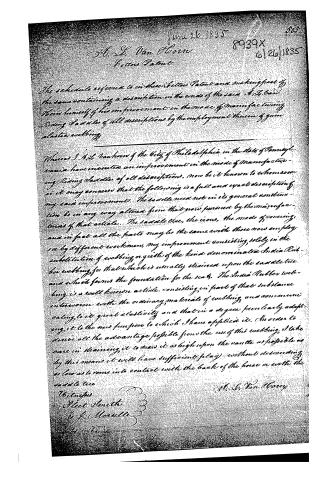
To all whom it may concern, be it known, that I, A. L. Van Horn, of the City of Philadelphia, have invented an improvement in the manner of making Riding Saddles of all descriptions, and that the following is a full and exact description thereof. The saddle need not in its general construction be in any way altered from that now pursued by the manufacturers of that article. The saddle tree, the irons, the mode of covering, and in fact all the parts may be the same with those now employed by different workmen, my improvements consisting solely in the substituting webbing, or girth, of the kind denominated India Rubber Webbing, for that which is usually strained upon the saddle tree, and which forms the foundation for the seat. The India Rubber Webbing is a well known article, consisting in part of that substance interwoven with the ordinary materials of webbing, and communicating to it great elasticity, and that in a degree peculiarly adapting it to the new purpose to which I have applied it. In order to derive all the advantage possible from the use of this webbing, I take care in straining it to draw it as high upon the cantle as possible, as by this means it will have sufficient play without descending so low as to come in contact with the back of the horse, or with the saddle tree. A. L. VAN HORN. Specification of a Patent for an Improvement in Flasks for Moulding Iron Tea Kettles, and other vessels of a similar nature. Granted to DAVID STEWART, Danville, Columbia County, Pennsylvania, June 26th, 1835.
Remarks. To all whom it may concern, be it known, that I, David Stewart, of Danville, in the County of Columbia, and State of Pennsylvania, have invented an improved mode of constructing Flasks for the moulding of Cast Iron Tea Kettles, by which the number of parts of which they ordinarily consist is reduced from four to two, and the necessity of turning the flask over in the operation of moulding is altogether obviated, and I do hereby declare that the following is a full and exact description thereof. I use a mould board of cast iron, upon which the pattern and flask are to be placed. The mould board has a circular excavation, or gutter, around its centre, which is to be filled with casting sand, upon which that part of the pattern rests which forms the rim, of the opening in the top of the kettle, which part would otherwise be chilled by the mould board in casting. The pattern for the kettle is in the usual form, and has a square shank rising from the centre of that part which forms the opening for the lid, which shank fits into a square hole in the centre of the iron mould board, when the pattern is placed upon it for moulding. The flask consists of two parts only, dividing horizontally immediately opposite the swell of the kettle, and the upper part extending a sufficient height above the bottom of the kettle for the requisite thickness of sand. The pattern being put into its proper place is surrounded by the lower half of the flask, and this is filled with the sand to a level; the upper half of the flask is then placed on, and the moulding of the outside completed, when the upper flask may be taken off, and the pattern removed. The manner of moulding the spout does not differ from that ordinarily pursued. The mould for making the core, and the manner of filling it differs from that heretofore followed, the core mould being filled from the part which forms the bottom, instead of that which forms the top of the kettle. A mould board is prepared having a hole in its centre of the same size with that in the iron mould board, and into this the shank of the anchor, which is to sustain the core, is placed, and that half of the mould which corresponds with the top of the kettle is passed over it, and secured in its place. The other half of the core mould is then put on, and the whole is filled with sand, properly rammed in. In order to fill it, the core mould has a suitable opening, or openings in the part which is uppermost, and which corresponds with the bottom of the kettle, and when this is properly filled, and the core pierced for air holes, it is ready to be removed to the iron mould board, and anchored in its proper place.
About this record
- Patentee
- the Journal of the Franklin Institute, Journal
- Date
- the Name and Date index of patents, DATAMP, USPTO records
- Invention
- DATAMP
- Listed in
- the Name and Date index of patents, DATAMP, USPTO records, Jim Shaw's X-patent list, the Journal of the Franklin Institute, Burke's List of Patents (1847)
- The National Archives' catalog gives the name differently.
- The patentee's full name comes from the Franklin Institute's journal.
- in_burke