

Drawings and documents
USPTO scan
The patent as scanned by the USPTO
-
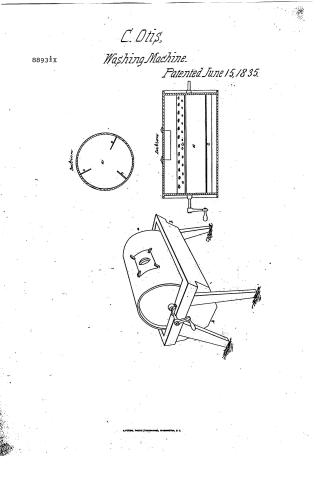 Page 1
-
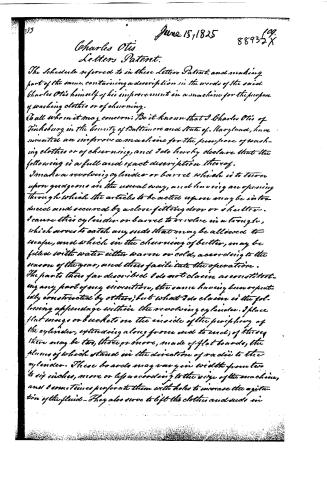 Page 2
-
 Page 3


U.S. Patent and Trademark Office · Google Patents
Published accounts: specification
Specification printed in the Journal of the Franklin Institute
Journal of the Franklin Institute, new ser., vol. 17 (1836), p. 62 · View the page
Text of the specification as printed in the Journal, from OCR; not proofread.
Specification of a Patent for Washing Clothes, and for Churning. Granted to CHARLES OTIS, of Finksburg, in the County of Baltimore, and State of Maryland, June 15th, 1835. I make a revolving cylinder, or barrel, which is to turn upon gudgeons in the usual way, and having an opening through which the articles to be acted upon may be introduced, and secured by a close fitting door, or shutter. I cause this barrel, or cylinder, to revolve in a trough which serves to catch any suds that may be allowed to escape, and which, in the churning of butter may be filled with water, either warm or cold, according to the season of the year, and thus facilitate the operation. The parts thus far described I do not claim as constituting any part of my invention, the same having been repeatedly constructed by others; but what I do claim is the following appendage within the revolving cylinders. I place flat wings, or buckets, on the inside of the periphery of the cylinder, extending along from end to end; of these there may be two, three, or more, made of flat boards, the planes of which stand in the direction of radii to the cylinder. These boards may vary in width from two to six inches, more or less, according to the size of the machine, and I sometimes perforate them with holes, to increase the agitation of the fluid. They also serve to lift the clothes and suds in washing, or the cream in churning, more effectually than the pins which have sometimes been employed for that purpose. I confine my claim exclusively to the employment of the wings, or buckets, herein described. C. OTIS. Progress of Theoretical and Practical Mechanics. Report on the use of the Hot Air Blast in iron Furnaces and Foundries. By A. GUENYVEAU, Engineer and Professor in the Royal School of Mines.* (Translated for this Journal, by Professor A. D. Bache.f) This report embraces the observations made during a tour of examination of the furnaces and foundries in the south of France, in some of which the hot air blast is used. The tour was undertaken by order of the director-general of bridges and roads, and of mines. In remarks upon the subject, a distinction must be made between the furnaces where coal is used and those which use charcoal. The amount of air required is so different in the two classes, being sometimes as two or three to one, that the apparatus for heating it is usually different. The results are, however, nearly the same for both classes. All the furnaces examined use ores from the same part of France. The hot air blast has succeeded best in the furnaces of Vienne (Isere), the two at Terre-Noire (near St. Etienne), and those of the Voulte (Ardeche.) In one furnace, that of Firmy (Aveyron), the results with this blast were not satisfactory, either with raw coal or with coke. The large establishments of Creusot and Alais, and those of l'Orme (Loire), have not yet applied heated air. The fuel used in them is coke. At the furnace near Torteron, where the fuel is a mixture of charcoal and coke, the hot air blast has been used to advantage, in regard to the quality of the iron. In the various smelting furnaces in Burgundy and Franche-Comté, where charcoal is used as a fuel, the new process has proved satisfactory. * Annales des Mines, vol. vii. Livraison 1. † This is a translation of extracts from the report of M. Guenyveau, and in parts where the details do not seem to be of special interest, an abstract of his results. Use of the Hot Air Blast in France. I. HEATING APPARATUS. Of these there are various forms in use. The objects sought are economy in heating the air, a sufficiently high temperature, and the preservation of the pipes. The apparatus used at Calder* (Scotland) appears to answer the best purpose. It is in use at Vienne, and in one of the Firmy furnaces. The first apparatus put up was like that used at the Clydet furnaces; this is still used at Torteron and la Voulte, but has, at Vienne, given place to the Calder apparatus. The heating pipes are two inches in diameter, and at Firmy have been replaced by others two and a half inches in diameter. It might seem that these pipes are too small, but experience has sanctioned their use. It is not known how long this apparatus will last; in fact the duration must depend upon the temperature to which the pipes are heated, and upon the nature of the coal. It is believed that the arrangement with highly inclined tubes will outlast that with horizontal ones. The temperature of the air is easily raised above the melting point of lead (604° Fahr.) The cost of the apparatus for each tuyere is about 1200 francs ($240.) The flame which appears at the trunnel head of smelting furnaces which use coke, has not been applied to heat the blast, although it has been advantageously applied in charcoal furnaces. It would seem that this mode of heating should apply particularly to furnaces in which raw coal is used, on account of the amount of unconsumed combustible matter which issues from the trunnel head; notwithstanding which, M. Dufrenoy gives one case, in the neighbourhood of Birmingham, in which the heating apparatus placed upon the platform of the furnace did not answer the purpose. The temperature of the air could not be raised above 360° Fahr., and subsequently it was heated by a separate furnace which consumed four tons of coal for each ton of iron. As, however, the temperature to which the air is heated at the Voulte furnace is below that just stated, the question cannot be considered as decided. The air blast is generally heated above melting point of tin (442° Fahr.), and sometimes above that of lead (604º Fahr.), and even higher. In other furnaces, as at the Voulte and Torteron, where horizontal heating pipes are used, the temperature has been diminished, in order to save the wear of the pipes. At the first mentioned furnace it never exceeds 340° Fahr., being at a mean about 320°, and at the second never exceeds the melting point of tin. At the furnaces of Terre-Noire the heat is carried by Taylor's apparatus to 572º Fahr. It has been said that the advantages of the hot air blast increase in the ratio of the temperature of the blast, an assertion which, although it appears probable, and has been confirmed by certain observations, is not true in all cases. At the Voulte the results were sensibly the same where the air was heated to 428° and to 320°.|| Several methods have been used to determine the temperature of the hot air blast. One was to use a common thermometer, with a metal scale; the bulb being inserted into the blast pipe near the nozzle. Another method was to use a slip of lead, tin, or of some fusible alloy, according to the tem* See this Journal, vol. xv. p. 213, pl. 2, figs. 6, 7, 8 and 9. † Ibid. vol. xv. p. 209, pl. 2, figs. 1 and 2. + See this Journal, vol. xv. p. 272, pl. 3, figs. 15 and 16. § Similar to that described by M. Dufrenoy, vol. xv. p. 213. It may readily be understood why an increase of 100° from 320° to 420° should not produce so sensible an effect as from 220° to 320°, or as from 120° to 220°TRANSLATOR. perature, which was exposed to the air issuing from a hole in the blast pipe.* At Torteron the alloy was two-thirds tin to one-third of lead. Great inconvenience has been felt from the leakage of the pipes used in the heating apparatus. These leaks when they occur in the heating ovens are only discovered by a deficiency in the yield of the furnace. They occur commonly at the joints, and the liability to them increases with the increased temperature of the blast. The repairs which are necessary alter the supply of air, and thus derange the system of working. It is a desideratum to render the leakage less common and the means of repair more easy. When these leaks occur, if the fire is not immediately extinguished, the pipes being no longer kept cool by the air passing through them, burn out very quickly. The heating apparatus placed near the trunnel head is free from this defect.t The effect of these difficulties has merely been to produce a resort to the reduction of temperature noticed at the furnaces of La Voulte and TorteThe remarks of M. Dufrenoy on the forms of apparatus, confirmed as they are by extensive observation, deserve great attention. ron. The effects of heating the air upon the quantity and pressure of that passed into the furnace may be thus estimated. If we suppose the air heated from 60° to 568° Fahr. its bulk will be doubled and consequently, under the same pressure, but half the quantity will pass through a given orifice, which would have passed had the air not been heated. Generally, until the area or nozzle of the blast pipe is nearly doubled, the advantage of the hot air blast is not realized. Before this change in the nozzle, the furnace is not duly supplied with air. Besides, the pressure at the tuyere has been observed to diminish with a given pressure at the blowing machine, a fact which may be explained by the resistance of the air moving through the pipes of the heating apparatus, the elbows in which tend to make the resistance quite considerable in amount. If then the pressure and the quantity of air thrown into the furnace should be the same with the hot and cold blast, the power of the blowing machine must be increased. This has not been found necessary in the English works, where on the contrary they have supplied more furnaces with heated air by the same blowing machine, than could be supplied with cold air. Less fuel being consumed in a given time, with a greater yield of metal, less air is required to support the combustion. In these works the power required to supply heated air is estimated at one-tenth more than that employed for the cold blast, for the same weight of ore, but as the weight of the air thrown in is diminished one-fourth, the same blowing machine which supplied three furnaces with cold air will supply four with the hot blast. At the Calder furnaces (Scotland,) the pressure of the hot air blast was less than that of the cold air previously used by two-thirteenths, and at the Clyde works by one-sixth. M. Varin estimates the economy from this source at la Voulte works at one-fifth, the pressure being reduced from three inches and a quarter of mercury to two inches and a half. At the Torteron furnace where the heated air blast has neither changed sensibly the amount of fuel used, nor of iron produced, the blowing machine requires a little more fuel to produce the steam required to move it, than it did when cold air was used. At Wasseralfingen where the consumption of charcoal has not varied materially by the change from the cold to the * By reference to this Journal, p. 74, vol. xvi. a more convenient method of using the thermometer will be found. -TRANSLATOR. † If so, it would seem that it must be deficient in heating power.-TRANSLATOR. Use of the Hot Air Blast in France. hot air blast, they require more power with the latter, a larger quantity of air being necessary in running the furnace. It is not said that the dimensions of the blast pipe nozzle have been changed. At Ancy-le-Franc in August, 1834, the pressure at the governor remaining constant, that at the tuyere was observed to fall to one-half, when the air was heated. The size of the nozzle was increased, but there was not an adequate power to supply the air required, and the yield of the furnace diminished. Tuyeres, cooled by water, have been substituted for the ordinary ones in furnaces using the heated air blast; the cooling effect of the blast being taken away, the ordinary tuyere is rapidly burned out. Cast-iron water tuyeres have been found to last longer than those of wrought iron; they wear out in from three to six months. In many establishments the blast pipe nozzle is permanently attached to the tuyere, an arrangement which answers well when it is not necessary to clean out the tuyeres. When this is necessary, the common arrangement is to be preferred, and this is generally the case in the French works even where charcoal is used. When the nozzle is not closely fitted to the tuyere, the blast is slightly cooled before it gets into the furnace, and part of it does not pass in. II. ON THE EFFECTS AND ADVANTAGES OF THE HOT AIR BLAST. The effect appears to be to increase the heat within the furnace, so thata refractory ore is fused; any stoppage in the furnace is prevented, and the working is more readily resumed after the furnace has been cooled. Less fusible ores may be used, less flux is required for their reduction, the slags are more fusible, and become spongy if water is thrown upon them when incandescent. This property has been observed only in the Styrian furnaces and others where charcoal is used as a fuel, and the ore is a manganesian carbonate of iron. Further, grey pig iron is obtained with every kind of ore, this variety of iron requiring a high temperature for its production. Generally the heated air and combustible gases which issue from the trunnel head, are diminished in quantity and the heat is more concentrated in the lower parts of the furnace; a source of great advantage, but which causes a more rapid destruction of the hearth and boshes. The working of the furnace when heated air is used is comparatively easy, there are fewer cases of clogging and they are readily remedied; the tuyeres are almost always free, no slag collecting and hardening about them. Frequently, a clogging in the furnace may be removed by raising the temperature of the blast. The advantages may be succinctly enumerated as follows. 1. A change in the iron which becomes more grey, and even black, and the slag is more fluid than when cold air is used. 2. An increase in the quantity of ore which a given weight of fuel will bear, whence results a diminution in the quantity of fuel required to produce a ton of metal, after the fuel required to heat the air has been taken into account. 3. A diminution in the quantity of flux, to which there are, however, exceptions. 4. An increase in the daily yield of a furnace. We do not enumerate among the advantages that of using crude coal, because it has been ascertained both in Wales and at Decazeville, that this may be done with the cold air blast. In regard to the quality of the iron produced by the hot air blast, the following facts have been collected. VOL. XVII.-No. 1.-JANUARY, 1836. 9 It has been asserted that iron, thus obtained, requires to be remelted when it becomes duly tenacious, and yet the Lyonese founders complain that the iron of Vienne is weak. On the other hand, iron from the Torteron furnace was cast into shells which required more powder to burst them than similar ones made from iron procured by the cold blast, the strength having been nearly double, in the former case, of that in the latter. In England there appears to have been no sensible difference between the castings made from iron obtained by the two different methods. Th same uncertainty prevails in regard to the forged iron obtained from pigs reduced by the aid of the hot air blast. M. Dufrenoy and M. Debilly, consider the notions prevalent on this subject in England, to be founded in prejudice. My observations in the South of France have shown that there is, if any, a very slight difference in the quality of the iron in favour of that made by the cold blast. At one of the furnaces it was suggested that silicious ores gave a worse iron by this process than by the cold air blast, the great heat facilitating the union of the silicium with the carbon and iron. A careful analysis is required to demonstrate this theory, in favour of the probability of which it may be stated that at Firmy, where a very silicious ore is used, the iron made by the hot air blast is worse than that by the other process, and when refined, produces a worse malleable iron. It is remarkable, moreover, that the best iron is obtained when the ore is in excess in charging the furnace, in which case the iron is reduced at the lowest temperature. [TO BE CONTINUED IN our NEXT.] Composition and specific gravity of different kinds of Glass. Ordinary flint-glass, according to Mr. Faraday's analysis, consists, in 100 parts, of silica 51.93, oxide of lead 33.28, potash 13.77, with minute portions of other substances. A specimen of the same kind of glass, manufactured for telescopes by the late M. Guinand, yielded the same chemist, silica 44.3, oxide of lead 43.05, and potash 11.75. Mr. Faraday found the specific gravity of M. Guinand's glass to be about 3.616, that of ordinary flint-glass 3.290, that of plate-glass 2.5257, and that of crown glass 2.5448. Glass has usually been considered, without much actual inquiry into the subject, to be strictly a chemical combination of its ingredients, and in all respects a very perfect artificial compound. This, however, is far from being the truth, as will appear from the following facts. That the alkali in common glass of all kinds is in a very imperfect state of combination, many circumstances concur to evince. For example, Mr. Griffiths has shown, that if a small quantity either of flint-glass, or of plate-glass, be very finely pulverized in an agate mortar, then placed upon a piece of turmeric paper and moistened with a drop of pure water, strong indications of free alkali will be obtained; and that if the pulverization be very perfect, the alkali can be detected in other kinds of glass, containing far smaller quantities of it. This proves, that in whatever state of combination the alkali may be, it is still subject to the action of moisture. That flint-glass is by no means a compound resulting from very strong chemical affinities, and that the oxide of lead which it contains is as imperfectly combined as the alkali, has been shown experimentally by Mr. Faraday, and also appears from the tarnish which is produced on its surface by exposure to sulphuretted vapours, owing to the combination of sulphur with the lead. Glass which has long been exposed to the weather, frequently exhibits a beautiful iridescent appearance, and is so far decayed, that it may be Carriage Wheels. scratched with the nail. The glass of some bottles of wine which had lain in a wet cellar near the Bank of London upwards of 150 years, examined by Mr. Brande, was soft, and greatly corroded upon the surface, in consequence of the partial abstraction of its alkali. After reciting some of these facts, and others of a similar description, Mr. Faraday observes, "Glass may be considered rather as a solution of different substances one in another, than as a strong chemical compound; and it owes its power of resisting [chemical] agents generally, to its perfectly compact state, and the existence of an insoluble and unchangeable film of silica, or highly silicated matter, upon its surface." See Mr. Faraday's Bakerian Lecture on the manufacture of glass for optical purposes; Phil. Trans. 1850, pp. 46-50.Parke's Chem. Cat, by Brayley. (Arcana, &c. 1835.) Carriage Wheels. On the 27th of May, at the Institution of Civil Engineers, Mr. Walker's paper, on the subject of the most advantageous form for wheels of different kinds of carriages, having been read, a member remarked that there were some practical objections to the use of horizontal axles, which were not alluded to in Mr. Walker's communication-one, the difficulty of making the wheel perfectly secure from coming off the axle, as a greater strain is unavoidably thrown on the linchpin. The wheels of ordinary country wagons are usually much dished, and the axles slightly inclined downwards, by which arrangement, the principal s
Published accounts: journal notice
Notice in the monthly list of patents
Journal of the Franklin Institute, new ser., vol. 16 (1835), p. 143 · View the page
347. Washing machine. -Charles Otis, Finksburg, Maryland,
Published accounts: journal notice
Notice in the monthly list of patents, with remarks
Journal of the Franklin Institute, new ser., vol. 17 (1836), p. 49 · View the page
37. For a Machine for Washing and Churning; Charles Otis, Finksburg, Baltimore county, Maryland, June 15.
Remarks. (See the specification.)
About this record
- Patentee
- the Journal of the Franklin Institute, Journal
- Date
- USPTO records, Burke's List of Patents (1847)
- Invention
- Burke's List of Patents (1847)
- Listed in
- USPTO records, Jim Shaw's X-patent list, the Journal of the Franklin Institute, Burke's List of Patents (1847)
- The sources give different dates; the date shown is the one most of them agree on.
- This patent does not appear in the Name and Date index.
- The date conflict was settled by Burke's 1847 list.
- The patentee's full name comes from the Franklin Institute's journal.
- The Franklin Institute's journal confirms the date shown.
- in_burke