

Drawings and documents
USPTO scan
The patent as scanned by the USPTO
-
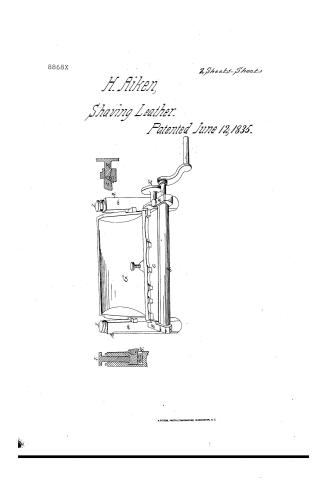 Page 1
-
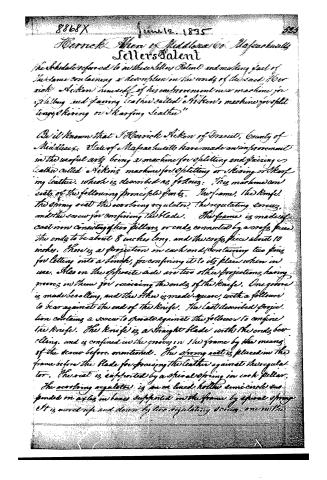 Page 2
-
 Page 3


U.S. Patent and Trademark Office · Google Patents
Published accounts: journal notice
Notice in the monthly list of patents, with remarks
Journal of the Franklin Institute, new ser., vol. 17 (1836), p. 43 · View the page
Although many patents are taken for trifling things, the one before us may be considered as standing alone in its own littlenes. The whole thing proposed is to cover the rods used for connecting the tops and bottoms of Franklin, ten plate, and other stoves, by half columns of cast iron. 18. For a Saw Set; Herrick Aiken, Dracut, Middlesex county, Massachusetts, June 12.
Remarks. The description of the saw set is very imperfect, or the instrument itself is strikingly so. There is to be a small piece of steel with a rounding face set in an iron bed, and upon this the setting is to be effected. Two horns, or projecting pieces on the bed, are employed to hold the said blade in its place, and there is to be a regulating guage, which in the drawing is represented as having teeth on it like those of a saw, and we are told that "the set of the teeth is performed by a hammer, or hammer and punch. The claim is to the foregoing parts." We know something about saws, saw sets, and saw setting, but should be at a loss, with all the helps before us, in attempting to construct and use the foregoing instrument.
Published accounts: journal notice
Notice in the monthly list of patents, with remarks
Journal of the Franklin Institute, new ser., vol. 17 (1836), p. 44 · View the page
19. For Splitting and Paring Leather; Herrick Aiken, Dracut, Middlesex county, Massachusetts, June 12.
Remarks. This machine is for cutting or skiving leather after it has been cut in strips or pieces to the required length and width. Like the foregoing, it is but imperfectly described, and could not, therefore, be carried into effect without the aid of invention. A cutting knife is to enter horizontally along a cast iron frame, and what is called a revolving regulator, which we are told "is an inclined, hollow semicircle," is placed above the knife, extending between two upright studs, to which, we suppose, it is attached by gudgeons, placed eccentrically, so that when turned down over the edge of the knife, its distance therefrom may be regulated by its eccentricity, and thus serves as a guage for different thicknesses. There are some other parts for which we could suppose a use, and a mode of fixing, but this is rather a departure from our general design. Very simple instruments have been long in use for the same purpose, and although this is called an improvement, the term must be taken in its technical acception only, meaning that it is not precisely like those which have preceded it. The claim made, is to "the arrangement and adaptation of the several parts of the machine so as to produce the one before described, and particularly the method of confining the knife, and the construction of the regulator." The former part of the claim may be tacked on to any specification; the latter portion is to things not properly described.
DATAMP: illustration
Illustrations from DATAMP
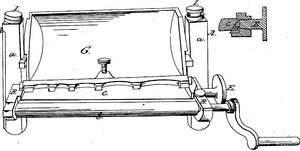
DATAMP (Directory of American Tool and Machinery Patents), via the Internet Archive · Archived DATAMP page
About this record
- Patentee
- DATAMP
- Date
- the Name and Date index of patents, DATAMP, USPTO records
- Invention
- DATAMP
- Listed in
- the Name and Date index of patents, DATAMP, USPTO records, Jim Shaw's X-patent list, the Journal of the Franklin Institute, Burke's List of Patents (1847)
- in_burke