

Drawings and documents
USPTO scan
The patent as scanned by the USPTO
-
 Page 1
-
 Page 2
-
 Page 3
-
 Page 4
-
 Page 5
-
 Page 6


U.S. Patent and Trademark Office · Google Patents
Published accounts: journal notice
Notice in the monthly list of patents
Journal of the Franklin Institute, new ser., vol. 16 (1835), p. 142 · View the page
312. Measuring distances. Samuel Stone, Long Green, Baltimore co., Md.
Published accounts: journal notice
Notice in the monthly list of patents, with remarks
Journal of the Franklin Institute, new ser., vol. 17 (1836), p. 38 · View the page
2. For an improvement in the Theodolite; Samuel Stone, Long Green, Baltimore county, Maryland, June 6.
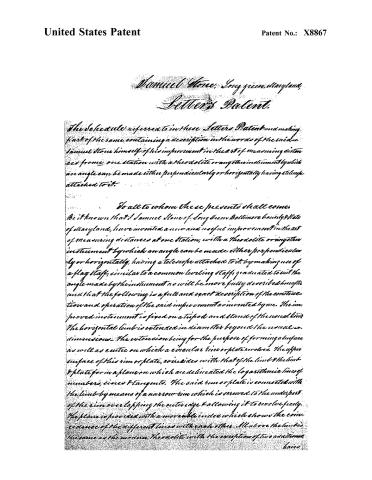
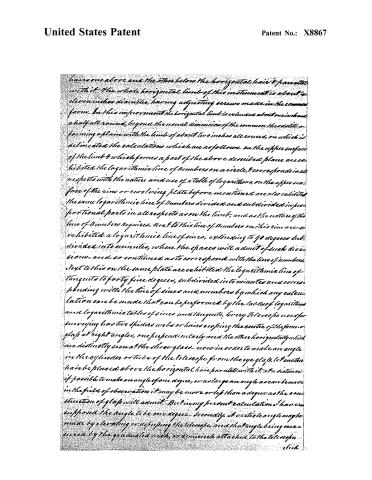
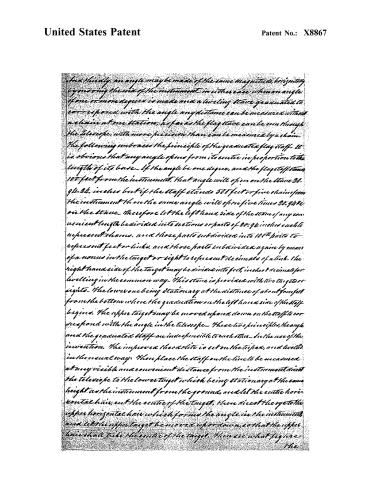
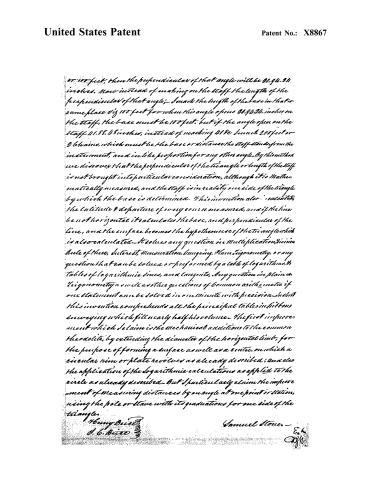
Remarks. The patentee states his improvement to be "in the art of measuring distances at one station with a theodolite, or any other instrument by which an angle can be made either perpendicularly or horizontally," &c. The patent, however, is taken for an improvement in the instrument, and not in the art of using it. He says, "the first improvement which I claim is the mechanical addition to the common theodolite, by extending the diameter of the horizontal limb for the purpose of forming a surface as well as a centre on which a circular rim or plate revolves, as already described; and also the application of the logarithmic calculations as applied to the circle, as already described. But I particularly claim the improvement of measuring distances by an angle at one point or station, using the pole or stave, with its graduations, for one side of the triangle." With respect to its construction and use, the inventor says: "This instrument embraces all the principles of a modern theodolite; besides which, it contains the following improvements: The first improvement is a circular revolving plate, sliding or resting upon the limb of the instrument, the upper surface of which forms a plane with the upper surface of the limb; on which are delineated a set of mathematical numbers, which supply the place of a table of logarithms, and all other logarithmic tables. "In the second place, this instrument is so constructed as to supersede the necessity and use of a chain in all cases. The distance of any visible object can be ascertained at one station, as far as the flag staff can be distinctly seen through the telescope of the instrument, to the exactness of chains, links, and decimals. "It also calculates the latitude and departure of every course run, and the base and perpendicular of all elevations. It further embraces all the fundamental rules of common arithmetic, viz: multiplication, division, single rule of three, interest, mensuration of superficies and solids, guaging, &c. Any question in plain trigonometry, right angled or oblique, can be solved on the instrument correctly; including all questions that can be performed by logarithms or logarithmic tables. The whole without the use of figures or a mathematical calculation," The instrument has received the approbation of the New York Institute, the managers of which have awarded their highest premium, a gold medal, to the inventor.
About this record
- Patentee
- DATAMP
- Date
- the Name and Date index of patents, DATAMP, USPTO records
- Invention
- DATAMP
- Listed in
- the Name and Date index of patents, DATAMP, USPTO records, Jim Shaw's X-patent list, the Journal of the Franklin Institute, Burke's List of Patents (1847)
- in_burke