

Drawings and documents
USPTO scan
The patent as scanned by the USPTO
-
 Page 1
-
 Page 2
-
 Page 3


U.S. Patent and Trademark Office · Google Patents
Published accounts: journal notice
Notice in the monthly list of patents, with remarks
Journal of the Franklin Institute, new ser., vol. 16 (1835), p. 397 · View the page
It will be readily seen that the coupling bar, or jointed rod, by which the car is attached to a locomotive, if attached to it at a point considerably above that by which it is attached to the car, will tend to lift the latter, and to draw down the former, and thus to increase the adhesion of its hind wheels. 35. For an improvement in Mills for Sawing Stone; Joseph L. Dutton, city of Philadelphia, May 22.
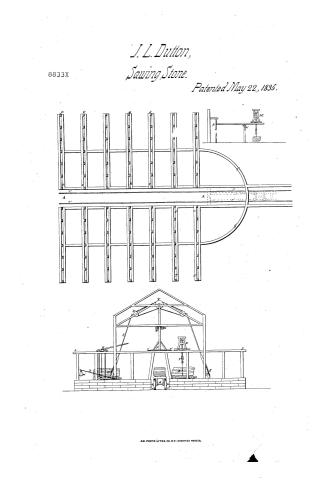
Remarks. This patent is taken for the particular construction of the building in which the sawing is to be effected. In the first place, the floor of the mill is to be raised to such a height from the ground "as to be on a line with the bed of the log or marble teams, by which means most of the expense incurred by unloading, and reloading, is saved." On this elevated floor are placed several short transverse railways, upon which run cars to which the blocks of stone are transferred, immediately from the common teams, and by which they are supported during the operation of sawing. Above the before mentioned railways, the frame work of the building supports other railways upon which also there is a car furnished with a screw, by means of a chain dependent from which, a block of marble may be suspended and transferred to any part of the mill where it may be wanted. A crane is likewise constructed, which sustains a car similar to that last described, for aiding in the transfer of the stone from one part of the building to another. The arm of this crane is supported upon friction wheels, running upon a suitable curved way, erected for that purpose. "I claim an exclusive right to the raising of the mill floor, as above described. The traversing car. The application of the upper car to saw mills. The crane whether applied to saw mills, or for any other purpose; and the regulating spring of the saw slides." We think that the foregoing claim is very susceptible of improvement. The mere raising of the floor, for the purpose pointed out, we do not think new in saw mills, for we err greatly if we have not seen, in Philadelphia itself, a mill, for sawing mahogany, with the floor so raised " as to be on a line with the bed of the log" carriage. Nothing is said about any novelty in the traversing car which is to receive the stone, nor do the upper cars differ from such as have been used for raising and transferring loads, for other purposes. The crane is claimed, "whether applied to saw mills, or for other purposes," now this assuredly does not mean a crane generally, yet we are not told in what particular this crane differs from others; a thing that should not be left to be inferred, but which ought to have been particularly specified. The fact is that the novelty and utility of the structure consist not so much in the formation of its individual parts, as in the general arrangement and combination of the whole, by which it is adapted to the attainment of the object proposed, and upon this the claim to invention must mainly rest.
Published accounts: journal notice
Notice in the monthly list of patents (listed with a different spelling or date)
Journal of the Franklin Institute, new ser., vol. 16 (1835), p. 71 · View the page
Stone sawing mills. Joseph L. Dutton, city of Philadelphia,
About this record
- Patentee
- DATAMP
- Date
- the Name and Date index of patents, DATAMP, USPTO records
- Invention
- DATAMP
- Listed in
- the Name and Date index of patents, DATAMP, USPTO records, Jim Shaw's X-patent list, the Journal of the Franklin Institute, the Journal of the Franklin Institute, Journal
- Also listed in a contemporary journal or list under a different spelling or date; the record shown follows the standard lists.