

Drawings and documents
USPTO scan
The patent as scanned by the USPTO
-
 Page 1
-
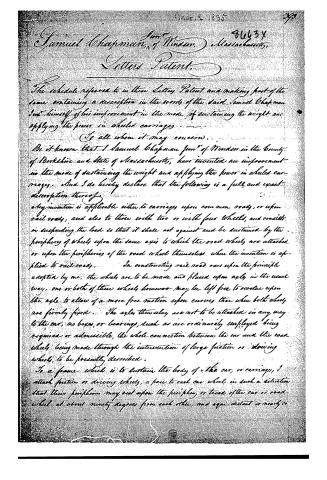 Page 2
-
 Page 3
-
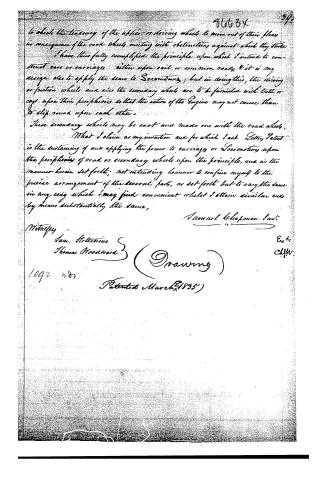 Page 4


U.S. Patent and Trademark Office · Google Patents
Published accounts: journal notice
Notice in the monthly list of patents, with remarks
Journal of the Franklin Institute, new ser., vol. 16 (1835), p. 231 · View the page
6. For a mode of Sustaining the Weight, and Applying the Power, in Wheeled Carriages; Samuel Chapman, Windsor, Berkshire county, Massachusetts, March 2.
Remarks. (See the specification.)
Published accounts: journal notice
Notice in the monthly list of patents, with remarks
Journal of the Franklin Institute, new ser., vol. 16 (1835), p. 257 · View the page
This patent is obtained for some new modifications of the galvanic apparatus, applied to the cure of diseases, several of which have been previously patented by the same gentleman. As the principle of action does not vary essentially from some of which we have given specifications, we deem it unnecessary to give a particular description of these new forms of the instruments employed. SPECIFICATIONS OF AMERICAN PATENTS. Specification of a Patent for an improvement in the Mode of Sustaining the Weight, and Applying the Power, in Wheeled Carriages. Granted to SAMUEL CHAPMAN, Jr., Windsor, Berkshire county, Massachusetts, March 2nd, 1835.
Remarks. To all whom it may concern, be it known, that I, Samuel Chapman, Jr., of Windsor, in the county of Berkshire, and State of Massachusetts, have invented an improvement in the mode of sustaining the weight, and applying the power, in wheeled carriages. And I do hereby declare that the following is a full and exact description thereof. My invention is applicable either to carriages upon common roads, or upon rail-roads; and also to those with two, or with four wheels, and consists in suspending the load so that it shall act against, and be sustained by, the peripheries of wheels upon the same axes to which the road wheels are attached, or, when the invention is applied to rail-roads, upon the peripheries of the road wheels themselves. In constructing rail-road cars upon the principle adopted by me, the wheels are to be made, and placed upon axles, in the usual way; one or both of these wheels, however, may be left free to revolve upon the axle, to allow of a more free motion upon curves than when both wheels are firmly fixed. The axles themselves are not to be attached in any way to the car, no boxes, or bearings, such as are ordinarily employed, being required, or admissible; the whole connexion between the car and the road wheels being made through the intervention of large friction, or driving, wheels, to be presently described. To a frame which is to sustain the body of the car, or carriage, I attach friction, or driving, wheels, a pair to each car wheel, in such a situation that their peripheries may rest upon the periphery, or tread, of the car or road wheel, at about ninety degrees from each VOL. XVI.-No. 4. - ОстоBER, 1835. 33 CHAPMAN'S Improvement in Wheeled Carriages. other, and equidistant, or nearly so, from the apex of the car wheel. The faces of these friction, or driving, wheels, are to be adapted to those of the car wheels, and they may, if found necessary, be furnished with flanches similar to them, and embracing their unflanched sides. It is manifest that, in a car thus constructed, the whole weight thereof, with its load, will rest upon the upper part of the peripheries of the road wheels, their axles serving no other purpose than to keep each pair of wheels in their proper positions, as related to each other. In applying the same principles to carriages on common roads, it will not be proper to allow the faces of the friction, or driving, wheels, to run in contact with the road wheels; but in this case I fix secondary wheels upon the same hubs with the road wheels, and, usually, at a small distance within them. These secondary wheels must be so much smaller in diameter than the road wheels, as may be necessary to keep them free from the dirt and obstructions upon the road. They have, in general, flanches rising from each of their sides, above their faces, so as to form a groove, to receive, and check the lateral motion of, the friction, or driving, wheels, which are to rest upon them; they revolve on gudgeons affixed to the frame work of the carriage, and transferring the bearing of the load on to the peripheries of these secondary wheels, which being firmly fixed on the same hubs on which the road wheels are placed, produce the same effect as though they actually rested upon the road wheels, abating the difference in their diameters. In a four wheeled carriage, which must be made capable of turning abrupt curves, the frame work which sustains the friction or driving wheels of the fore and the hind wheels must be detached from each other, allowing them to play upon a perch in the common manner, or in any other which will admit of the same effect being produced. In order to keep the wheels in their places upon common roads, where they are liable to sudden jolts, I place two smaller friction wheels upon the frame work of the carriage, at situations diametrically opposite, or nearly so, to the friction, or driving, wheels. These friction wheels need not be more than five or six inches in diameter, as, although they are near to, they do not actually touch, the faces of the secondary wheels, unless they are brought into contact to check the tendency of the upper, or driving, wheels, to move out of their places in consequence of the road wheels meeting with obstructions, against which they strike. I have thus fully exemplified the principle upon which I intend to construct cars, or carriages, either upon rail, or common, roads; and it is my design, also, to apply the same to locomotives; but in doing this, the driving, or friction wheels, and also the secondary wheels, are to be furnished with teeth, or cogs, upon their peripheries, so that the action of the engine may cause them to slip round upon each other. These secondary wheels may be cast, and made one with the road wheels. What I claim as my invention, and for which I ask letters patent, is the sustaining of, and applying the power to, cars, carriages, or locomotives, upon the peripheries of road, or secondary wheels, upon the principle, and in the manner, herein set forth; not intending, however, to confine myself to the precise arrangement of the several parts as set forth, but to vary the same in any way which I may find convenient, whilst I attain similar ends by means substantially the same, A, rail. B, car wheel. CC, frame of the carriage. D, driving wheels. E, friction wheels. SAMUEL CHAPMAN, Jr.
About this record
- Patentee
- DATAMP
- Date
- the Name and Date index of patents, DATAMP, USPTO records
- Invention
- DATAMP
- Listed in
- the Name and Date index of patents, DATAMP, USPTO records, Jim Shaw's X-patent list, the Journal of the Franklin Institute, Burke's List of Patents (1847)
- in_burke