

Drawings and documents
USPTO scan
The patent as scanned by the USPTO
-
 Page 1
-
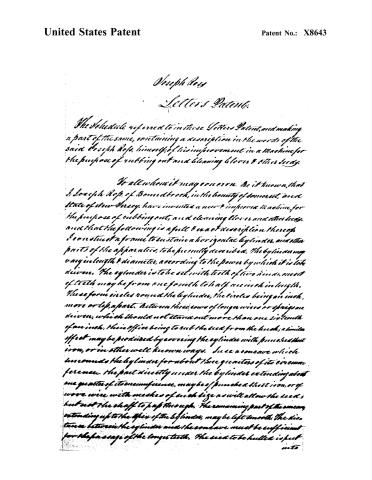 Page 2
-
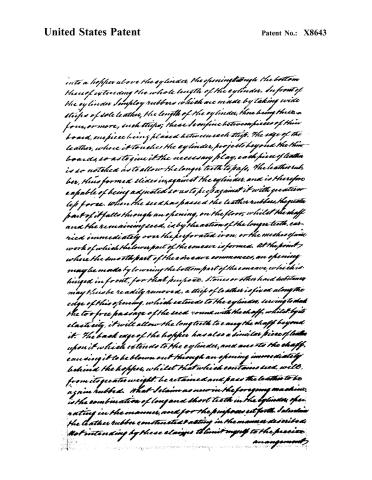 Page 3
-
 Page 4
-
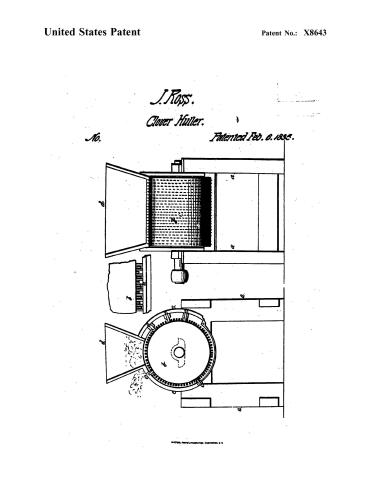 Page 5


U.S. Patent and Trademark Office · Google Patents
Published accounts: journal notice
Notice in the monthly list of patents, with remarks
Journal of the Franklin Institute, new ser., vol. 16 (1835), p. 158 · View the page
4. For a Thrashing Machine; Joseph Ross, Boundbrook, Somerset county, New Jersey, February 6.
Remarks. (See the specification.)
Published accounts: journal notice
Notice in the monthly list of patents, with remarks
Journal of the Franklin Institute, new ser., vol. 16 (1835), p. 171 · View the page
Movable letters, or types, are to be fixed in a stock, or case, much in the manner of those for marking linen, but a lip, or projection, is to be formed on the type, to prevent their falling out of the stock, when partially loose. "The whole claimed as our invention, and to be used either cold or hot for the purposes of branding, stamping, marking, labeling, printing, &c., with letters, figures, characters, &c." May the book-binders, &c., use their movable types, as they have heretofore been in the habit of doing? Perhaps so, as there is no lip to keep them from falling out of the stock, or case. SPECIFICATIONs of American Patents. Specification of a Patent for a Machine for Thrashing Grain, Granted to JOSEPH Ross, of Boundbrook, Somerset county, New Jersey, February 6th, 1835.
Remarks. To all whom it may concern, be it known, that I, Joseph Ross, of Boundbrook, in the county of Somerset, and State of New Jersey, did, on the 12th day of April, 1833, obtain letters patent of the United States, for a machine for shelling corn, and that I have since discovered that, by certain improvements, or variations therein, I can adapt the same to the thrashing of grain. My said improvement, however, being capable of being used as a thrashing machine, by applying the cylindrical body and concave herein described to any suitable frame, other than that used with my shelling machine; the only motive for combining the two being the saving of expense. I make that part which is usually denominated the cylinder in thrashing machines, smaller in the middle than at the two ends, so that, instead of being a cylinder, it is, in fact, formed by the union of two truncated cones, at their smaller ends. The difference of diameter between the middle and ends may be about one inch; I prefer not to make the difference greater, as I can then use a concave, which is straight longitudinally, whilst, if the cylindrical part was made much smaller in the middle, it would be necessary to make the concave conform thereto, by giving it a rise in the centre; but I usually make the teeth driven into the cylinder to vary in length, so that their outer ends will, in revolving, pass each at the same distance from the concave. I drive teeth into the cylindrical body, which teeth project from an inch to an inch and a half, and also drive similar teeth into the concave; these teeth may be of square three-eighths iron. I do not drive them straight, but incline them in both, in such a way as shall tend to prevent their breaking the straw, their slope separating them readily therefrom. I usually cover the cylinder and concave with sheet iron, as this tends to render them the more durable.
About this record
- Patentee
- DATAMP
- Date
- DATAMP
- Invention
- DATAMP
- Listed in
- the Name and Date index of patents, DATAMP, USPTO records, Jim Shaw's X-patent list, the Journal of the Franklin Institute, Burke's List of Patents (1847)
- The sources give different dates; the date shown is the one most of them agree on.
- The date conflict was settled by Burke's 1847 list.
- The Franklin Institute's journal confirms the date shown.
- in_burke
- burke_date_differs