

Drawings and documents
National Archives restored drawings: drawing
Nathan Robinson's Patent Drawing for a Plough

National Archives, Restored Patent Drawings (Record Group 241) · Full-size scan at the National Archives · Catalog record
Text on the drawing
Words on the drawing as machine-read by the National Archives; not checked. Useful mainly for searching.
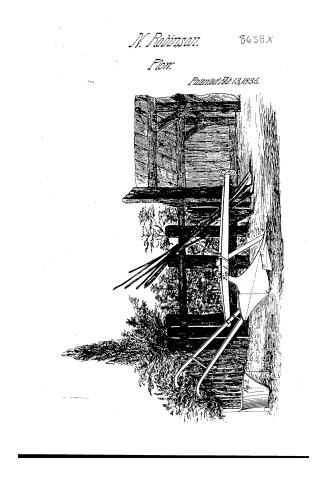
Entered / 91. PLOWS. / [114] Plow / NATHAN . ROBINSON / CLASSIF / PLOUGH / Patented 13 Teby 1835. / 86382 / DIVISION. / DO / Refirences. Fig. 1. From A to B 47 inches. From A to c 30 inches. From C to D 13 inches. Fig.2. From E to F Hyinches.- From F to G 7/2 inches overjet. / Patent Office the 3 of 3d April 1834 / Top hose190 ge Vol 23=1835 / Made under the direction of the Commifsioner / Thin flattred / of Patents in conformity with act of 3rd march 1837 / Commifsioner of Fatents
USPTO scan
The patent as scanned by the USPTO
-
 Page 1
-
 Page 2
-
 Page 3


U.S. Patent and Trademark Office · Google Patents
Published accounts: specification
Specification printed in the Journal of the Franklin Institute
Journal of the Franklin Institute, new ser., vol. 16 (1835), p. 177 · View the page
Text of the specification as printed in the Journal, from OCR; not proofread.
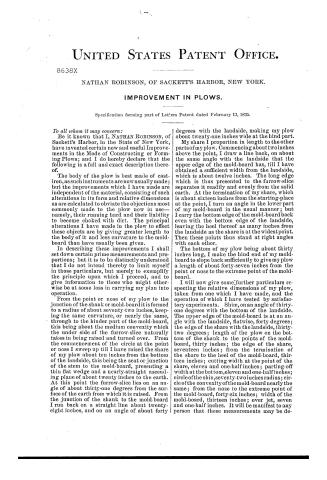
Specification of a Patent for an improved Plough. Granted to NATHAN ROBINSON, Sackett's Harbor, Jefferson county, New York, February 13th, 1835. To all whom it may concern, be it known, that I, Nathan Robinson, of Sackett's Harbour, Jefferson county, in the State of New York, have invented certain new and useful improvements in the VOL. XVI. No. 3.-SEPTEMBER, 1835. 23 ROBINSON'S Improved Plough. mode of constructing, or forming, the plough, and that the following is a full and exact description thereof. The body of the plough is best made of cast-iron, as such instruments are now usually made, but the improvements which I have made are independent of the material, consisting of such alterations in its form and relative dimensions, as are calculated to obviate the objections most commonly made to the ploughs now in use, namely, their running hard, and their liability to become choked with dirt. The principal alterations I have made in the plough, to effect these objects, are by giving greater length to the body of it, and less curvature to the mould board, than have usually been given. In describing these improvements, I shall set down certain precise measurements and proportions; but it is to be distinctly understood that I do not intend thereby to limit myself in these particulars, but merely to exemplify the principle upon which I proceed, and to give information to those who might otherwise be at some loss in carrying my plan into operation. From the point, or nose, of my plough, to the junction of the shank and mould board, it is formed to a radius of about seventy-two inches, keeping the same curvature, or nearly the same, through to the hinder part of the mould board, this being about the medium convexity which the under side of the furrow slice naturally takes in being raised and turned over. From the commencement of the circle at the point, or nose, I sweep up till I have raised the share of my plough about ten inches from the bottom of the land side, this being the seat, or junction, of the stem to the mould board; presenting a thin, flat wedge, and a nearly straight ascending plane, of about twenty inches, to the earth. At this point the furrow slice lies on an angle of 31° from the surface of the earth from which it is raised. From the junction of the shank to the mould board, I run back on a straight line about twenty-eight inches, and on an angle of about 40° with the land side, making my plough about twenty-one inches wide at the hind part. My share I proportion in length to the other parts of my plough; commencing about two inches above the point, I draw a line back on about the same angle with the land side that the upper edge of the mould board has, till I have obtained a sufficient width from the land side, which is about twelve inches. The long edge, which is thus presented to the furrow slice, separates it readily and evenly from the solid earth. At the termination of my share, which is about sixteen inches from the starting place, at the point, I turn an angle in the lower part of my mould board, in the usual manner; but I carry the bottom edge of the mould board back even with the bottom edge of the land side, leaving the heel thereof as many inches from the land side as the share is at the widest point; these three points then stand at right angles with each other. The bottom of my plough being about thirty inches long, I make the hind end of my mould board to slope back sufficiently to give to my plough a length of about forty-seven inches from the point, or nose, to the extreme point of the mould board. I will now give some further particulars respecting the relative WING'S Mill Bush, or Spindle Box. dimensions of my plough, taken from one which I have made, and the operation of which I have tested by satisfactory experiments. Share on an angle of 31° with the bottom of the land side; the upper edge of the mould board is at an angle with the land side flatwise, 40°; the edge of the share with the land side, 32°; length of the plough on the bottom of the shank to the point of the mould board, 30 inches; the edge of the share, 17 inches; from the termination of the share to the heel of the mould board, 13 inches; cutting width at the point of the share, 11½ inches; parting off width on the bottom, 11 inches; circle of the shin, 72 inches radius; circle of the concavity of the mould board, nearly the same; from the nose to the extreme point of the mould board, 46 inches; width of the mould board, 13 inches; overjet, 7 inches. It will be manifest to any person that these measurements may be departed from, to a certain extent, without thereby essentially altering the character of my plough; and it will also be evident to those who are acquainted with the construction of ploughs in general, that the form which I have given to mine, by proportioning the different parts to each other, is such as impresses upon it a character by which it will be readily distinguished from others. What I claim, therefore, as my invention, is a plough formed upon the principles, or in the manner, herein set forth, by which it is made to run more easily and cleanly than those now in use. NATHAN ROBINSON.
Published accounts: journal notice
Notice in the monthly list of patents, with remarks
Journal of the Franklin Institute, new ser., vol. 16 (1835), p. 162 · View the page
16. For a Plough; Nathan Robinson, Sackett's Harbor, Jefferson county, New York, February 13.
Remarks. (See the specification.)
Published accounts: journal notice
Notice in the monthly list of patents, with remarks
Journal of the Franklin Institute, new ser., vol. 16 (1835), p. 177 · View the page
The principle on which this instrument operates, is that of the wheel and axle, the moving power being applied in such a direction by means of the position of the gudgeons, or axis of the machine, (as the gudgeons together may be termed,) as to cause the machine, whenever, in its sliding movement, it meets an impediment, to revolve at once upon its axis, thus surmounting the impediment by rolling over it. A mass of hay, or grain, collected upon, and forward of, the teeth, forms such an impediment; so that, in general, when the rake is thus loaded, and the tender wishes to drop the load, all he has to do is to let go his hold of the handle, and, the horse still going on, the rake instantly revolves, thus discharging its load, and at once resuming its position again, to collect another. In case the mass of hay, or grain, collected on and before the teeth, be very heavy, and the tender wishes to move it some distance before he drops it, to prevent the rake from revolving, and thus discharging the load sooner than he wishes, it will sometimes be necessary for him to throw his own weight, or some part of it, on the back part of the rake, by stepping with one foot, or both, upon the head piece. A little practise on the part of the tender, renders the management of the rake, in all its uses, very easy. NOAH BRIGGS. Specification of a Patent for an improved Plough. Granted to NATHAN ROBINSON, Sackett's Harbor, Jefferson county, New York, February 13th, 1835.
Remarks. To all whom it may concern, be it known, that I, Nathan Robinson, of Sackett's Harbour, Jefferson county, in the State of New York, have invented certain new and useful improvements in the VOL. XVI. No. 3.-SEPTEMBER, 1835. 23 ROBINSON'S Improved Plough. mode of constructing, or forming, the plough, and that the following is a full and exact description thereof. The body of the plough is best made of cast-iron, as such instruments are now usually made, but the improvements which I have made are independent of the material, consisting of such alterations in its form and relative dimensions, as are calculated to obviate the objections most commonly made to the ploughs now in use, namely, their running hard, and their liability to become choked with dirt. The principal alterations I have made in the plough, to effect these objects, are by giving greater length to the body of it, and less curvature to the mould board, than have usually been given. In describing these improvements, I shall set down certain precise measurements and proportions; but it is to be distinctly understood that I do not intend thereby to limit myself in these particulars, but merely to exemplify the principle upon which I proceed, and to give information to those who might otherwise be at some loss in carrying my plan into operation. From the point, or nose, of my plough, to the junction of the shank and mould board, it is formed to a radius of about seventy-two inches, keeping the same curvature, or nearly the same, through to the hinder part of the mould board, this being about the medium convexity which the under side of the furrow slice naturally takes in being raised and turned over. From the commencement of the circle at the point, or nose, I sweep up till I have raised the share of my plough about ten inches from the bottom of the land side, this being the seat, or junction, of the stem to the mould board; presenting a thin, flat wedge, and a nearly straight ascending plane, of about twenty inches, to the earth. At this point the furrow slice lies on an angle of 31° from the surface of the earth from which it is raised. From the junction of the shank to the mould board, I run back on a straight line about twenty-eight inches, and on an angle of about 40° with the land side, making my plough about twenty-one inches wide at the hind part. My share I proportion in length to the other parts of my plough; commencing about two inches above the point, I draw a line back on about the same angle with the land side that the upper edge of the mould board has, till I have obtained a sufficient width from the land side, which is about twelve inches. The long edge, which is thus presented to the furrow slice, separates it readily and evenly from the solid earth. At the termination of my share, which is about sixteen inches from the starting place, at the point, I turn an angle in the lower part of my mould board, in the usual manner; but I carry the bottom edge of the mould board back even with the bottom edge of the land side, leaving the heel thereof as many inches from the land side as the share is at the widest point; these three points then stand at right angles with each other. The bottom of my plough being about thirty inches long, I make the hind end of my mould board to slope back sufficiently to give to my plough a length of about forty-seven inches from the point, or nose, to the extreme point of the mould board. I will now give some further particulars respecting the relative WING'S Mill Bush, or Spindle Box. dimensions of my plough, taken from one which I have made, and the operation of which I have tested by satisfactory experiments. Share on an angle of 31° with the bottom of the land side; the upper edge of the mould board is at an angle with the land side flatwise, 40°; the edge of the share with the land side, 32°; length of the plough on the bottom of the shank to the point of the mould board, 30 inches; the edge of the share, 17 inches; from the termination of the share to the heel of the mould board, 13 inches; cutting width at the point of the share, 11½ inches; parting off width on the bottom, 11 inches; circle of the shin, 72 inches radius; circle of the concavity of the mould board, nearly the same; from the nose to the extreme point of the mould board, 46 inches; width of the mould board, 13 inches; overjet, 7 inches. It will be manifest to any person that these measurements may be departed from, to a certain extent, without thereby essentially altering the character of my plough; and it will also be evident to those who are acquainted with the construction of ploughs in general, that the form which I have given to mine, by proportioning the different parts to each other, is such as impresses upon it a character by which it will be readily distinguished from others. What I claim, therefore, as my invention, is a plough formed upon the principles, or in the manner, herein set forth, by which it is made to run more easily and cleanly than those now in use. NATHAN ROBINSON.
About this record
- Patentee
- DATAMP
- Date
- the Name and Date index of patents, DATAMP, USPTO records
- Invention
- DATAMP
- Listed in
- the Name and Date index of patents, DATAMP, USPTO records, Jim Shaw's X-patent list, the Journal of the Franklin Institute, Burke's List of Patents (1847)
- in_burke