

Drawings and documents
National Archives restored drawings: drawing
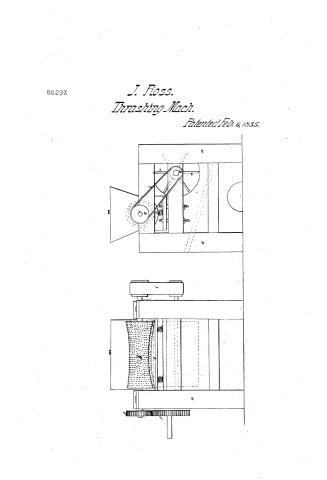
J. Ross' Patent Drawing for a Thrashing Machine


National Archives, Restored Patent Drawings (Record Group 241) · Full-size scan at the National Archives · Catalog record
Text on the drawing
Words on the drawing as machine-read by the National Archives; not checked. Useful mainly for searching.
Sheet 1. 0/2 / 130. THRASHING. / Thrashing Machines. / A. Cylinder Machines. / cyl o / J.ROSS / CLASSIFICATION / Thrashing Mach / 8629-X / Patented b-Feb 1835 / DIVISION. / TIZ / 772 / a Frame b. C. Bed e whirl f cog wheel 9. whirl of Fan Z' Z Band / Patent Office Net 31 1842 / me Hopeper 77 Firm / Made under the Inction of the commissioner / of Patents in conformity with act of 3 March 1837- / Strickland Del. / ML Ellmonth / Commessioner of Patents
Sheet 2. 130. [159] Clover THRASHING. Hullers. Houlling / of / Vol 23 / $2 _ - / CEASSIFICATION / Patented 6" Feb"1835 / 8.629 / J.ROSS / DIVISION. / a France / Clover Mach' / b. Cylinder / C. concaves / d. Hopper / e. Rubbers / THE I / ОНОРОДОРО / Patent office 1842 / Made under the direction of the Commissions / Strickland Del / of Patel in conformity with achg 5. March 1837- / mL Sundorth / Commissioner of Paterts
USPTO scan
The patent as scanned by the USPTO
-
 Page 1
-
 Page 2
-
 Page 3


U.S. Patent and Trademark Office · Google Patents
Published accounts: specification
Specification printed in the Journal of the Franklin Institute
Journal of the Franklin Institute, new ser., vol. 16 (1835), p. 172 · View the page
Text of the specification as printed in the Journal, from OCR; not proofread.
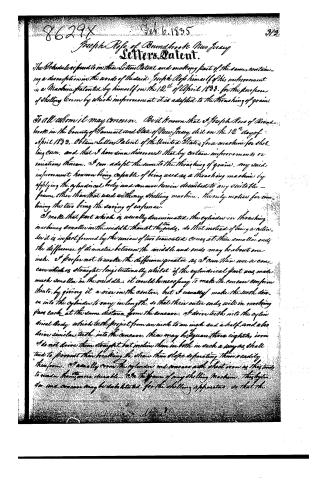
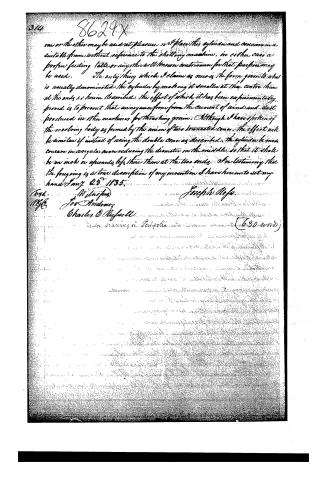
Specification of a Patent for a Machine for Thrashing Grain, Granted to JOSEPH Ross, of Boundbrook, Somerset county, New Jersey, February 6th, 1835. To all whom it may concern, be it known, that I, Joseph Ross, of Boundbrook, in the county of Somerset, and State of New Jersey, did, on the 12th day of April, 1833, obtain letters patent of the United States, for a machine for shelling corn, and that I have since discovered that, by certain improvements, or variations therein, I can adapt the same to the thrashing of grain. My said improvement, however, being capable of being used as a thrashing machine, by applying the cylindrical body and concave herein described to any suitable frame, other than that used with my shelling machine; the only motive for combining the two being the saving of expense. I make that part which is usually denominated the cylinder in thrashing machines, smaller in the middle than at the two ends, so that, instead of being a cylinder, it is, in fact, formed by the union of two truncated cones, at their smaller ends. The difference of diameter between the middle and ends may be about one inch; I prefer not to make the difference greater, as I can then use a concave, which is straight longitudinally, whilst, if the cylindrical part was made much smaller in the middle, it would be necessary to make the concave conform thereto, by giving it a rise in the centre; but I usually make the teeth driven into the cylinder to vary in length, so that their outer ends will, in revolving, pass each at the same distance from the concave. I drive teeth into the cylindrical body, which teeth project from an inch to an inch and a half, and also drive similar teeth into the concave; these teeth may be of square three-eighths iron. I do not drive them straight, but incline them in both, in such a way as shall tend to prevent their breaking the straw, their slope separating them readily therefrom. I usually cover the cylinder and concave with sheet iron, as this tends to render them the more durable. In the frame of my shelling machine, this cylinder and concave may be substituted for the shelling apparatus, so that the one or the other may be used at pleasure; or I place this cylinder and concave in a suitable frame, without reference to the shelling machine; in either case, a proper feeding table, or any other well known contrivance for that purpose, may be used. The only thing which I claim as new, is the form given to what is usually denominated the cylinder, by making it smaller at the centre than at the ends, as herein described, the effect of which, it has been experimentally proved, is to prevent that annoyance from the current of wind and dust, produced in other machines for thrashing grain. Although I have spoken of the revolving body as formed by the union of two truncated cones, the effect will be similar if, instead of Ross' Machine for Cleaning Clover, &c. using the double cone, as described, the cylinder be made concave, in a regular curve, reducing its diameter in the middle, so that it shall be an inch, or upwards, less there than at the two ends. JOSEPH ROSSs,
Published accounts: specification
Specification printed in the Journal of the Franklin Institute
Journal of the Franklin Institute, new ser., vol. 16 (1835), p. 173 · View the page
Text of the specification as printed in the Journal, from OCR; not proofread.
Specification of a Patent for a Machine for Cleaning Clover, and other Seeds. Granted to JOSEPH Ross, Boundbrook, Somerset county, New Jersey, February 6th, 1835. To all whom it may concern, be it known, that I, Joseph Ross, of Boundbrook, in the county of Somerset, and State of New Jersey, have invented a new and improved machine for the purpose of rubbing out and cleaning clover, and other seeds, and that the following is a full and exact description thereof. I construct a frame to sustain a horizontal cylinder, and other parts of the apparatus, to be presently described. The cylinder may vary in length and diameter, according to the power by which it is to be driven. The cylinder is to be set with teeth of two kinds; one set of teeth may be from one-fourth to half an inch in length. These form circles round the cylinder, the circles being an inch, more or less, apart. Between these, rows of longer teeth, wires, or sprigs, are driven, which should not stand out more than one-sixteenth of an inch, their office being to rub the seed from the husk; a similar effect may be produced by covering the cylinder with punched sheet iron, or in other well known ways. I use a concave which surrounds the cylinder for about threequarters of its circumferencc. The part directly under the cylinder, extending about one-quarter of its circumference, may be of punched sheet iron, or of wove wire, with meshes of such size as will allow the seed, but not the chaff, to pass through. The remaining part of the concave, extending up to the apex of the cylinders, may be left smooth. The distance between the cylinder and the concave must be sufficient for the passage of the larger teeth. The seed to be hulled is put into a hopper above the cylinder, the opening through the bottom thereof extending the whole length of the cylinder. In front of the cylinder I employ rubbers, which are made by taking wide strips of sole leather, the length of the cylinder, there being three, four, or more, such strips; these I confine between pieces of thin board, one piece being placed between each strip. The edge of the leather, where it touches the cylinder, projects beyond the thin boards, so as to give it the necessary play; each piece of leather is so notched as to allow the longer teeth to pass. The leather rubber, thus formed, slides in against the cylinder, and is, therefore, capable of being adjusted so as to press against it with greater, or less, force. When the seed has passed the leather rubbers, the greater part of it falls through an opening on to the floor, whilst the chaff and the remaining seed, are, by the action of the longer teeth, carried imme PORTER'S Cheese Press. diately over the perforated iron, or the meshes of wire work, of which the lower part of the concave is formed. At the point where the smooth part of the concave commences, an opening may be made by lowering the bottom part of the concave, which is hinged in front for that purpose. Stones, or other hard substances, may be thus readily removed. A strip of leather is fixed along the edge of this opening, which extends to the cylinder, serving to check the too free passage of the seed round with the chaff, whilst, by its elasticity, it will allow the long teeth to carry the chaff beyond it. The back edge of the hopper has also a similar piece of leather upon it, which extends to the cylinder, and arrests the chaff, causing it to be blown out through an opening immediately behind the hopper, whilst that which contains seed, will, from its greater weight, be retained, and pass the leather, to be again rubbed. What I claim as new in the foregoing machine, is the combination of long and short teeth in the cylinder, operating in the manner, and for the purposes, set forth. I also claim the leather rubber, constructed and acting in the manner described; not intending, by these claims, to limit myself to the precise arrangement set forth, but to vary the same in any way, whilst I produce the same effects by machinery operating substantially upon the same principle. JOSEPH ROSS.
Published accounts: journal notice
Notice in the monthly list of patents, with remarks
Journal of the Franklin Institute, new ser., vol. 16 (1835), p. 158 · View the page
5. For a machine for Hulling Clover; Joseph Ross, Boundbrook, Somerset county, New Jersey, February 6.
Remarks. (See the specification.)
Published accounts: journal notice
Notice in the monthly list of patents, with remarks
Journal of the Franklin Institute, new ser., vol. 16 (1835), p. 172 · View the page
In the frame of my shelling machine, this cylinder and concave may be substituted for the shelling apparatus, so that the one or the other may be used at pleasure; or I place this cylinder and concave in a suitable frame, without reference to the shelling machine; in either case, a proper feeding table, or any other well known contrivance for that purpose, may be used. The only thing which I claim as new, is the form given to what is usually denominated the cylinder, by making it smaller at the centre than at the ends, as herein described, the effect of which, it has been experimentally proved, is to prevent that annoyance from the current of wind and dust, produced in other machines for thrashing grain. Although I have spoken of the revolving body as formed by the union of two truncated cones, the effect will be similar if, instead of Ross' Machine for Cleaning Clover, &c. using the double cone, as described, the cylinder be made concave, in a regular curve, reducing its diameter in the middle, so that it shall be an inch, or upwards, less there than at the two ends. JOSEPH ROSSs, Specification of a Patent for a Machine for Cleaning Clover, and other Seeds. Granted to JOSEPH Ross, Boundbrook, Somerset county, New Jersey, February 6th, 1835.
Remarks. To all whom it may concern, be it known, that I, Joseph Ross, of Boundbrook, in the county of Somerset, and State of New Jersey, have invented a new and improved machine for the purpose of rubbing out and cleaning clover, and other seeds, and that the following is a full and exact description thereof. I construct a frame to sustain a horizontal cylinder, and other parts of the apparatus, to be presently described. The cylinder may vary in length and diameter, according to the power by which it is to be driven. The cylinder is to be set with teeth of two kinds; one set of teeth may be from one-fourth to half an inch in length. These form circles round the cylinder, the circles being an inch, more or less, apart. Between these, rows of longer teeth, wires, or sprigs, are driven, which should not stand out more than one-sixteenth of an inch, their office being to rub the seed from the husk; a similar effect may be produced by covering the cylinder with punched sheet iron, or in other well known ways. I use a concave which surrounds the cylinder for about threequarters of its circumferencc. The part directly under the cylinder, extending about one-quarter of its circumference, may be of punched sheet iron, or of wove wire, with meshes of such size as will allow the seed, but not the chaff, to pass through. The remaining part of the concave, extending up to the apex of the cylinders, may be left smooth. The distance between the cylinder and the concave must be sufficient for the passage of the larger teeth. The seed to be hulled is put into a hopper above the cylinder, the opening through the bottom thereof extending the whole length of the cylinder. In front of the cylinder I employ rubbers, which are made by taking wide strips of sole leather, the length of the cylinder, there being three, four, or more, such strips; these I confine between pieces of thin board, one piece being placed between each strip. The edge of the leather, where it touches the cylinder, projects beyond the thin boards, so as to give it the necessary play; each piece of leather is so notched as to allow the longer teeth to pass. The leather rubber, thus formed, slides in against the cylinder, and is, therefore, capable of being adjusted so as to press against it with greater, or less, force. When the seed has passed the leather rubbers, the greater part of it falls through an opening on to the floor, whilst the chaff and the remaining seed, are, by the action of the longer teeth, carried imme PORTER'S Cheese Press. diately over the perforated iron, or the meshes of wire work, of which the lower part of the concave is formed. At the point where the smooth part of the concave commences, an opening may be made by lowering the bottom part of the concave, which is hinged in front for that purpose. Stones, or other hard substances, may be thus readily removed. A strip of leather is fixed along the edge of this opening, which extends to the cylinder, serving to check the too free passage of the seed round with the chaff, whilst, by its elasticity, it will allow the long teeth to carry the chaff beyond it. The back edge of the hopper has also a similar piece of leather upon it, which extends to the cylinder, and arrests the chaff, causing it to be blown out through an opening immediately behind the hopper, whilst that which contains seed, will, from its greater weight, be retained, and pass the leather, to be again rubbed.
Published accounts: journal notice
Notice in the monthly list of patents, with remarks
Journal of the Franklin Institute, new ser., vol. 16 (1835), p. 174 · View the page
What I claim as new in the foregoing machine, is the combination of long and short teeth in the cylinder, operating in the manner, and for the purposes, set forth. I also claim the leather rubber, constructed and acting in the manner described; not intending, by these claims, to limit myself to the precise arrangement set forth, but to vary the same in any way, whilst I produce the same effects by machinery operating substantially upon the same principle. JOSEPH ROSS. Specification of a Patent for a Self-adjusting Cheese Press. Granted to RUFUS PORTER, Belerica, Middlesex county, Massachusetts, February 6th, 1835.
Remarks. Two posts, five feet long, four inches wide, and two inches thick, are placed parallel to each other, two feet apart, and having a cap piece across the top; and two pieces of plank, twenty-eight inches long, and six inches wide, are nailed to the bottoms, crossing from one to the other; and two other pieces, eighteen inches long, are nailed to each post, crossing at right angles with the first, and by which the posts are supported in an upright position; two planks, one of them ten, and the other six inches wide, extend horizontally from one post to the other, and constitute the bed and follower of the press. These are not attached to the posts, but the ends of the bed plank are attached by tenons, or nails, to four vertical sliding guides, two at each end, one of which is placed on each side of each post. These sliding guides are sixteen inches long, extending two inches below, and twelve inches above, the plank, which is also further supported by two cleats, one of which passes beneath each end of the plank, and is secured to the guides. A small shaft, having a gudgeon on pivots at each end, and a pulley three inches in diameter near each end, extends from one cleat to the other, under the centre of the plank. The ends of the follower plank, which is placed about six inches above the bed plank, are attached to two vertical, sliding planks, which are ten inches long, and four inches wide; being guided, or kept in place, by the four sliding guides, the two pairs of PORTER'S Cheese Press. which are an inch less distant than the two posts. Another shaft crosses above the follower, having gudgeons, or pivots, which enter the sliding planks. This shaft has a pulley, or grooved wheel, on its centre, of nine inches diameter, a groove at each end, of two inches diameter, and other two grooves, near the first, of three inches diameter. Two small ropes are made fast to the shaft within the two small grooves, and proceed thence downward through both planks, under the pulleys, and thence upward to the larger grooves, passing twice round the shaft, and are then made fast. Another cord extends from the cap piece downward, twice round the large pulley, thence upward over a small pulley which is attached to the cap, the end of the cord being at liberty. By this cord, the press planks, &c. are drawn upward, by which process the ropes are given off from the larger grooves, and are taken up by the smaller; the planks are thus permitted to separate, and a cheese may be placed between them, when, if permitted to descend, the press planks will approach each other, and produce a pressure equal to eighteen times the weight of the cheese to be thus pressed. Front view of R. Porter's Cheese Press. A A, posts. В, сар. C, small pulley. D, bottom cross planks, or A C B sills. E, bed plank. F, follower. G G, sliding guides. H, small shaft. I I I I, sliding planks. J, large shaft. J K K, large pulley, or groove wheel. G G F L L, ends of the cross planks.
About this record
- Patentee
- DATAMP
- Date
- the Name and Date index of patents, DATAMP, USPTO records
- Invention
- DATAMP
- Listed in
- the Name and Date index of patents, DATAMP, USPTO records, Jim Shaw's X-patent list, the Journal of the Franklin Institute, Burke's List of Patents (1847)
- in_burke