

Drawings and documents
National Archives restored drawings: drawing
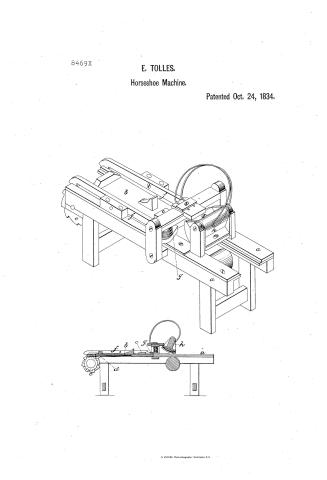
Elisha Tolles' Patent Drawing for a Machine for Making Horse Shoes

National Archives, Restored Patent Drawings (Record Group 241) · Full-size scan at the National Archives · Catalog record
Text on the drawing
Words on the drawing as machine-read by the National Archives; not checked. Useful mainly for searching.
59. Chains, Staples and Horseshoes. / Herseshoe-Machines. / Su volt p118. / 250 Elisha Tolles making horse shoes dated 24 Oct 1834 / CLASSIFICATION / 118 / 8469- X / DI ISION / The bars are alternately fed from the reghtand left sed es, / II / Certain pout, bent around the former by arms rotating / cut off by knipes, carried forward by slide agamet former to a / on find centres gg and then moved forward and forms içi white / virating swage he which creases, punches / face of choe - / Reference / a Parrallel cheeks / b. Sliding piece / c Former / d Catch or rack / e Cams / Shears / 2. / Segment This / Sogment dies for stamping
USPTO scan
The patent as scanned by the USPTO
-
 Page 1
-
 Page 2


U.S. Patent and Trademark Office · Google Patents
Published accounts: specification
Specification printed in the Journal of the Franklin Institute
Journal of the Franklin Institute, new ser., vol. 15 (1835), p. 339 · View the page
Text of the specification as printed in the Journal, from OCR; not proofread.
Specification of a patent for a machine for making or turning Horse Shoes. Granted to ELISHA TOLLES, Winchester, Litchfield county, Connecticut, October 24th, 1834. Know all men by these presents, that I, Elisha Tolles, of Winchester, in the county of Litchfield, and state of Connecticut, have invented a new and useful machine for turning or making horse shoes, and that the following is a full and exact description thereof. I make a bench of wood, or iron, or of the two combined, of sufficient strength to support the machinery, and sustain the pressure necessary to the operation to be performed. This bench has two parallel cheeks, placed at a distance of six or eight inches from each other, and of such length as may be necessary, say five or six feet. Between these cheeks, at what I will call the hind end of the machine, a sliding piece works backwards and forwards in grooves, being carried by a pitman attached to any sufficient motive power. This slide forms the bed upon which the piece of iron to form the shoe, is received and sustained, during the whole operation. On the end of this slide, opposite to that to which the pitman is attached, a piece of iron rises, which is to give the form to the inner curve of the shoe. The end of this piece, which first comes into contact with the bar of iron, is rounded, and its sides are straight, the curving in of the hind or corked end of the shoe being given after its delivery from the machine. The bar of iron, of which the shoe is to be formed, being selected of a suitable size, and heated in a forge or furnace, is placed crosswise upon the bench, and just in front of the former on the slide, the latter being retracted. On the under side of the slide, there is a rack, which takes into a toothed wheel, upon a shaft crossing the hind end of the machine; this shaft carries cams, which act upon two levers, serving the purpose of shears to cut off the bar, and of stops to gauge it. When one of these levers is up, the other is down; and as bars are fed alternately from each side of the machine, a bar is passed under the raised end of one lever, and is stopped against the depressed end of the other; the slide then advancing, the raised lever, or shear, is depressed by the action of one of the cams, and the bar is cut off by it, the part of the bed immediately under it, forming the other edge of the shear. The piece thus cut off, is carried forward by the curved end of the slide to be turned, or formed into a shoe, its middle bearing against the beforenamed piece on the slide. At this moment, its two ends come into contact with two segment dies, working horizontally upon strong centres on the bench. The edges of these dies are so formed as to embrace the bar between them and the projecting piece upon the slide, giving the proper width to the shoe, and the proper shape to its outer edge. As the slide advances, the bar to form the shoe is carried under another segmental die, vibrating upon gudgeons between two standards, which rise vertically from the bench. The under side or face of this die, is so formed as to groove, punch, and give the entire shape to the outer surface of the shoe, whilst the bed of the slide upon which it rests, shapes the part which is to come into contact with the hoof. At the moment the slide comes into contact with the last mentioned, or vertical die, teeth upon each edge of the slide engage with corresponding teeth on the die, and they are thus made to act in perfect concert with each other. When the lateral dies act no longer on the bar, they are returned to their places by the action of springs, or weights, and as the slide returns, the hind end of the shoe, touching against them, is pushed off from the bed, and falls through between the cheeks of the bench. The vertical die is kept back against its bearing, so as to engage properly with the slide, by means of a weighted lever, spring, or otherwise. The drawing of this apparatus, deposited in the Patent Office, together with the written references thereunto annexed, will fully illustrate the construction and action of this machinery, and, as I believe, fully complies, in this respect, with the requirements of the patent law. I am aware that rollers, or parts of rollers, forming segment dies, have been used for forging, or giving form to various articles of iron; I do not, therefore, claim these, taken separately, or alone, as of my invention; neither do I claim the cams, slide racks, or any of the other parts which I have described, in their individual characters; but what I do claim, and for which I ask a patent, is the general combination and arrangement of the several parts of this machine, as described, for effecting the purpose set forth, namely, the manufacturing of horse shoes; whether the said machine be constructed exactly in the manner described, or varied in any way which may be found expedient, whilst the general principle remains the same, and a similar result is obtained. ELISHA TOLLES. TRANSLATIONS FROM FOREIGN JOURNALS. On the Use of Anthracite in the Smelting Furnace of Vizille. By M. ROBIN, Director of the Neiderbrunn Works.* (Continued from page 269.) I omit the details of this working, the results of which were uncertain, in order to avoid repetition in speaking of the trials that followed, which, from the experience already had, were conducted with more regularity. After the blowing machine had been repaired, the furnace was again put in blast, Jan. 19, 1828. In order that the accidents which might happen during this new trial, should be attributable to anthracite alone, the charges were regulated so that the quantity of ore was always a little under that which the coal could carry, so as always to produce gray castings; other qualities of casting would indicate a derangement in the furnace. When the trials on the combustible were completed, it would be time enough to ascertain how much ore could be melted. The composition of the charge was scarcely varied during the essays upon this coal; it was composed of nearly two-thirds of the rich, and one-third of the poor, ore, and sometimes, besides, a small quantity of flux, to improve the slag, or scull. The experiment soon showed what composition of slag was most proper to assure the good working of the furnace. Upon this point, no variation from the composition of the slag of the coke furnace could be admitted; 30 to 33 per cent. of lime, 15 to 20 of alumine and magnesia, and of oxide of manganese, the remainder silex, were the principal proportions, from which they could not vary without encountering difficulties. With less than 30 per cent. of lime, the slag was viscous, or slimy, cementing together the ashes of the anthracite, and forming deposites in the hearth, as well as in the boshes. By surpassing this proportion, the excess of lime adhered to the furnace, and melted it; an excess of magnesia gave also a very refractory slag, and in the ore of Halles, could only be exceeded by great care. Instead of putting the furnace in blast with pure coke, it was in• Translated for this Journal, by S. V. Merrick. teresting to know whether this could be done with half coke, and half anthracite; proportions at which the first trials had been stopped. The expense of coke made the success of this experiment of great importance to the establishment, since the coke had to be transported seventy-two miles. They proceeded to put the fire to the furnace as follows, with the precautions employed in the coke furnace, and with care to proportion the blast to the density of the new combustible. The furnace was half filled with coal; during the heating, that which was consumed was replaced successively with charges composed of 600 lbs. of coals, and a like weight of ore; that is, about twothirds the usual full charge. They operated thus during twenty-three days, and made twentytwo runs; at this time the ore arrived at the tuyeres. The blast was given by two opposite tuyeres, with openings, twenty-three lines in diameter; the pressure of the mercury gauge, which was at first very feeble, was soon raised to 20.7 lines: at the end of three days, the charges filled the furnace entirely. This manner of operating produced no satisfactory results; it was impossible to make the furnace work well, after six days of varied attempts. The blast passed through the charge with difficulty; it reacted on the tuyeres, and had much trouble to maintain itself towards the tymp; when it escaped from this part of the furnace, it projected the scoria with force beyond the boshes. The charges descended slowly; the furnace was encumbered with anthracite, in dust, which checked the slag, otherwise scarce, from bathing and heating properly all parts below the boshes. The scoria was, besides, subject to the action of the blast, which reached also the metal, and rendered it so thick that it coagulated against the dam stone, from whence it was removed by pieces. To avoid this last inconvenience, a tuyere was opened opposite the tymp, so as to re-heat the front part of the boshes, and also to assist the ascent of the blast. The pressure was raised gradually to 5 in. 2 lines; but all these efforts were fruitless. The third tuyere was suppressed, as it only had the effect of paralyzing the blast of one of those from the side; the furnace became dark, and the blast often threw out the scoria and small coal. The scoria, generally well fused, became, from time to time, black; the first casting observed was white: on the second day it was mottled, which proved that the furnace worked better; but it soon returned to the first quality, and thus alternated during many days. As only 20 to 22 charges descended during twenty-four hours, the melted material arrived slowly at the boshes. It was only in the sixteenth day after putting on the blast, that a feeble run of white iron was obtained. To be relieved from this state, recourse was had to pure coke, in order that the trials might recommence from this point. It is possible the success would have been better, if the furnace had been filled with coals before putting in the charge, and if they had charged On the Use of Anthracite in Smelting Furnaces. with a little more ore, when the blast was commenced, and in place of roasted mineral, in dust, employed the crude ore in pieces; coke about the tuyeres would have permitted the blast to pass gradually, till it arrived at the ore. In this way all the column of material would have been heated, and the draught facilitated, and by adapting the material to the state of fusion, they would have avoided another difficulty, which they feared; that of destroying the furnace, by pushing it too fast. At the arrival of the coke before the tuyeres, the furnace recovered itself as by enchantment, the draft became excellent, the charges doubled their rapidity; the scoria, perfectly fluid, became white, shaded with blue on the surface, and presented on analysis mere traces of oxide of iron. The first running gave iron mottled, almost gray; the flame at the mouth, which before had been sombre and feeble, mounted suddenly, and acquired a beauty which is one of the characteristics of the coke furnace. In order not to waste the coke, they placed two new mouths to the tuyere, of eighteen lines diameter, blowing with a pressure of four inches one line. In spite of that, they made forty-two charges in twenty-four hours. Soon the first tenth, then the second tenth, of anthracite, added to the coke, was passed; at this time the poor roasted ore was replaced by crude ore; no change was remarked in the working of the furnace. With three-tenths of anthracite, the dust of the anthracite began to show itself, and there was an evident relaxation in the descent of the charges; the blast returned past the tuyere. With half coke and half anthracite, the same phenomena occurred. At this moment, in place of the rich roasted ore, one-half of the same ore unroasted, or crude, was substituted; this alteration made no change towards a more perfect working of the furnace; they had now arrived at the point where the first trials were stopped; the furnace worked as well as with the coke; the scoria did not change for an instant; the castings were very gray, had a fine grain, and a remarkable tenacity. The first three-tenths of anthracite, which had not presented difficulties, were charged very quickly, and in less than thirteen days, one-half had been added. As the matter which was to run down from this period was unknown, they stopped longer to judge of the effect produced by every new proportion of anthracite; six-tenths, however, passed as well as the lower proportions. The working of the furnace was very regular with seven-tenths, but the casting was slightly mottled towards the end of this essay; they succeeded without trouble to bring it back to the gray. The gray pig, at six-tenths and seven-tenths of anthracite, was a gray less deeply marked than that obtained before; the grain close, but less uniform. The moment mottled iron appeared, the scoria became white. During the whole of these essays, this law was constantly remarked 1 in the scoria; that for the gray pig, it was blueish, and for the casting slightly mottled, or mottled gray, of a perfect white; of a clear brown for the casting of Welsh mottled, and deep brown, or black, for the white iron. This last was produced sometimes with scoria, of good colour; then the quality was due to a sort of refining which is received on the hearth, when the blast struck forcibly against the scoria, and reached the naked iron, or rather when the metal became refined by exposure to the blast above the tuyeres, by the too slow descent of the charge. The working of the furnace, which till this time had been regular, changed with eight-tenths anthracite; the dust of the coal, which was already abundant, commenced to clog; the draught became sensibly more variable; the air was returned more forcibly by the tuyeres; the casting became mottled, then white, and having returned to mottle, changed again; the scoria assumed every shadow of colour, even to blue; the material became scarcely red at the furnace mouth, the flame became feeble, and the charges commenced to descend irregularly, often by sudden falls. The furnace was not difficult to manage in this state; but the attempts of every kind, made during nine days, to restore it to a good working order, were fruitless. They then charged with eight-tenths of anthracite, the same phenomena continuing to be manifested, in a still more decided manner. The descent of the charges was extraordinarily slow, the whole iron becoming clammy; their fracture, however, showing some mottled parts. From these trials, it was easy to see that it would be impossible to make the furnace work with nine-tenths, or even eight-tenths, of anthracite; it was, however, decided that the experiments should be pushed to the extreme, in spite of all risks to the furnace; they therefore, during four days, charged with pure anthracite. When it took the place of the mixture, the labour, already so hard, was further augmented. They remarked, but in a more decided manner, the same accidents which occurred when the furnace was put in blast with half anthracite. The draught and flame at the mouth were almost extinct; the blast returned by the tymp, and by the tuyeres, throwing out frequently the scoria, the coal, and even the metal; this became so thick, that they were compelled to draw it out almost entire from the hearth, by blows. It was only by raising the dam, stopping up the tymp with clay, and by making there, for two or three hours, holes which allowed the scoria and iron to run out together, that they were able to obtain some masses of iron, which together weighed a few hundred kilograms only. The casting from the anthracite was of a grayish white, facettes very small, a little radiating; its surface was covered with small bubbles, proceeding from the effervescence which strong iron displays, when submitted to a refining. The fractures frequently showed hollows, which were coated with irised arborescences, like those often seen in native silver. On the Use of Anthracite in Smelting Furnaces. The scoria which accompanied the small runnings of iron were demivitrious, of a yellowish brown colour, and, of course, easily removed. Before the arrival at the tuyeres of the charges, containing seven-tenths of anthracite, which were worked after the pure anthracite, to restore the furnace to action, its situation grew worse, the little holes before spoken of, could not be continued a long time, because the half refined iron attached itself to the walls, and, in a great measure, choked the furnace. The progress of this new evil was arrested by making a hole as low as possible, by which the melted matters were allowed to run out during certain hours; from time to time these openings were closed, to maintain the heat in the upper part of the furnace. On the arrival of the new charges below, the furnace soon recovered itself; but to get rid of the choking, they were obliged to return to pure coke. It would be tedious to speak of all the means used to maintain the furnace in good working order. It will be sufficient to state that the pressure of the blast was carried, during two days, from 7 to 7.4 in., with two openings of 30 lines; whilst for the five-tenths of anthracite, they only employed tuyere irons of 24 lines opening, and with 4 in. 61 lines pressure; and for seven-tenths anthracite, the same tuyeres, with 5 in. 6 lines of pressure. As this enormous pressure given to the air was insufficient to carry it properly through the charge, it seemed probable that, if the column of material was curtailed in elevation, they could more readily obtain this effect. The charging was stopped till the burthen receded six feet, and then ten feet, below the mouth, but without success. When the furnace was re-established by means of coke, they repassed in nine days, without meeting any accident, to a charge of seven-tenths anthracite, and stopped at this proportion, which was convenient for making some other essays, especially for finding the maximum of mineral which could be smelted under these circumstances. It was ascertained that they could produce grey metal, with charges composed of 200 of fuel to 310 of ore, (crude,) of which 100 was poor ore; but that beyond this limit, the iron became mottled. At this point they made twenty-one charges in twenty-four hours, and reduced only 3220 lbs. of metal, burning 2.60 of fuel to 1. of iron, and the ore yielded only 24.73 per cent. of metal. The furnace was difficult to manage. When the blast was urged, to hasten the descent of the charges, it did not pass through with sufficient ease, and part was lost at the tuyeres. It was thought that this inconvenience would disappear if the burthen had less height; and, for the third time in the course of these experiments, they allowed it to descend ten feet below the mouth, This last attempt appeared to promise better results than the first essays, during which the furnace was already completely deranged; but the wind appeared to be thrown back as strongly, and the metal became white. The dust accumulated in the base of the furnace, VOL. XV. No. 5.-MAY, 1835. 44 evidently opposed to the circulation of the air. The unexpected change in the quality of the iron arose, perh
Published accounts: journal notice
Notice in the monthly list of patents, with remarks
Journal of the Franklin Institute, new ser., vol. 15 (1835), p. 329 · View the page
42. For a Machine for Making or Turning Horse Shoes; Elisha Tolles, Winchester, Litchfield county, Connecticut, October 24.
Remarks. (See specification.) VOL. XV. No. 5.-MAY, 1835.
Published accounts: journal notice
Notice in the monthly list of patents, with remarks
Journal of the Franklin Institute, new ser., vol. 15 (1835), p. 339 · View the page
"These are some of the modifications of its use, and there are obviously other applications of this principle, analagous to them; but those above mentioned sufficiently indicate the extent and variety of its applicability." Specification of a patent for a machine for making or turning Horse Shoes. Granted to ELISHA TOLLES, Winchester, Litchfield county, Connecticut, October 24th, 1834.
Remarks. Know all men by these presents, that I, Elisha Tolles, of Winchester, in the county of Litchfield, and state of Connecticut, have invented a new and useful machine for turning or making horse shoes, and that the following is a full and exact description thereof. I make a bench of wood, or iron, or of the two combined, of sufficient strength to support the machinery, and sustain the pressure necessary to the operation to be performed. This bench has two parallel cheeks, placed at a distance of six or eight inches from each other, and of such length as may be necessary, say five or six feet. Between these cheeks, at what I will call the hind end of the machine, a sliding piece works backwards and forwards in grooves, being carried by a pitman attached to any sufficient motive power. This slide forms the bed upon which the piece of iron to form the shoe, is received and sustained, during the whole operation. On the end of this slide, opposite to that to which the pitman is attached, a piece of iron rises, which is to give the form to the inner curve of the shoe. The end of this piece, which first comes into contact with the bar of iron, is rounded, and its sides are straight, the curving in of the hind or corked end of the shoe being given after its delivery from the machine. The bar of iron, of which the shoe is to be formed, being selected of a suitable size, and heated in a forge or furnace, is placed crosswise upon the bench, and just in front of the former on the slide, the latter being retracted. On the under side of the slide, there is a rack, which takes into a toothed wheel, upon a shaft crossing the hind end of the machine; this shaft carries cams, which act upon two levers, serving the purpose of shears to cut off the bar, and of stops to gauge it. When one of these levers is up, the other is down; and as bars are fed alternately from each side of the machine, a bar is passed under the raised end of one lever, and is stopped against the depressed end of the other; the slide then advancing, the raised lever, or shear, is depressed by the action of one of the cams, and the bar is cut off by it, the part of the bed immediately under it, forming the other edge of the shear. The piece thus cut off, is carried forward by the curved end of the slide to be turned, or formed into a shoe, its middle bearing against the beforenamed piece on the slide. At this moment, its two ends come into contact with two segment dies, working horizontally upon strong centres on the bench. The edges of these dies are so formed as to embrace the bar between them and the projecting piece upon the slide, giving the proper width to the shoe, and the proper shape to its outer edge. As the slide advances, the bar to form the shoe is carried under another segmental die, vibrating upon gudgeons between two standards, which rise vertically from the bench. The under side or face of this die, is so formed as to groove, punch, and give the entire shape to the outer surface of the shoe, whilst the bed of the slide upon which it rests, shapes the part which is to come into contact with the hoof. At the moment the slide comes into contact with the last mentioned, or vertical die, teeth upon each edge of the slide engage with corresponding teeth on the die, and they are thus made to act in perfect concert with each other. When the lateral dies act no longer on the bar, they are returned to their places by the action of springs, or weights, and as the slide returns, the hind end of the shoe, touching against them, is pushed off from the bed, and falls through between the cheeks of the bench. The vertical die is kept back against its bearing, so as to engage properly with the slide, by means of a weighted lever, spring, or otherwise.
About this record
- Patentee
- the Journal of the Franklin Institute, Journal
- Date
- the Name and Date index of patents, USPTO records, Jim Shaw's X-patent list
- Invention
- the Name and Date index of patents
- Listed in
- the Name and Date index of patents, USPTO records, Jim Shaw's X-patent list, the Journal of the Franklin Institute, Burke's List of Patents (1847)
- The patentee's full name comes from the Franklin Institute's journal.
- in_burke