

Drawings and documents
USPTO scan
The patent as scanned by the USPTO
-
 Page 1
-
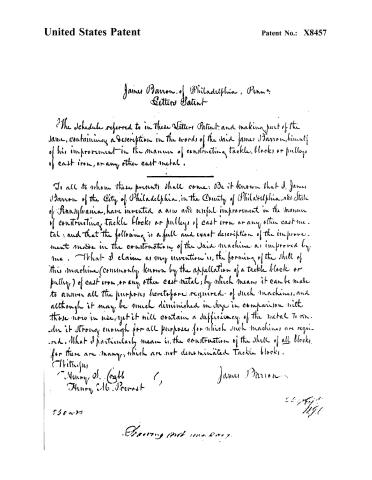 Page 2


U.S. Patent and Trademark Office · Google Patents
Published accounts: journal notice
Notice in the monthly list of patents, with remarks
Journal of the Franklin Institute, new ser., vol. 15 (1835), p. 324 · View the page
31. For Tackle Blocks, or Pulleys, of Cast-iron; James Barron, Esq., United States Navy, stationed at the Navy Yard, Philadelphia; October 20.
Remarks. The claim made is to the forming the shell of this machine of cast iron, or any other cast metal; and it is observed that, although such a block may be much diminished in size, when compared with those in use, yet it will be sufficiently strong for all required purposes. It is further observed, that there are various blocks which are not called tackle blocks, but yet it is intended to claim the making the shell of all blocks in the way designated. The shells of blocks have been frequently made of wrought iron, but we are not aware that they have been cast of that metal, because, when great strength is required in a small compass, wrought iron is manifestly preferable to cast, the latter, however, offering no small advantage in first cost. It is said in the Traité Complet de Mécanique, by Borgnis, p. 62 and 63, of vol. ii., that "the cases, or shells, of pulleys are made either of elm, or of iron," and that "figures 7, 10 and 13, represent compound blocks, with cases, or shells, of iron; these occupy less space than those of wood; but I am of opinion that, for compound blocks of large size, those of wood, properly strengthened by ferules, and bands of iron, are to be preferred; in the first place, because they are more to be depended upon; for experience has proved that iron is more subject to unforeseen accidents than wood, such as breaking, or bending; the defects in wood are apparent, and may be seen at first sight, whilst, on the contrary, those in iron sometimes elude the observation of persons of the greatest experience. Secondly, the little thickness usually given to the iron partitions which separate the sheeves, in order to obtain lightness, endangers the constant friction of the cords against each other, and against the edges of the iron, with which they come in contact in their passage." These observations refer to wrought iron, and although the objections under the second head may be in a great degree obviated in cast-iron, we are of opinion that those under the first will apply with sufficient force to prevent the general adoption of the plan.
About this record
- Patentee
- DATAMP
- Date
- the Name and Date index of patents, DATAMP, USPTO records
- Invention
- DATAMP
- Listed in
- the Name and Date index of patents, DATAMP, USPTO records, Jim Shaw's X-patent list, the Journal of the Franklin Institute, Burke's List of Patents (1847)
- in_burke