

Drawings and documents
USPTO scan
The patent as scanned by the USPTO
-
 Page 1
-
 Page 2
-
 Page 3


U.S. Patent and Trademark Office · Google Patents
Published accounts: specification
Specification printed in the Journal of the Franklin Institute
Journal of the Franklin Institute, new ser., vol. 15 (1835), p. 207 · View the page
Text of the specification as printed in the Journal, from OCR; not proofread.
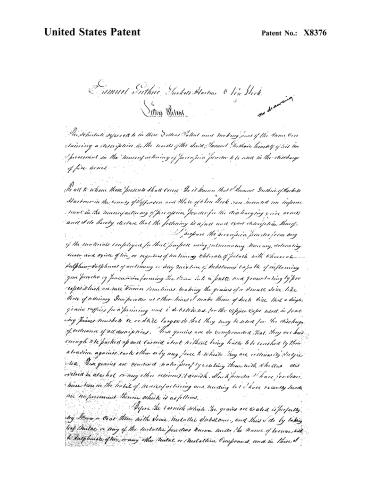
Specification of a Patent for an improvement in the manufacture of Percussion Powder. Granted to SAMUEL GUTHRIE, of Sacket's Harbour, Jefferson county, New York, August 21st, 1834. To all to whom these presents shall come, be it known, that I, Samuel Guthrie, of Sacket's Harbour, in the county of Jefferson, and State of New York, have invented an improvement in the manufacturing of percussion powder, for the discharging of firearms; and I do hereby declare that the following is a full and exact description thereof. I prepare the percussion powder from any of the materials employed for that purpose, using fulminating mercury, detonating silver, and oxide of tin, or regulus of antimony; chlorate of potash with charcoal, sulphur, sulphuret of antimony, or any mixture of substances capable of inflaming gunpowder, by percussion, forming the same into a paste, and granulating by processes which are well known; sometimes making the grains of a small size, like those of ordinary gunpowder; at other times, I make them of such size that a single grain suffices for a priming, and is substituted for the copper caps used in fowling pieces, muskets, &c.; or still larger, so that they may be used for the discharge of ordnance of all descriptions. These grains are so compounded, that they are hard enough to be packed up, and carried about, without being liable to be crushed by their abrasion against each other, or by any force to which they are ordinarily subjected. These grains are rendered water-proof by coating them with shellac, dissolved in alcohol, or any other resinous varnish. Such powder I have, for some time, been in the habit of manufacturing and vending; but I have recently made an improvement therein, which is as follows. Before the varnish with which the grains are coated is perfectly dry, I cover, or coat, them with some metallic substance; and this I do by taking leaf metal, or any of the metallic powders known under the name of bronze, or bi-sulphuret of tin, or any other metal, or metalline compound; and in these I roll the grains whilst yet tackey with the varnish. The powder thus prepared is not only improved in appearance, but has greater smoothness and durability than before. After thus coating the grains, I sometimes apply another covering of copal, or other water-proof varnish, being governed in this particular by the nature of the powder, and the purpose to which it is to be applied. What I claim as my invention, and wish to have secured to me by letters patent, is the giving to the granulated powder a metallic covering, in the manner, and for the purpose, herein set forth. SAMUEL GUTHRIE. TRANSLATIONS FROM FOREIGN JOURNALS. REPORT To the Board of Directors of Bridges, Public Roads, and Mines, upon the Use of Heated Air in the Iron Works of Scotland and England. By M. DUFRENOY, Engineer of Mines. Paris, 1834. (Translated for this Journal, by S. V. Merrick.) Continued from p. 125. WORKS IN THE ENVIRONS OF GLASGOW. The vicinity of Glasgow is one vast coal region, the first in Great Britain, both in the extent and the thickness of the veins. This coal basin is also very remarkable for the abundance of its iron ore, both imbedded in the argillaceous schist of the region, and in regular veins, often of considerable extent. The layers of coal in the vicinity of Glasgow, which belong to the lower strata of the coal formation, alternate with beds of mountain limestone, so that in the same locality, are often united the coal, the Report on the use of Heated Air in Iron Works. ore, and flux, and often the fire clay used in the construction of the furnaces. These invaluable advantages are in part compensated by the enormous loss incident to the carbonization of the coal in this locality, as well as by the lightness of the coke produced. From these circumstances, a ton of iron requires at the Glasgow Works for its production, a much larger quantity of fuel than in any district of England. The employment of the heated air has produced a revolution in the Scotch works, and enabled them to sustain a competition with those of Wales. Clyde Iron Works were, as before stated, the first in which the heated air was tried. The apparatus now in use (plate 2, figures 1 and 2,) is composed of a double row of horizontal pipes, a, a, a, a, 150 feet long. These pipes are nineteen inches in diameter, and one inch and a half thick. The exterior row passes behind the furnace, and enters the other row, dividing the air into two parts; so that the blast is carried equally to each tuyere. The valves placed at E regulate the distribution of air, and stop either branch when repairs are required. In the length of 150 feet, the tubes pass through five furnaces, or heaters, F, F, F, F, F, of which two are placed near the tuyeres; so that the air has no time to cool before entering the furnace, Figs. 1 and 2 give an exact idea of the form and disposition of the five heating fires; they are connected by a conduit of brick, g, g, g, which envelopes the pipes; by this means the flame which escapes from the fireplace, circulates about the pipes, and heats their whole length. To preserve the parts of the pipe immediately in contact with the flame, they are encased in fire brick the whole length of the furnace. In the first apparatus of this kind which was constructed, the ends of the pipes were inserted one in the other, having some play to prevent any rupture by expansion; the result was a great loss of air, and the plan was abandoned. Besides, it was remarked, that a great waste always took place at the joints of the pipes; so that it was not sufficient to fasten them with bolts and nuts; the joints were therefore covered with a ring of iron cast on after they were finished. By means of this precaution, the pipes lasted a long time; at the time of my visit, they had been five months in use without repairs. On the exit pipes are made small holes, V, V, by means of which any change of temperature in the air might be ascertained. This precaution is indispensable, because one of the essential conditions in the use of heated air, is, that its temperature be kept uniform-with this apparatus they raised the air to 612° Fahr., which is higher than the melting point of lead. In the Clyde Works, two of the four furnaces have each an apparatus like the one described, but in the other two there was no room for the extent of pipes, and they are contracted into smaller space, by being doubled upon themselves. The working of a furnace with heated air, requires no particular precaution; the operation is the same as before its introduction, the only difference consisting in the substitution of raw coal for coke. VOL. XV. No. 3.-MARCH, 1835. 27 This substitution did not immediately follow the adoption of the new plan; it was some time after, and only when the temperature of the air was raised above the melting point of lead, that the immense benefit of the change was discovered, giving a consequent diminution in the expense of manufacture. The general idea adopted in Scotland, is, that certain qualities of coal cannot be employed crude, except when the air is highly heated. We have already said that at the Monkland Works, where the air is heated to 460° and 490° Fahr., coke is still used. The descent of the furnace is very regular-the distances between the charges are nearly equal, the charging being regulated by the space left empty in the throat. The richness of the ore not roasted, varies from 22 to 34 per cent., and the composition of the charges follows this variation, At the time of my visit, the average yield of ore, after roasting, was 44 per cent., and the charges thus composed: 660 lbs. coal, 520 lbs. ore roasted. 100 lbs. lime. They usually made 40 charges in 24 hours. During the two days that I witnessed the working of the Clyde Works, the number of charges were July 4-from 6, A. M. to 6, P. M., from 6, P. M. to 6, A. M. 38 39 6-from 6, A. M. to 6, P. M., from 6, P. M. to 6, A. M., 37 40 t. cwt. 12. Total, 17 15 The yield of the furnace in these four castings, was, t. cwt. t. cwt. t. cwt. t. cwt. 4 8; 4 for 154 charges. 9; 4 6; 4 Or, 8 t. 17 cwt. 2 qrs. each 24 hours. This result shows that a ton of iron is produced at an expense of 2 t. 8 cwt. 2 qrs. coal. The consumption of the heating fire is 8 cwt. Total, 2 t. 16 cwt. 2 qrs. per ton of iron. The castings are made every twelve hours. The metal obtained is usually a mixture of No. 1 and No. 2. That which goes first from the hearth is No. 1. These two varieties of iron are distinguished by the small channels which furrow the surface of the metal while cooling. The tuyeres are hermetically closed round with clay, and as they cannot resist the elevated temperature to which they are submitted, water tuyeres have been substituted similar to those used in the fineries. The fig. 3, plate 2, represents the tuyeres employed at the Clyde Works; they are of cast iron, and last various lengths of time, averaging five or six months. The tuyeres are closed in, to prevent the entrance of cold air through the openings. There is no objection to this arrangement, because the air is so hot, that no scoria accumulates upon the pipe, and the workmen are never obliged to free the tuyeres. There is a high white heat in this part of the furnace; nevertheless there are scarcely any sparks produced by the oxidation of the iron, and the particles that fall are black in the centre, showing that the metal is still covered with a small layer of melted scoria. The flame issuing from the furnace is of a bright red, while that from the coke furnace, worked with cold air, is of a yellowish colour. This difference of colour is as marked as that which exists between the flame of alcohol coloured by strontia, and by baryta. The pressure of the blast in the air vessel, is two pounds and a half, or five inches of mercury to the square inch. It is sensibly the same near the tuyeres, only the gauge which indicates it is subject to great oscillations. This pressure was formerly three pounds. The opening of the tuyere is three inches; it was two inches and a half when cold air was used. The quantity of air forced into the furnace is less. The blowing engine, of seventy horse power, served only three furnaces; now it feeds four with ease. From the dimensions of the blowing cylinder* the quantity of wind, which was 2827 cubic feet per minute of cold air, is now but 2120 cubic feet. The furnaces of the Clyde have not been altered since the introduction of hot air. They had been in blast a long time when this new plan was adopted; one of them has been seven years in blast, and the regularity of its operations gives an earnest that it will last a long time. At the commencement of this report, I have already stated the economy of fuel, and of flux, which had been obtained at the Clyde Works, by the introduction of hot air. I think it, nevertheless, useful to show the correctness of the estimate by transcribing a statement of the different expenses ses of manufacture during a month, while cold air was used, and a corresponding month, with the use of hot air. I make this statement from the books of the Works, to which I have been allowed access with a rare liberality. Consumption and produce of three Furnaces using cold air and coke, during the month of February, 1829. Pig Iron. Coke. Ore. Flux. Castings. Total. No. 1. No. 2. No. 3. t. c. t. c. t. c. t. c. t. c. t. c. t. c. t. c. 1st week 386 227 9 68 2 72 13 32 13 18 13 1 13 125 12 2d do. 411 10 242 11 72 11 3d do. 401 51 19 37 11 47 2 6 136 19 231 16 70 18 44 16 48 2 38 7 3 131 8 4th do. 301 10 177 13 53 6 53 27 9 26 3 0 105 12 1500 499 11 1879 9264 17 222 8 145 15 130 522 Add the consumption of the engine, averaging one ton of slack to the ton of iron made. • The steam engine which works the blowing apparatus, requires for fuel twenty tons of broken coal, or slack, per day of twenty-four hours, which costs one shilling and eight pence, sterling per ton, (forty cents.) Report on the use of Heated Air in Iron Works. Consumption and produce of four Furnaces, using hot air and coal, during the month of February, 1835. Crude Coal. Pig Iron. Ore. Flux. Castings. Total. No. 1. No. 2. No. 3. t. c. t. c. t. c. t. c. t. c. t. C. 66 t. c. 1st week 516 15 490 2d do. 514 7 91 16 81 4 28 15 155 3 " 265 2 491 6 91 7 48 8 46 15 161 18 “ 257 1 3d do. 521 15 486 8 91 8 94 12 59 10 109 8 264 4th do. 470 10 434 12 81 18 75 2 47 10 102 1 224 3 2023 1902 13 356 9 299 6 182 10 528 10 1010 6 The consumption of the steam engine averaged eleven cwt. per ton of iron produced. The result of an examination of these tables is, that for one ton of iron produced, there was consumed as follows:1829. With Cold Air and Coke. 1833. Air Heated to 612° Fahr. and Crude Coal. 1. Coal for fusiont. cwt. t. cwt. 3 tons of coke, corresponding to coal, 6 15 • Crude coal, Do. for steam engine, • 2 11 Do. for steam engine, 1 Do. for heating the air, 8 7 15 2 19 2. Ore roasted, 3523 lbs. or 1 15 Ore, 3780 lbs. or 1 18 Its average yield being 57 per Its average yield being 56 per cent. cent. 3. Flux, 1056 lbs., or 10 Flux, 704 lbs. or 7 The daily production of the Furnace was 11,904 lbs. or about six tons. 18,035 lbs., or about nine tons. The daily production having been raised at the Clyde Works from six to nine tons. The introduction of hot air has produced an economy in the consumption of fuel, and in the expense of manual labour. The following table shows the cost of manufacturing pig iron during these two periods:In 1833. Hot Air. In 1829. Cold Air. t. c. d. c. do. for the blowing machine, at 1s 8d. per ton, (40 cents,) Coal for the heating apparatus, Flux, at 9s. per ton, ($2 16,) Labour, at 10s. per ton, ($240,) Coal for melting, at 5s. per ton, ($1 20,*) Mineral roasted, at 128. per ton, ($2 88,) General expense, int'st. of capital 6s. ($148,) 6 13 898 t. c. 2 d. c. 2 40 2 80 11 22 8 48 1 15 5 041185 47 10 1 08 7 76 2 40 160 1 44 96 Total, * The cost in sterling money is reduced to United States currency at the rate of $4 80 per pound.-TRANS. 19 74 11 89 Calder Iron Works. These works are three miles from Glasgow, on the Edinburgh Road; the hot air blast has been used at them for three years past; two of the furnaces are fed by an apparatus like that at the Clyde Works, but at the other two, the air is heated by means of a system of small tubes, represented in plate 2, figures 6, 7, 8, and 9. This apparatus is composed of two large horizontal tubes, a c, and a' c', six feet long, nine inches in diameter in the clear, and one inch thick. Nine small tubes, six inches in diameter outside, and three inches inside, doubling upon each other like syphons, are placed vertically upon the pipes, a c, and a' c', and fastened, by being driven tight into the throat d. This system of tubes is placed in a rectangular furnace, ten feet long, three feet wide, and twelve or fifteen feet high. To prevent injury to the joints, care is taken to protect them from the direct action of the fire. The joint m, n, of the large pipes is placed outside of the furnace, and the connexions of the small pipes with the large are shielded by fire brick. The flame is carried through the furnace by the longitudinal flue, g, h, passing the whole length; it is then spread among the tubes which it envelopes, gaining the chimney by the openings 0, 0, 0. The temperature of the air is raised by this apparatus to 612° Fahr., as at the Clyde Works; the consumption of coal is seven cwt. of coal per ton of iron produced. This apparatus appears to be preferable to that of the Clyde. It takes less room; the bends in the small tubes, it is true, increase the friction of the air passing through them, but this circumstance appears to have but little influence on its motion. The power expended by the blowing engine is not greater than that at the Clyde Works, and the pressure of the air is two pounds and three-quarters per square inch. The expense of construction is quite small. The greatest part of it is formed of cast iron, which can be replaced at the works in case of accident. The cost of construction is estimated at about $150, requiring about seven tons of castings-say about one and a half tons for the large pipes, and five and a half tons for the small tubes. By estimating the iron cast into pipes, at $24 per ton, which is the average cost at the works using coal, the expense of each apparatus will be about as follows: Masonry, Earthen parts of the furnace, Casting pipes, $100 60 168 $328 The expense will then be about $656 for each smelting furnace. At Calder they estimate the cost at about $168 to each tuyere. The apparatus at the Clyde is much more expensive; the quantity of Consumption and produce of Furnace No. 3 in 1828, by the Use of the Cold Blast and of Coke. Cast Metal. blishment. The results which follow are extracted from the books of the estathe month of July last. 3. The same results from the use of hot air and crude coal, during with cold air and coke. 1. The consumption and products of the Calder Furnace, worked heated to 300° Fahr., also consuming coke. 2. The expenses and products of the same furnace, fed with air times as much as at the Calder Works. iron required is seventeen or eighteen tons, and the masonry twelve the progress of the introduction of hot air, we shall indicate, those of the Clyde, and it is useless to repeat them; but to exhibit The working of the furnaces present the same circumstances as Coke. Ore Flux. roasted. Total. No. 1. No. 2. No. 3. t. c. q. t. c. q. t. c. q. t. c. t. c. t. c. t. c. 550 2 276 8 0 105 3 95 4 39 1 20 3 154 8 545 1 274 5 0 101 1 100 1 34 2 18 2 152 5 575 1 295 6 1108 106 6 44 3 15 14 166 3 1670 3 1 845 19 1314 3 1301 11 117 6 53 19 472 16 Loss of Coal in coking, 2041 6 3 563 18 3 Loss of Ore by roasting, 40 per cent. 3711 10 0 1409 18 Ore, Crude-pressure of air, 34 lbs. Consumption and produce of Furnace No. 3 in 1831. Air heated to 300° Fahr. and Coke. Metal. Coke. Ore roasted. Flux. Total. No. 1. No. 2. No. 3. t. c. t. 189 12 120 c. q. 30 t. c. q. 52 10 1 t. c. t. c. t. c. t. c. 57 11 11 42 2 110 13 204 3130 6 64 7 46 7 27 73 7 393 15250 9 116 17 1 103 18 11 481 5166 19 1 Loss of ore-pressure of air, 3 1-10 lbs. 69 2 184 From 6 Jan. to 3 Feb. From 3 Feb. to 2 March From 2 March to 30 do. 55 per cent. Coal, From Jan. 2 to 16 From Jan. 16 to 30 Loss of Coal Coal 875 417 8 1 Ore crude. t. C. From 4 Nov. to 2 Dec. 1832 406 Consumption and produce of Furnace No. 3 during twelve weeks in 1832 and 1833 by heated air and crude coal. Coke. Ore roasted. Flux. Metal. No. 1. No. 2. (No. 3. 65 5 102 15 62 t. c. q. t. c. q. t. c. t. c. t. c. 379 2 Total. t. c. 55 10 220 5 From 24 Feb. to 23 March, 1833 458 8 389 61 64 7 1 116 10 31 52 10 200 From 24 Mar. to 23 April, 1833 Loss in Ore Crude Ore 476 4 427 14 1 53 19 1 121 10 36 10 62 1340 12 1166 2 2 183 11 2340 15 129 10 170 797 8 1993 10 2 Pressure of air, 24 lbs. 220 640 5 By comparing these tables, we learn that for one ton of iron produced, the furnace No. 3 consumed as follows: 1831. Air heated to 1833. Air heated to 612° 1828. Cold air & coke. 300° Fahr. and coke. Fahr. and coal. 7075 of coke, corres-4279 of coke, corres-Coal crude, pondingto 15724 lbs. ponding to 9510 lbs., T. cwt. coal, 7 T. 17 cwt. t.cwt. 4187 lbs. or 2 2 Fuel for heating the apparatus, valued at or 4 15 t.cwt.q. t.
Published accounts: journal notice
Notice in the monthly list of patents, with remarks
Journal of the Franklin Institute, new ser., vol. 15 (1835), p. 199 · View the page
42. For an improvement in the manufacture of Percussion Powder; Samuel Guthrie, Sacket's Harbour, Jefferson county, New York, August 21.
Remarks. (See the specification.)
Published accounts: journal notice
Notice in the monthly list of patents, with remarks
Journal of the Franklin Institute, new ser., vol. 15 (1835), p. 207 · View the page
All the variety of patterns given to goods of this description, may be produced in my mode of weaving, and although I have made some improvements in the loom which I use for the purpose, similar articles may be woven in the ordinary figure loom; I do not, therefore, describe, or claim, any particular machinery for effecting the object in view, but claim only the arrangement of the double and single threads in the chain, and in the filling, applied in the manner, and for the purpose, herein described. Although I have spoken of double and single threads, both in the chain and filling, it is to be understood that these denominations respect the size of the threads employed, rather than the mere fact of their being double, or single, as a double yarn may be employed in lieu of that which I denominate single, provided its fineness was such as to produce the intended effect, and a fine double yarn thus used, I should consider as interfering with my invention, as it would enable the weaver to produce a manufactured article essentially similar to that described. JOHN SMITH. Specification of a Patent for an improvement in the manufacture of Percussion Powder. Granted to SAMUEL GUTHRIE, of Sacket's Harbour, Jefferson county, New York, August 21st, 1834.
Remarks. To all to whom these presents shall come, be it known, that I, Samuel Guthrie, of Sacket's Harbour, in the county of Jefferson, and State of New York, have invented an improvement in the manufacturing of percussion powder, for the discharging of firearms; and I do hereby declare that the following is a full and exact description thereof. I prepare the percussion powder from any of the materials employed for that purpose, using fulminating mercury, detonating silver, and oxide of tin, or regulus of antimony; chlorate of potash with charcoal, sulphur, sulphuret of antimony, or any mixture of substances capable of inflaming gunpowder, by percussion, forming the same into a paste, and granulating by processes which are well known; sometimes making the grains of a small size, like those of ordinary gunpowder; at other times, I make them of such size that a single grain suffices for a priming, and is substituted for the copper caps used in fowling pieces, muskets, &c.; or still larger, so that they may be used for the discharge of ordnance of all descriptions. These grains are so compounded, that they are hard enough to be packed up, and carried about, without being liable to be crushed by their abrasion against each other, or by any force to which they are ordinarily subjected. These grains are rendered water-proof by coating them with shellac, dissolved in alcohol, or any other resinous varnish. Such powder I have, for some time, been in the habit of manufacturing and vending; but I have recently made an improvement therein, which is as follows. Before the varnish with which the grains are coated is perfectly dry, I cover, or coat, them with some metallic substance; and this I do by taking leaf metal, or any of the metallic powders known under the name of bronze, or bi-sulphuret of tin, or any other metal, or metalline compound; and in these I roll the grains whilst yet tackey with the varnish. The powder thus prepared is not only improved in appearance, but has greater smoothness and durability than before. After thus coating the grains, I sometimes apply another covering of copal, or other water-proof varnish, being governed in this particular by the nature of the powder, and the purpose to which it is to be applied. What I claim as my invention, and wish to have secured to me by letters patent, is the giving to the granulated powder a metallic covering, in the manner, and for the purpose, herein set forth. SAMUEL GUTHRIE. TRANSLATIONS FROM FOREIGN JOURNALS. REPORT To the Board of Directors of Bridges, Public Roads, and Mines, upon the Use of Heated Air in the Iron Works of Scotland and England. By M. DUFRENOY, Engineer of Mines. Paris, 1834. (Translated for this Journal, by S. V. Merrick.) Continued from p. 125. WORKS IN THE ENVIRONS OF GLASGOW. The vicinity of Glasgow is one vast coal region, the first in Great Britain, both in the extent and the thickness of the veins. This coal basin is also very remarkable for the abundance of its iron ore, both imbedded in the argillaceous schist of the region, and in regular veins, often of considerable extent. The layers of coal in the vicinity of Glasgow, which belong to the lower strata of the coal formation, alternate with beds of mountain limestone, so that in the same locality, are often united the coal, the Report on the use of Heated Air in Iron Works. ore, and flux, and often the fire clay used in the construction of the furnaces. These invaluable advantages are in part compensated by the enormous loss incident to the carbonization of the coal in this locality, as well as by the lightness of the coke produced. From these circumstances, a ton of iron requires at the Glasgow Works for its production, a much larger quantity of fuel than in any district of England. The employment of the heated air has produced a revolution in the Scotch works, and enabled them to sustain a competition with those of Wales. Clyde Iron Works were, as before stated, the first in which the heated air was tried. The apparatus now in use (plate 2, figures 1 and 2,) is composed of a double row of horizontal pipes, a, a, a, a, 150 feet long. These pipes are nineteen inches in diameter, and one inch and a half thick. The exterior row passes behind the furnace, and enters the other row, dividing the air into two parts; so that the blast is carried equally to each tuyere. The valves placed at E regulate the distribution of air, and stop either branch when repairs are required. In the length of 150 feet, the tubes pass through five furnaces, or heaters, F, F, F, F, F, of which two are placed near the tuyeres; so that the air has no time to cool before entering the furnace, Figs. 1 and 2 give an exact idea of the form and disposition of the five heating fires; they are connected by a conduit of brick, g, g, g, which envelopes the pipes; by this means the flame which escapes from the fireplace, circulates about the pipes, and heats their whole length. To preserve the parts of the pipe immediately in contact with the flame, they are encased in fire brick the whole length of the furnace. In the first apparatus of this kind which was constructed, the ends of the pipes were inserted one in the other, having some play to prevent any rupture by expansion; the result was a great loss of air, and the plan was abandoned. Besides, it was remarked, that a great waste always took place at the joints of the pipes; so that it was not sufficient to fasten them with bolts and nuts; the joints were therefore covered with a ring of iron cast on after they were finished. By means of this precaution, the pipes lasted a long time; at the time of my visit, they had been five months in use without repairs. On the exit pipes are made small holes, V, V, by means of which any change of temperature in the air might be ascertained. This precaution is indispensable, because one of the essential conditions in the use of heated air, is, that its temperature be kept uniform-with this apparatus they raised the air to 612° Fahr., which is higher than the melting point of lead. In the Clyde Works, two of the four furnaces have each an apparatus like the one described, but in the other two there was no room for the extent of pipes, and they are contracted into smaller space, by being doubled upon themselves. The working of a furnace with heated air, requires no particular precaution; the operation is the same as before its introduction, the only difference consisting in the substitution of raw coal for coke. VOL. XV. No. 3.-MARCH, 1835. 27 This substitution did not immediately follow the adoption of the new plan; it was some time after, and only when the temperature of the air was raised above the melting point of lead, that the immense benefit of the change was discovered, giving a consequent diminution in the expense of manufacture. The general idea adopted in Scotland, is, that certain qualities of coal cannot be employed crude, except when the air is highly heated. We have already said that at the Monkland Works, where the air is heated to 460° and 490° Fahr., coke is still used. The descent of the furnace is very regular-the distances between the charges are nearly equal, the charging being regulated by the space left empty in the throat. The richness of the ore not roasted, varies from 22 to 34 per cent., and the composition of the charges follows this variation, At the time of my visit, the average yield of ore, after roasting, was 44 per cent., and the charges thus composed: 660 lbs. coal, 520 lbs. ore roasted. 100 lbs. lime. They usually made 40 charges in 24 hours. During the two days that I witnessed the working of the Clyde Works, the number of charges were July 4-from 6, A. M. to 6, P. M., from 6, P. M. to 6, A. M. 38 39 6-from 6, A. M. to 6, P. M., from 6, P. M. to 6, A. M., 37 40 t. cwt. 12. Total, 17 15 The yield of the furnace in these four castings, was, t. cwt. t. cwt. t. cwt. t. cwt. 4 8; 4 for 154 charges. 9; 4 6; 4 Or, 8 t. 17 cwt. 2 qrs. each 24 hours. This result shows that a ton of iron is produced at an expense of 2 t. 8 cwt. 2 qrs. coal. The consumption of the heating fire is 8 cwt. Total, 2 t. 16 cwt. 2 qrs. per ton of iron. The castings are made every twelve hours. The metal obtained is usually a mixture of No. 1 and No. 2. That which goes first from the hearth is No. 1. These two varieties of iron are distinguished by the small channels which furrow the surface of the metal while cooling. The tuyeres are hermetically closed round with clay, and as they cannot resist the elevated temperature to which they are submitted, water tuyeres have been substituted similar to those used in the fineries. The fig. 3, plate 2, represents the tuyeres employed at the Clyde Works; they are of cast iron, and last various lengths of time, averaging five or six months. The tuyeres are closed in, to prevent the entrance of cold air through the openings. There is no objection to this arrangement, because the air is so hot, that no scoria accumulates upon the pipe, and the workmen are never obliged to free the tuyeres. There is a high white heat in this part of the furnace; nevertheless there are scarcely any sparks produced by the oxidation of the iron, and the particles that fall are black in the centre, showing that the metal is still covered with a small layer of melted scoria. The flame issuing from the furnace is of a bright red, while that from the coke furnace, worked with cold air, is of a yellowish colour. This difference of colour is as marked as that which exists between the flame of alcohol coloured by strontia, and by baryta. The pressure of the blast in the air vessel, is two pounds and a half, or five inches of mercury to the square inch. It is sensibly the same near the tuyeres, only the gauge which indicates it is subject to great oscillations. This pressure was formerly three pounds. The opening of the tuyere is three inches; it was two inches and a half when cold air was used. The quantity of air forced into the furnace is less. The blowing engine, of seventy horse power, served only three furnaces; now it feeds four with ease. From the dimensions of the blowing cylinder* the quantity of wind, which was 2827 cubic feet per minute of cold air, is now but 2120 cubic feet. The furnaces of the Clyde have not been altered since the introduction of hot air. They had been in blast a long time when this new plan was adopted; one of them has been seven years in blast, and the regularity of its operations gives an earnest that it will last a long time. At the commencement of this report, I have already stated the economy of fuel, and of flux, which had been obtained at the Clyde Works, by the introduction of hot air. I think it, nevertheless, useful to show the correctness of the estimate by transcribing a statement of the different expenses ses of manufacture during a month, while cold air was used, and a corresponding month, with the use of hot air. I make this statement from the books of the Works, to which I have been allowed access with a rare liberality. Consumption and produce of three Furnaces using cold air and coke, during the month of February, 1829. Pig Iron. Coke. Ore. Flux. Castings. Total. No. 1. No. 2. No. 3. t. c. t. c. t. c. t. c. t. c. t. c. t. c. t. c. 1st week 386 227 9 68 2 72 13 32 13 18 13 1 13 125 12 2d do. 411 10 242 11 72 11 3d do. 401 51 19 37 11 47 2 6 136 19 231 16 70 18 44 16 48 2 38 7 3 131 8 4th do. 301 10 177 13 53 6 53 27 9 26 3 0 105 12 1500 499 11 1879 9264 17 222 8 145 15 130 522 Add the consumption of the engine, averaging one ton of slack to the ton of iron made. • The steam engine which works the blowing apparatus, requires for fuel twenty tons of broken coal, or slack, per day of twenty-four hours, which costs one shilling and eight pence, sterling per ton, (forty cents.) Report on the use of Heated Air in Iron Works. Consumption and produce of four Furnaces, using hot air and coal, during the month of February, 1835. Crude Coal. Pig Iron. Ore. Flux. Castings. Total. No. 1. No. 2. No. 3. t. c. t. c. t. c. t. c. t. c. t. C. 66 t. c. 1st week 516 15 490 2d do. 514 7 91 16 81 4 28 15 155 3 " 265 2 491 6 91 7 48 8 46 15 161 18 “ 257 1 3d do. 521 15 486 8 91 8 94 12 59 10 109 8 264 4th do. 470 10 434 12 81 18 75 2 47 10 102 1 224 3 2023 1902 13 356 9 299 6 182 10 528 10 1010 6 The consumption of the steam engine averaged eleven cwt. per ton of iron produced. The result of an examination of these tables is, that for one ton of iron produced, there was consumed as follows:1829. With Cold Air and Coke. 1833. Air Heated to 612° Fahr. and Crude Coal. 1. Coal for fusiont. cwt. t. cwt. 3 tons of coke, corresponding to coal, 6 15 • Crude coal, Do. for steam engine, • 2 11 Do. for steam engine, 1 Do. for heating the air, 8 7 15 2 19 2. Ore roasted, 3523 lbs. or 1 15 Ore, 3780 lbs. or 1 18 Its average yield being 57 per Its average yield being 56 per cent. cent. 3. Flux, 1056 lbs., or 10 Flux, 704 lbs. or 7 The daily production of the Furnace was 11,904 lbs. or about six tons. 18,035 lbs., or about nine tons. The daily production having been raised at the Clyde Works from six to nine tons. The introduction of hot air has produced an economy in the consumption of fuel, and in the expense of manual labour. The following table shows the cost of manufacturing pig iron during these two periods:In 1833. Hot Air. In 1829. Cold Air. t. c. d. c. do. for the blowing machine, at 1s 8d. per ton, (40 cents,) Coal for the heating apparatus, Flux, at 9s. per ton, ($2 16,) Labour, at 10s. per ton, ($240,) Coal for melting, at 5s. per ton, ($1 20,*) Mineral roasted, at 128. per ton, ($2 88,) General expense, int'st. of capital 6s. ($148,) 6 13 898 t. c. 2 d. c. 2 40 2 80 11 22 8 48 1 15 5 041185 47 10 1 08 7 76 2 40 160 1 44 96 Total, * The cost in sterling money is reduced to United States currency at the rate of $4 80 per pound.-TRANS. 19 74 11 89 Calder Iron Works. These works are three miles from Glasgow, on the Edinburgh Road; the hot air blast has been used at them for three years past; two of the furnaces are fed by an apparatus like that at the Clyde Works, but at the other two, the air is heated by means of a system of small tubes, represented in plate 2, figures 6, 7, 8, and 9. This apparatus is composed of two large horizontal tubes, a c, and a' c', six feet long, nine inches in diameter in the clear, and one inch thick. Nine small tubes, six inches in diameter outside, and three inches inside, doubling upon each other like syphons, are placed vertically upon the pipes, a c, and a' c', and fastened, by being driven tight into the throat d. This system of tubes is placed in a rectangular furnace, ten feet long, three feet wide, and twelve or fifteen feet high. To prevent injury to the joints, care is taken to protect them from the direct action of the fire. The joint m, n, of the large pipes is placed outside of the furnace, and the connexions of the small pipes with the large are shielded by fire brick. The flame is carried through the furnace by the longitudinal flue, g, h, passing the whole length; it is then spread among the tubes which it envelopes, gaining the chimney by the openings 0, 0, 0. The temperature of the air is raised by this apparatus to 612° Fahr., as at the Clyde Works; the consumption of coal is seven cwt. of coal per ton of iron produced. This apparatus appears to be preferable to that of the Clyde. It takes less room; the bends in the small tubes, it is true, increase the friction of the air passing through them, but this circumstance appears to have but little influence on its motion. The power expended by the blowing engine is not greater than that at the Clyde Works, and the pressure of the air is two pounds and three-quarters per square inch. The expense of construction is quite small. The greatest part of it is formed of cast iron, which can be replaced at the works in case of accident. The cost of construction is estimated at about $150, requiring about seven tons of castings-say about one and a half tons for the large pipes, and five and a half tons for the small tubes. By estimating the iron cast into pipes, at $24 per ton, which is the average cost at the works using coal, the expense of each apparatus will be about as follows: Masonry, Earthen parts of the furnace, Casting pipes, $100 60 168 $328 The expense will then be about $656 for each smelting furnace. At Calder they estimate the cost at about $168 to each tuyere. The apparatus at the Clyde is much more expensive; the quantity of Consumption and produce of Furnace No. 3 in 1828, by the Use of the Cold Blast and of Coke. Cast Metal. blishment. The results which follow are extracted from the books of the estathe month of July last. 3. The same results from the use of hot air and crude coal, during with cold air and coke. 1. The consumption and products of the Calder Furnace, worked heated to 300° Fahr., also consuming coke. 2. The expenses and products of the same furnace, fed with air times as much as at the Calder Works. iron required is seventeen or eighteen tons, and the masonry twelve the progress of the introduction of hot air, we shall indicate, those of the Clyde, and it is useless to repeat them; but to exhibit The working of the furnaces present the same circumstances as Coke. Ore Flux. roasted. Total. No. 1. No. 2. No. 3. t. c. q. t. c. q. t. c. q. t. c. t. c. t. c. t. c. 550 2 276 8 0 105 3 95 4 39 1 20 3 154 8 545 1 274 5 0 101 1 100 1 34 2 18 2 152 5 575 1 295 6 1108 106 6 44 3 15 14 166 3 1670 3 1 845 19 1314 3 1301 11 117 6 53 19 472 16 Loss of Coal in coking, 2041 6 3 563 18 3 Loss of Ore by roasting, 40 per cent. 3711 10 0 1409 18 Ore, Crude-pressure of air, 34 lbs. Consumption and produce of Furnace No. 3 in 1831. Air heated to 300° Fahr. and Coke. Metal. Coke. Ore roasted. Flux. Total. No. 1. No. 2. No. 3. t. c. t. 189 12 120 c. q. 30 t. c. q. 52 10 1 t. c. t. c. t. c. t. c. 57 11 11 42 2 110 13 204 3130 6 64 7 46 7 27 73 7 393 15250 9 116 17 1 103 18 11 481 5166 19 1 Loss of ore-pressure of air, 3 1-10 lbs. 69 2 184 From 6 Jan. to 3 Feb. From 3 Feb. to 2 March From 2 March to 30 do. 55 per cent. Coal, From Jan. 2 to 16 From Jan. 16 to 30 Loss of Coal Coal 875 417 8 1 Ore crude. t. C. From 4 Nov. to 2 Dec. 1832 406 Consumption and produce of Furnace No. 3 during twelve weeks in 1832 and 1833 by heated air and crude coal. Coke. Ore roasted. Flux. Metal. No. 1. No. 2. (No. 3. 65 5 102 15 62 t. c. q. t. c. q. t. c. t. c. t. c. 379 2 Total. t. c. 55 10 220 5 From 24 Feb. to 23 March, 1833 458 8 389 61 64 7 1 116 10 31 52 10 200 From 24 Mar. to 23 April, 1833 Loss in Ore Crude Ore 476 4 427 14 1 53 19 1 121 10 36 10 62 1340 12 1166 2 2 183 11 2340 15 129 10 170 797 8 1993 10 2 Pressure of air, 24 lbs. 220 640 5 By comparing these tables, we learn that for one ton of iron produced, the furnace No. 3 consumed as follows: 1831. Air heated to 1833. Air heated to 612° 1828. Cold air & coke. 300° Fahr. and coke. Fahr. and coal. 7075 of coke, corres-4279 of coke, corres-Coal crude, pondingto 15724 lbs. ponding to 9510 lbs., T. cwt. coal, 7 T. 17 cwt. t.cwt. 4187 lbs. or 2 2 Fuel for heating the apparatus, valued at or 4 15 t.cwt.q. t.cwt.q. 6 Valued at 8 • Ore roasted 3792 lbs. 51 2 10 0 or 1 T. 18 cwt. 2217 lbs. or 17 3735 lbs. or 1 17 0 Ore crude 5970 lbs. or 2 T. 19 cwt. 2 qr. 4575 " or Flux 1330lbs. or 13cwt. 1260" or 26 6228 12 2 572 " " NOTE.-The consumption for the steam engine is not considered. The furnace has produced each twenty-four hours, 1828. t. cwt. 1831. Metal, 11,238 lbs. 5 121| 13,143 lbs. or t. cwt. 1833. 6 13| 16,428 lbs. or 300 52 t. cwt. 8 4 The consumption of combustible has, therefore, diminished from 7 t. 17 cwt. to 2 t. 2 cwt., and the amount of flux from 13 cwt. per ton of iron in 1828, to 5 cwt. in 1833. This diminution must be charged to the increased temperature in the furnace by the use of heated air. I will indicate at the close of this Report, the reasons which appear to me to account for this increase of temperature, the existence of which is certain, though we have not been able to measure it. The quantity of air blast has been reduced from 3500 cubic feet per minute, to 2627 feet, the pressure being reduced from 31 pounds on the square inch, to 2 pounds. The expense of the fuel for heating the air, varies from 7 to 8 cwt. per ton of iron. The consumption for the blast engine remains the same, but as the yield of the furnace has advanced from 5 tons 12 cwt., to 8 ton 4 cwt., the expense, divided on each ton of iron, is reduced from 1 ton 4 cwt., to 14 cwt.; the slack only is used for this purpose. The consumption of ore has varied much, but, as the scoria never contains more than from .02 to .015 of iron, this difference depends on the quality of the ore, according as the Ball ironstone, (mine eu rognous) or flat ironstone, (mine eu couche) is used. At Calder, as in the Clyde Works, the daily production of iron has been increased in a great proportion; this circumstance operates powerfully on the price of fabrication, as will be seen by the following statement. Cost of making one ton of Pig Iron at the Calder Works. 1828. Cold Air and Coke. 1833. Air heated to 322 cwt. and Crude Coal. t. cwt. d. c. t. cwt. d. c. 7 17 coal for fusion, at 4s. 6d. per ton, 2 2 at 5s. per ton, 2 52 8 50 14 coal for blast engine, at 1s. 14 at 1s. 8d. 28 8d. per ton, 48 2 19 crude ore, at 6s. per ton, Expense of roasting, at 10s. per ton, 4 25 8 for heating apparatus, at 1s. 8d. 16 1 17 Ore roasted, at 12s. per 40 ton, 5 33 13 Flux, at 7s. per ton, 1 09 5 Flux, 46 Labour, at 10s. per ton, 2 40 Labour reduced in proportion to increase of yield, 1 62 General expense, interest, &c. 1 44 General expense, interest, &c. 1 01 18 76 11 38 The blast engine employed at Calder is made with two cylinders, one over the other, with one shaft, so that the pistons of both are attached to the same beam. (tige.) The upper cylinder is fifty inches, and the lower cylinder seven feet, in diameter, each being seven feet long; the stroke of the piston, which is nine inches thick, is seven feet, and it makes sixteen strokes a minute. Monkland Iron Works, near Airdrie. The heating apparatus used at this establishment is similar to that at Calder, being formed with two large pipes, and a number of small tubes, jointed in the large ones, the relative positions being changed. The two large pipes, a b, a'b', (figs. 4 and 5, plate 2,) are vertical, and framed as shown in the plate. The small tubes, c' c, five feet long, which make the communication between them, are placed horizontal. This difference of position, and diminished length of the tubes, prevent the temperature of the air from being raised so high as at Clyde, or Calder. At the time I visited Monkland, the air was heated to 450° Fah., and coke was still in use for smelting. The economy in fuel and flux obtained at these works, since the introduction of hot air, is nearly the same as at the Calder works, when the air at that furnace was heated to 300° Fahr., and coke still used in the furnace. Before the adoption of the new plan, the Monkland works consumed from seven to eight tons of coal, for each ton of metal; since that time, there has been consumed, t. cwt. 40 of coal for smelting; do. for hot air apparatus; 6 $ 5 crude ore; 10 flux. The daily yield is now six tons; the pressure of the blast, two and three quarters of a pound. The metal produced in the three works of which I have given the details, is, for the most part, intended for the foundry; the No. 3 iron alone is made into bar iron, and for this purpose is sold to the forges near Newcastle. The pig metal, Nos. 1 and 2, though both destined for the foundries, are not employed indifferently. The No. 1 iron is principally used for castings, which are to be worked as steam cylinders, &c., or for those requiring great strength. The No. 2 iron, though easily cut with a chisel, is nevertheless harder than the No. 1; it is employed, in preference, for cog wheels, and work requiring considerable hardness. Besides the works of which I have treated, three others exist in Scotland, using the hot air blast; the results obtained in these establishments, by the adoption of the new plan, being similar to those cited, it appears useless to enter into details respecting them. Iron Works in the Environs of Newcastle-on-Tyne. In the coal basin of Northumberland, the largest and richest in the kingdom, which furnishes almost all the fuel used in London, and the vicinity of the Thames, there are but two iron-works: 1st. The Butterly Iron Works, six miles from Newcastle, on the London road-the other called the Tyne Iron Works, on the banks VOL. XV. No. 3.-MARCH, 1835. 28 of the Tyne, three miles from Newcastle. This region does not abound in good iron ore, and the proprietors have been unable, after the most minute search, to procure mineral enough to supply these two works; but their position on the banks of the Tyne enables them, in spite of these unfavourable circumstances, to draw their supplies from Lancashire and Cornwall, at a cheaper rate than they can be obtained, for the most part, in our iron works. Both these works have used the heated air for a year past. The Butterly works, constructed but three years since, contains two furnaces forty-five feet high, four reverberatory furnaces, and several cupolas; all the iron made, is intended for castings. The results given by the apparatus for heating the air, are not sufficiently important to warrant a particular description and plate. The apparatus consists merely of a tube, returned five times upon itself at right angles, and disposed so that the cross section presents five circles, of which four have for their centres the angles of a rectangular parallelogram, and the fifth the point where the two diagonals intersect. The tubes are placed horizontally, and are connected by bolts and nuts through lugs on the outside. The interior diameter of these pipes is fourteen inches, and the metal one and a half inches thick; the length of the heated part is fifty feet, and the pipe is placed in a rectangular furnace, a little shorter than it, so that the joints and angles may not be exposed to the action of the fire. The expenditure in fuel of this apparatus, is about six hundred weight to the ton of iron produced. The pressure of the air is one and a half pound, being the same as before the introduction of the hot air. The velocity of the blast is a little less. The charges of the furnace are as follows: 700 lbs. coke, (this coal gives 45 per cent. of coke;) 650 lbs. mineral roasted, being a mixture of equal parts of ore, (minerai houiller,) and the red oxide of iron from Lancashire; 400 lbs. flux. From the register, it appears that there were made, in furnace No. 1, July 10, 40 charges 66 66 11,42 12, 38 66 or an average of 40. 66 The same furnace produced, in these three days, 23 tons 11 cwt. of metal, or a daily average of 7 tons 17 cwt. By taking this data, we find that, to make one ton of iron at Butterly, they consume, 4 tons of coal for fusion; 6 cwt. coal in lumps to heat the air; 1 ton 13 cwt. ore roasted; 1 ton flux. The quantity of flux employed is very considerable, because it is much charged with water, being a marly chalk, brought from the banks of the Thames, by the coal ships. The mixture of ore, when roasted, contains 60 per cent. of iron. To appreciate the saving which has resulted at the Butterly works, from the use of hot air, it is necessary to know exactly the consumption for a ton of iron, before the introduction of the plan. I have not been able to procure documents which would furnish this; but Mr. J. Hunt, the manager, assured me that the expenditure was seven tons of coal. If we compare these results with those obtained in Scotland, we shall find that the consumption at Butterly corresponds nearly with that at Calder in 1830, when the temperature of the air was raised to 300° Fahr., and coke was still burned. At Newcastle, the price of coal forbids its use in the crude state, because the lumps, which are worth one dollar and forty cents the ton, must be used; while the slack, at forty cents, may be used to make coke for this purpose. It is nevertheless advantageous to give the air a higher temperature. Tyne Iron Works. The consumptions of material in this work, for the production of a ton of metal, are nearly the same as at Butterly; but an important difference existing between these establishments is, that, at the Tyne works, a great portion of the pig metal is made into malleable iron. This iron, which is of a superior quality, is almost exclusively rolled into boiler plates. In the same furnaces, and with the same minerals, the two kinds of iron are made by varying the relative proportions of ore and coke. Cupolas are also fed with heated air to great advantage, 225 pounds of coke being sufficient to melt a ton of metal. The furnaces having been constructed since the adoption of the hot air plan, no comparisons in regard to economy could be instituted. Environs of Manchester and Liverpool. The Rant iron works, near Wrexham, in Flintshire-the Apdale, the Laneend, and the Silverdale works, near Newcastle-under-Line, Staffordshire-have adopted the hot air plan. The apparatus used in these establishments, are very like those represented in plate 2, figs. 7 and 8. At Apdale, precisely the same apparatus is used, and the results obtained since its introduction are almost identically the same as at Calder, the temperature of the air being raised to 600 or 612° Fahr. The consumption of coal, formerly six tons to the ton of iron, is now reduced to three and a quarter tons. They still employ coke, the coal being sulphurous. The expense of the heating apparatus is 7 cwt. of coal to the ton of iron. The quantity of flux is reduced in the same proportion. In July, when I visited Apdale, only one furnace was in blast, which had been five years at work, but only six months with heated air. Since that time, the yield of the furnace has been from six to seven tons per day; the iron produced being almost all No. 1; while before, the metal had been nearly equal parts of No. 2 and No. 3, the last being made into bar iron. One work near Newcastle, belonging to Mr. Furnstone, has abanLaws of Motion of Steam Vessels. doned the use of the hot air blast. I should have endeavoured to ascertain the cause of this, had I learned the fact in time to visit the works. (To be continued.) Laws of Motion of Steam Vessels. By P. W. BARLOW, Esq., Civil Engineer. The author commences with the description of a paddle wheel for steam vessels, of a new construction, in which the floats are made to enter and leave the water nearly in a vertical position. He then investigates several formulæ adapted to the calculation of the forces and velocities arising from this form of the apparatus, and gives an account of the results of various experiments made on its efficiency, as compared with the common wheels, and with relation to the consumption of fuel. The general results to which he is led are as follows: 1st. When vessels are so laden as that the wheel is but slightly immersed, little advantage is derived from the vertically acting paddles. 2dly. In cases of deep immersion, the latter have considerable advantage over the wheel of the usual construction. 3dly. In the common wheel, while the paddle passes through the lower portion of the arc, that is, when its position is vertical, it not only affords less resistance to the engine, but is less effective in propelling the vessel than in any part of its revolution. 4thly. The paddle of the wheel, while passing through the lower portion of the arc, affords more resistance to the engine, and is more effective in propelling the vessel, than in any part of its revolution; a property which is a serious deduction from its value; for, in consequence of the total resistance to all the paddles being so much less than in the common wheel, much greater velocity is required to obtain the requisite pressure, and a greater expenditure of steam power is incurred. This loss of power is most sensible when the wheel is slightly immersed; but in cases of deep immersion, the vertical paddle has greatly the advantage. 5thly. In any wheel, the larger the paddles, the less is the loss of force, because the velocity of the wheel is not required to exceed that of the vessel in so great a degree, in order to acquire the resistance necessary to propel the vessel. 6thly. With the same boat, and the same wheel, no advantage is gained by reducing the paddle so as to bring out the full power of the engine; the effect produced being simply that of increasing the speed of the wheel, and not that of the vessel. 7thly. An increase of speed will be obtained by reducing the diameter of the wheel, at least within such limits as allow of the floats remaining sufficiently immersed in the water, and provided the velocity of the engine does not exceed that at which it can perform its work properly. 8thly. An advantage would be gained by giving to the wheel a larger diameter, as far as the immersion of the paddles produced by loading the vessel would not so sensibly affect the angle of inclination of the paddle; but this advantage cannot be obtained with an engine of the same length of stroke, because, in order to allow the engine to make its full number of strokes, it Action of Steam on Glass. will then be necessary to diminish the size of the paddles, which is a much greater evil than having a wheel of smaller diameter with larger paddles.-Proceedings of the Royal Society. [Rep. Pat. Inv. Professor Turner's Experiments on the Action of High Pressure Steam on Glass. The following is an abstract of a notice of some experiments recently made by Dr Turner, Professor of Chemistry in the University of London, on the action of high pressure steam on glass and on several other substances, which was read before the Geological Society on the fourth of June last. The facts which it recites will serve further to illustrate the nature of glass, and the circumstances of its decomposition. We shall probably return to the subject on a future occa sion. An opportunity having presented itself to the author, of including substances in a high pressure steam boiler, he took advantage of it to try the effect which would be produced on glass, and he accordingly encased in wire gauze some specimens of plate and window glass [the latter being crown glass, we presume, and suspended them from the top of the boiler, so that they were surrounded by steam whenever the boiler was in action. They were kept in this situation for four months, during which time the boiler was commonly in action ten hours daily, except Sundays, its temperature being then at 300° Fahr.
About this record
- Patentee
- DATAMP
- Date
- the Name and Date index of patents, DATAMP, USPTO records
- Invention
- DATAMP
- Listed in
- the Name and Date index of patents, DATAMP, USPTO records, Jim Shaw's X-patent list, the Journal of the Franklin Institute, Burke's List of Patents (1847)
- in_burke