

Drawings and documents
National Archives restored drawings: drawing
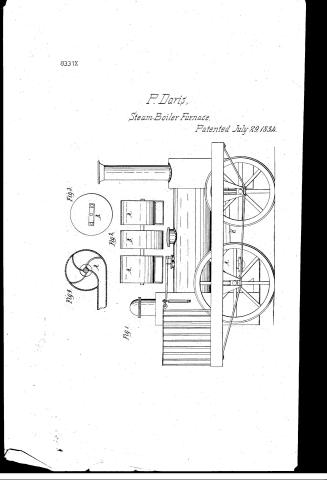
Phineas Davis' Patent Drawing for a Method of Promoting Combustion

National Archives, Restored Patent Drawings (Record Group 241) · Full-size scan at the National Archives · Catalog record
Text on the drawing
Words on the drawing as machine-read by the National Archives; not checked. Useful mainly for searching.
Boiler Cal / Claps Chal / Phincas Davis, / VOL 19.7. / 9-2- / Fuding / ASSIFICATION / Promoting Combustion Sc, / Paten ted 29 July 1834, / 8331-X / DIVISION. / Fight, side References. elevation of Loco motive, / Fig2, front / fansand steamwheel, / Fio₂ 3 side / steam wheelease, / Fig 4 section of fan base, / A fans. B. steam what C. eduction pipes. / Fight. / Fig 3 / Fight, / 1g / O O / Fift, / oiR / al / Paters Others / December / Made under the direction of the Commissioner of Patents / isi conformity with the ach of Congress of 3'ifmarch 1837 / Hh Sumoth / Commissioner of Date
USPTO scan
The patent as scanned by the USPTO
-
 Page 1
-
 Page 2
-
 Page 3
-
 Page 4


U.S. Patent and Trademark Office · Google Patents
Published accounts: specification
Specification printed in the Journal of the Franklin Institute
Journal of the Franklin Institute, new ser., vol. 15 (1835), p. 113 · View the page
Text of the specification as printed in the Journal, from OCR; not proofread.
Specification of a Patent for an improvement in the mode of Chilling Cast Iron Wheels for Rail-road Cars. Granted to PHINEAS DAVIS, Civil Engineer, city of Baltimore, July 29th, 1834. Whereas, it has been found that, in the casting of what are called chilled wheels, for rail-road cars, that the part of the wheel which is most liable to wear, namely, the rise, cone, or curve, between the tread of the wheel and the flanch, is usually less hard than the other parts, for the obvious reason that the metal is there less rapidly cooled by the chill: Now, be it known, that I, Phineas Davis, of the city of Baltimore, in the state of Maryland, have invented a new and improved mode of chilling such wheels, in which, by the cooling influence of a hoop, or ring, of wrought iron, made and placed in the flask, or mould, at the time of casting, in a way to be presently set forth, I have succeeded in removing this difficulty; and I do hereby declare that the following is a full and exact description thereof. Those acquainted with the business of casting iron, are aware that the operation of chilling consists in placing within the mould, so as to make a part thereof, a piece, or pieces, of iron, which, when the metal is poured in, rapidly cools that portion with which it is in contact, and renders it hard. In the casting of wheels for rail-road cars, the chill consists of an iron hoop, of considerable thickness, and with which the whole face of the wheel, including its flanch and tread, is in contact; but from its form, as I have already indicated, there is one part of it, uniting the tread with the flanch, which is less rapidly cooled than the others. To remove this difficulty, I employ what may be denominated an internal chill; this consists of an iron hoop, or ring, which I usually form of round rods, half an inch in diameter, giving to the hoop, or ring, such a diameter as shall cause it, when laid in the flask, and the casting made, to be surrounded by, and completely imbedded within, the cast metal, and to stand about half an inch within the body of that part of the wheel which forms the curve, or cone, before spoken of, and opposite the centre thereof. But as, in the usual thickness of the rims of such wheels, the said ring would be covered on the inside by only a thin shell of metal, I form such a bead, projection, or thickening, opposite thereto, on the inside of the pattern of the wheel, as will cause the metal to cover it, about three-eighths of an inch. Iron founders are well acquainted with the means of supporting such articles as the before described ring, within the flask, so that they may be embraced within the cast metal. The method which I have adopted of effecting this in my wheels, is the following. I take VOL. XV.-No. 2. - FEBRUARY, 1835. 15 four strips of iron, which may be one-tenth of an inch thick, one-fourth of an inch broad, and four or five inches long, and one end of each of these I bend round the ring, so as to clasp it tightly, the remainder of the strap forming a shank, or bearing, which rests upon the sand in the lower flask. These clasps stand at equal distances apart, and, when in the mould, point towards the centre of the wheel. The pattern must be so made, that the parting of the sand in the flask will be opposite to the centre of the ring. Facing sand, of the usual description, should be used in making the mould. The ring, before being placed in the mould, should have its surface made bright, by filing, or otherwise. It must also be heated, say to the temperature of boiling water, to dissipate any moisture, or other evaporable matter, which might otherwise cause it to blow. The casting should be performed immediately after placing the ring in the flask. Although I have described the mode of procedure in casting, and in other parts of the process for forming wheels within which are imbedded a ring of wrought iron, I do not claim these as making any part of my invention; but I do claim the using of a hoop, or ring, of wrought iron, to be laid, and cast, within the body of a rail-road wheel, in such manner as to operate as an internal chill, to cool more rapidly, and consequently to harden, the part which I have described under the name of the curve, or cone thereof; I claim no more. PHINEAS DAVIS.
Published accounts: specification
Specification printed in the Journal of the Franklin Institute
Journal of the Franklin Institute, new ser., vol. 15 (1835), p. 114 · View the page
Text of the specification as printed in the Journal, from OCR; not proofread.
Specification of a Patent for Promoting the Combustion of Anthracite in Locomotive, and other Steam Engines. Granted to PHINEAS DAVIS, Civil Engineer, city of Baltimore, July 29th, 1834. Be it known to whomsoever it may concern, that I, Phineas Davis, of Baltimore, in the state of Maryland, have invented a new mode of promoting the combustion of anthracite, and other fuel, in the furnaces, and fireplaces, of locomotive, and other steam engines, and that the following is a full and exact description of my said invention. The means by which I promote the combustion of anthracite, or other fuel, is by the employment of fan wheels, or vanes, revolving within drums, in a manner well known to machinists; and my improvement consists in the arrangement of the apparatus by which I employ the waste, or escape steam, to give motion to such fans, or vanes. For a locomotive engine, I usually employ two fan wheels, and I have found them, and their appendages, to answer well in practice, when made of the dimensions which I am about to indicate, although, in this particular, there may be considerable variation, without injury to the effect. The wheels may be from eighteen to twenty inches in diameter, and from ten to twelve inches wide; they may be placed upon the same axis, and at the distance of about eighteen inches from each other in the clear; in many instances, two vanes to each wheel will be sufficient, but a greater number may be used; the drums within which the wheels revolve, do not differ from those ordinarily employed in similar blowing machines. The wind is conducted from these drums through tubes seven or eight inches square, which lead from them in the direction of a tangent to the circle described by the wheels, into a tight ash pit under the grate of the furnace; and the air is thereby forced through the fuel with such velocity, as to cause the fire to burn with great energy, so as to produce an abundant supply of steam from anthracite, notwithstanding the tendency of that fuel to pack, and thereby to impede the ordinary draft, when employed for locomotive engines. In order to give motion to the fan wheels, I place a steam wheel upon the same shaft with them, generally at the centre thereof, so as to be equidistant from them. This steam wheel is constructed in the same manner, nearly, as the wind wheels, differing from them principally in its dimensions, and its being acted upon and impelled by an elastic fluid, (steam,) whilst they act upon and impel an elastic fluid, (air.) The steam wheel has usually four wings, or vanes, from three to five inches in width; and it may be from twenty to twenty-four inches in diameter. This wheel is enclosed within a drum, of such dimensions as just to allow the vanes to revolve freely within it. A tube connected with the exhaust pipe, from each end of the cylinder, enters the drums tangentically, and the waste steam is thus injected forcibly against the extreme ends of the vanes, impelling them, and consequently the wind wheels, with great velocity. The steam which thus enters escapes at an opening, or openings, in the centre of the drum, made similar to those at which the air enters from the action of, and to supply the, fan wheels. As it is necessary to command the blast, so as to regulate the intensity of the fire, which would often be too great were the whole of the waste steam discharged upon the steam wheel, I attach a branch pipe to that which conducts the steam from the cylinder, or cylinders, to the steam wheel, and employ a valve, or valves, so arranged as to enable me to direct the whole, or any desired portion, of the steam, through such branch pipe, and thus attain the desired object in the most perfect manner. The continued fresh supply of steam, and the diminished centrifugal force of that which has acted upon the vanes, continues, however, to operate until the moment of its escape at the opening surrounding the centre, provided the parts are properly proportioned to each other, for although its energy is diminished, so also is the actual velocity of the vane, as the centre is approached. The opening in the steam wheel, for the escape of steam, I usually make on one side only, and cover this with a cap, or drum, and from this cap, or drum, a tube extends upwards to carry off the steam in such a way that no inconvenience may be experienced by its discharge. Although I intend always to use the waste steam from the cylinder, or cylinders, it is manifest that steam may be supplied from the boiler, to act upon the steam wheel; but this procedure would not be economical, and would yet be a manifest invasion of my rights. I am aware that wind wheels, such as I have described, have been used to supply a blast to the furnaces of locomotive engines; I am also aware that wheels have been propelled by the action of steam upon wings, or vanes, surrounding them; I do not, therefore, claim either of these, singly and separately, as my invention; but what I do claim is the combination and arrangement of the parts such as I have described, by which the waste, or escape steam, is made to act upon vanes revolving within a drum, for the purpose of giving motion to wind wheels, to feed the furnaces of steam engines. And I do hereby declare, that I have herein explained and set forth what I believe to be the best method of applying the waste steam to accomplish the proposed object, but that I do not intend thereby to confine myself to this precise mode of construction and arrangement, but to vary the same as I may find convenient, whilst I operate upon the same principle, and attain a like end by analogous means. PHINEAS DAVIS. ENGLISH PATENTS.
Published accounts: journal notice
Notice in the monthly list of patents, with remarks
Journal of the Franklin Institute, new ser., vol. 15 (1835), p. 110 · View the page
48. For promoting the Combustion of Anthracite, in Locomotive, and other Steam Engines; Phineas Davis, Civil Engineer, city of Baltimore, July 29.
Remarks. (See the specification.)
About this record
- Patentee
- DATAMP
- Date
- the Name and Date index of patents, DATAMP, USPTO records
- Invention
- DATAMP
- Listed in
- the Name and Date index of patents, DATAMP, USPTO records, Jim Shaw's X-patent list, the Journal of the Franklin Institute, Burke's List of Patents (1847)
- in_burke