

Drawings and documents
National Archives restored drawings: drawing
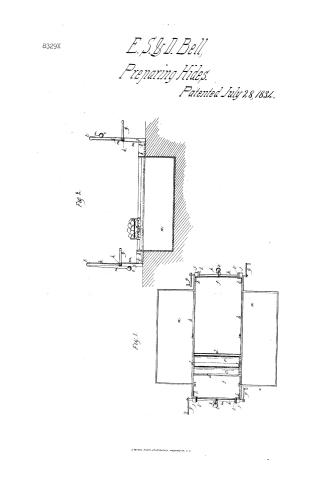
E. S. and D. Bell's Patent Drawing for a Machine for Tanning

National Archives, Restored Patent Drawings (Record Group 241) · Full-size scan at the National Archives · Catalog record
Text on the drawing
Words on the drawing as machine-read by the National Archives; not checked. Useful mainly for searching.
for / 149, Hides, Skins and Leather, / Apparatus, / 9. Tanning. / 3, / CLASSI TICATION / 8329, X / DIVISION. / E.S g D.BELL. TANNING. / Patented July 28th 1834. / Figure 1. / Figure 2. / References. / Patent Office 30th Ine 1838 / Fight For view of the platform and Two vats / Fig 2. Vertical vien of the playorm & vertical section of vat / f bed of platform of S. cranks h. shafts i counter weighths / a. The vats 1. sicles platform C. rollers a. roller frame / the direction of the Commipioner of / j crank posts R. neight posts 2. pulleys. m. cords / Patentsin conformity with act3 March 1837 / ML Sumor the / Commissioner of Patents,
USPTO scan
The patent as scanned by the USPTO
-
 Page 1
-
 Page 2
-
 Page 3
-
 Page 4
-
 Page 5
-
 Page 6


U.S. Patent and Trademark Office · Google Patents
Published accounts: journal notice
Notice in the monthly list of patents
Journal of the Franklin Institute, new ser., vol. 15 (1835), p. 109 · View the page
44. For improvements in the Process of Tanning; Edward S. and Daniel Bell, Smithfield, Jefferson county, Virginia, July 28.
Published accounts: journal notice
Notice in the monthly list of patents, with remarks
Journal of the Franklin Institute, new ser., vol. 15 (1835), p. 111 · View the page
Although I have designated the dimensions of certain parts of this apparatus, I do not intend thereby to limit myself in this particular, as these admeasurements may be departed from, and the particular arrangement varied, whilst the principle of action will remain the same; as, for example, the concave may be placed below the cylinder, and the hair carried downwards; the mode of gearing, also, and the number of rows of pins, &c., may be changed. I do not, therefore, claim the separate parts herein described; but what I do claim as my invention, is the employment of a cylinder and concave, furnished with points, and operating in the manner set forth, by which it is adapted to the picking of curled hair, instead of picking the same by hand, as has heretofore been practised. JOHN THOMPSON. Description of certain improvements in the Process of Tanning. Patented by EDWARD S. and DANIEL BELL, Smithfield, Jefferson county, Virginia, July 28th, 1834.
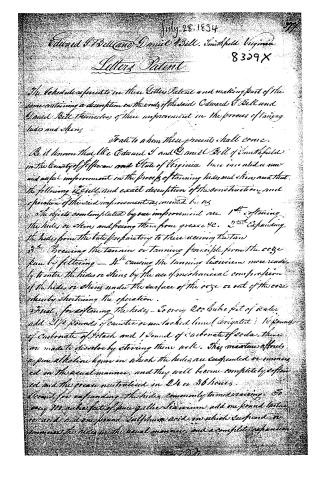
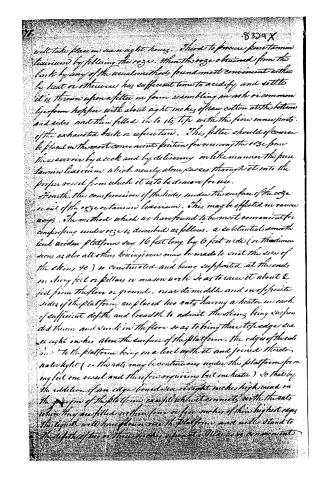
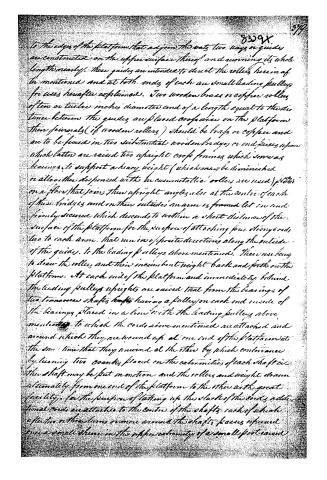
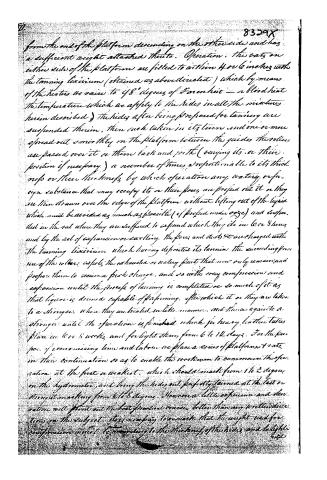
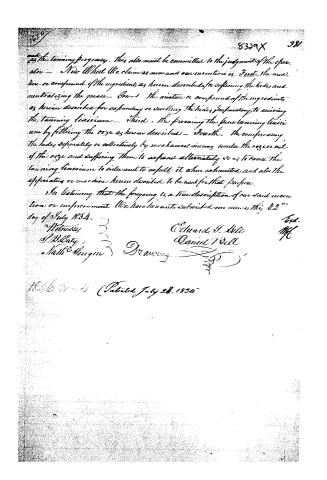
Remarks. The objects of the improved modes of procedure for which this patent is obtained, are, First. The softening the hides, or skins, and the freeing them from grease. Secondly. Expanding the hides preparatory to their receiving the tan. Thirdly. The procuring the tannin, or tanning principle, from the ooze, pure, by filtering. Fourthly. Causing the tanning lixivium more readily to enter the hides, by the use of mechanical compression made upon them, under the surface of the ooze, and thereby shortening the operation. BELL'S Improvement in Tanning. The claims made are to the modes, and apparatus, adopted for the attainment of these ends. For softening the hides, twenty-one and a half pounds of caustic lime, unslaked, and levigated, and sixteen pounds of carbonate of potash, and one pound of carbonate of soda, are to be added to every two hundred cubic feet of water. In the alkaline liquor thus formed, the hides are to be suspended in the usual way, by which means they will be completely softened, and have their grease neutralized, in from twenty-four to thirty-six hours. The expanding or raising, of the hides is to be effected by adding to every hundred feet of pure gallic lixivium, one pound of tartaric, and one pound of sulphuric, acids; by suspending the hides in this solution, a complete expansion, it is said, will take place in six or eight hours. To procure the tanning liquid pure, the ooze, after having been obtained from the bark, is to be filtered by putting it into a vessel of the nature of the common hopper for obtaining ley, the bottom and sides of which are to be covered with about eight inches of raw cotton, and filled in with fine refuse tan, or exhausted bark. Through this the pure tanning liquor is to be passed, and collected in a proper receptacle. The most important part of the process, however, appears to be the following, namely, the subjecting the hides or skins to mechanical pressure under the surface of the ooze, or tanning liquor. The apparatus employed for this purpose is fully described, and well represented in the drawing. A platform is to be made, and placed upon firm supports, which platform may be situated between two vats containing ooze, and in which the hides are suspended. The platform stands a few inches below the level of the ooze in the vats, which is admitted to flow over it, there being ledges which serve to retain it upon the platform. Upon this platform, the hides are to be submitted to the requisite degree of pressure. The tanning liquid is to be kept, by means of heaters, at a temperature of 98° Fahrenheit. The hides are to be taken from the vats, and spread smoothly upon the platform, and then a kind of carriage, sustained upon two long rollers of wood, or brass, is made to pass over them, the carriage being loaded with such a weight as may be necessary for the skins to be operated upon. The guides, ways, friction rollers, pulleys, &c., which are employed in the moving of this carriage back and forth, we need not describe. The object of this pressure is to remove the watery particles from the pores, which are left there after the ooze has become exhausted by the combination of its tannin with the skin; the pores are thus closed, and the skin condensed, and in that state it is to be slipped again into the vat, without exposing it to the air, where, in the course of six or eight hours, it will again be expanded by the refilling of the pores with fresh ooze. This operation is to be repeated, employing a stronger tanning liquid after the first has produced all the effect expected from it; and thus, in succession, a stronger and stronger, until the process is completed, "which, for heavy leather, takes place in six or eight weeks, and for light skins, in from six to twelve days. DAVIS'S Mode of Chilling Cast Iron Wheels.
About this record
- Patentee
- DATAMP
- Date
- the Name and Date index of patents, DATAMP, USPTO records
- Invention
- DATAMP
- Listed in
- the Name and Date index of patents, DATAMP, USPTO records, Jim Shaw's X-patent list, the Journal of the Franklin Institute, Burke's List of Patents (1847)
- in_burke