

Drawings and documents
National Archives restored drawings: drawing
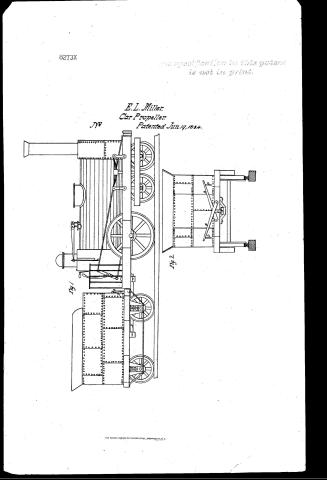
C.L. Miller Patent Drawing for a Method of Increasing Adhesion of the Driving Wheels of Locomotive Engines

National Archives, Restored Patent Drawings (Record Group 241) · Full-size scan at the National Archives · Catalog record
Text on the drawing
Words on the drawing as machine-read by the National Archives; not checked. Useful mainly for searching.
105. Railway Rolling Stock / believing / Locomo / Traction / 6. L. Miller propetting / Increasine Adhesion of Driving Wheels / Locomotions / COASSIFICATION / 8273 / Locormotion / of Locomotive Engines, / Traction Increases / Patented 17.June 1534. / DIVISION. DI / 105. RAILWAY CARS, / Locomotives. / Fif.1. / Full, / .... / 0000000 / U. / OF / Re ferences, / Fift. Incornative + tenderside view / Patent Office beary 1841 / Fid.2. tender front view, / Made under the direction of the Commipions of Patents / Alever connecting Engine / in conformity with act of bengreps March 1837 / B.B. crop levers. to throw weight of tenderon / Engine. d fulerum pin attached to lever A upon which / 428mm Mr / levers B prefs. D. hooks to hold down levers, / Commification of Patents,
USPTO scan
The patent as scanned by the USPTO
-
 Page 1
-
 Page 2
-
 Page 3


U.S. Patent and Trademark Office · Google Patents
Published accounts: specification
Specification printed in the Journal of the Franklin Institute
Journal of the Franklin Institute, new ser., vol. 15 (1835), p. 48 · View the page
Text of the specification as printed in the Journal, from OCR; not proofread.
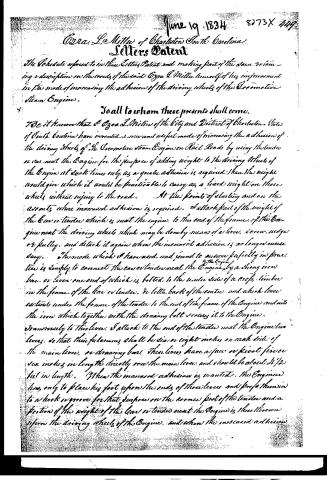
Specification of a Patent for a mode of increasing the adhesion of the driving wheels of the Locomotive Steam Engine. Granted to EZRA L. MILLER, Charleston, South Carolina, June 19th, 1834. To all to whom these presents shall come, be it known, that I, Ezra L. Miller, of the city and district of Charleston, state of South Carolina, have invented a new and useful mode of increasing the adhesion of the driving wheels of the locomotive steam engine on railroads, by using the tender, or car, next the engine, for the purpose of adding weight to the driving wheels of the engine, at such times only as a greater adhesion is required than the weight would give, which it would be practicable to carry as a fixed weight on those wheels, without injury to the road. At the points of starting, and on the ascents where increased adhesion is required, I attach part of the weight of the car, or tender, which is next the engine, to the end of the frame of the engine next the driving wheels, which may be done by means of a lever, screw, wedge, or pulley, and detach it again, when the increased adhesion is no longer necessary. The mode which I have used, and found to answer perfectly in practice, is simply to connect the car, or tender, next the engine, to the engine, by a strong iron bar, or lever, one end of which is bolted to the under side of a cross timber in the frame of the car, or tender, a little back of the centre, and which lever extends under the frame of the tender, to the end of the frame of the engine, and into the iron which, together with the drawing bolt, secures it to the engine. Transversely to this lever, I attach to the end of the tender next the engine, two levers, so that their fulcra shall be six or eight inches on each side of the main lever, or drawing bar. These levers have a jaw, or pivot, five or six inches in length, directly over the main lever, and should be about 44 feet in length. When the increased adhesion is wanted, the engineer has only to place his foot upon the ends of these levers, and press them into a hook, or groove, for that purpose, on the corner post of the tender; and a portion of the weight of the car, or tender, next the engine, is thus thrown upon the driving wheels of the tender; and when the increased adhesion is no longer wanted, this weight is detached by simply loosening the ends of the levers. What I claim as my invention, is the making use of the car, or tender, next the engine, for the purpose of increasing the adhesion of the driving wheels of the locomotive steam engine, at those points where more adhesion is required than the weight would give, which it is eligible to carry as a fixed weight on those wheels, whether the same be effected in the mode above described, or any other which attains the same end. E. L. MILLER.
Published accounts: journal notice
Notice in the monthly list of patents, with remarks
Journal of the Franklin Institute, new ser., vol. 15 (1835), p. 43 · View the page
43. For a mode of Increasing the adhesion of the Driving Wheels in the Locomotive Steam Engine; Ezra L. Miller, city of Charleston, South Carolina, June 19.
Remarks. (See the specification.)
Published accounts: journal notice
Notice in the monthly list of patents, with remarks
Journal of the Franklin Institute, new ser., vol. 15 (1835), p. 48 · View the page
After describing this machine, by the aid of several drawings, representing its construction in detail, the patentees say, "Most of the operative parts of the machine, as within described, are such as are well known, and are used in other machines, but differently combined together; we do not therefore claim them, in their individual characters, as making any part of our invention; but what we do claim, is the placing the main shaft, which carries the screw, vertically, and giving to it a continuous motion, by the general arrangement of the parts described. We also claim the mode of feeding herein set forth, as adapted to the motion of the vertical shaft, and we do hereby declare that whilst we claim the general principle, or mode of action, of the vertical shaft and its appendages, we do not intend to confine ourselves to the exact mode of construction herein set forth, but to vary the same in any manner which we may deem proper, whilst the principle of action remains the same, and similar effects are produced." SPECIFICATIONS OF AMERICAN PATENTS. Specification of a Patent for a mode of increasing the adhesion of the driving wheels of the Locomotive Steam Engine. Granted to EZRA L. MILLER, Charleston, South Carolina, June 19th, 1834.
Remarks. To all to whom these presents shall come, be it known, that I, Ezra L. Miller, of the city and district of Charleston, state of South Carolina, have invented a new and useful mode of increasing the adhesion of the driving wheels of the locomotive steam engine on railroads, by using the tender, or car, next the engine, for the purpose of adding weight to the driving wheels of the engine, at such times only as a greater adhesion is required than the weight would give, which it would be practicable to carry as a fixed weight on those wheels, without injury to the road. At the points of starting, and on the ascents where increased adhesion is required, I attach part of the weight of the car, or tender, which is next the engine, to the end of the frame of the engine next the driving wheels, which may be done by means of a lever, screw, wedge, or pulley, and detach it again, when the increased adhesion is no longer necessary. The mode which I have used, and found to answer perfectly in practice, is simply to connect the car, or tender, next the engine, to the engine, by a strong iron bar, or lever, one end of which is bolted to the under side of a cross timber in the frame of the car, or tender, a little back of the centre, and which lever extends under the frame of the tender, to the end of the frame of the engine, and into the iron which, together with the drawing bolt, secures it to the engine. Transversely to this lever, I attach to the end of the tender next the engine, two levers, so that their fulcra shall be six or eight inches on each side of the main lever, or drawing bar. These levers have a jaw, or pivot, five or six inches in length, directly over the main lever, and should be about 44 feet in length.
Published accounts: journal notice
Notice in the monthly list of patents
Journal of the Franklin Institute, new ser., vol. 15 (1835), p. 49 · View the page
When the increased adhesion is wanted, the engineer has only to place his foot upon the ends of these levers, and press them into a hook, or groove, for that purpose, on the corner post of the tender; and a portion of the weight of the car, or tender, next the engine, is thus thrown upon the driving wheels of the tender; and when the increased adhesion is no longer wanted, this weight is detached by simply loosening the ends of the levers. What I claim as my invention, is the making use of the car, or tender, next the engine, for the purpose of increasing the adhesion of the driving wheels of the locomotive steam engine, at those points where more adhesion is required than the weight would give, which it is eligible to carry as a fixed weight on those wheels, whether the same be effected in the mode above described, or any other which attains the same end. E. L. MILLER. Specification of a Patent for an improvement in the mode of manufacturing Vinegar. Granted to EDWARD CLARK, Saugerties, Ulster county, New York, June 19th, 1834.
About this record
- Patentee
- DATAMP
- Date
- the Name and Date index of patents, DATAMP, USPTO records
- Invention
- DATAMP
- Listed in
- the Name and Date index of patents, DATAMP, USPTO records, Jim Shaw's X-patent list, the Journal of the Franklin Institute, Burke's List of Patents (1847)
- in_burke