

Drawings and documents
USPTO scan
The patent as scanned by the USPTO
-
 Page 1
-
 Page 2
-
 Page 3


U.S. Patent and Trademark Office · Google Patents
Published accounts: specification
Specification printed in the Journal of the Franklin Institute
Journal of the Franklin Institute, new ser., vol. 14 (1834), p. 341 · View the page
Text of the specification as printed in the Journal, from OCR; not proofread.
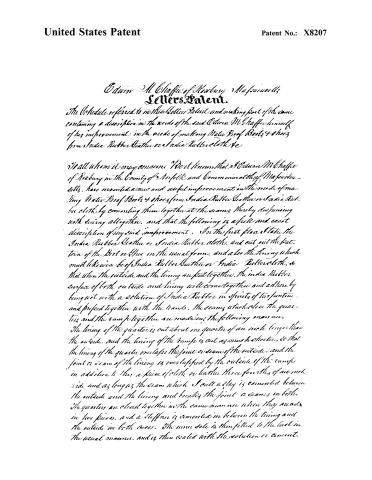
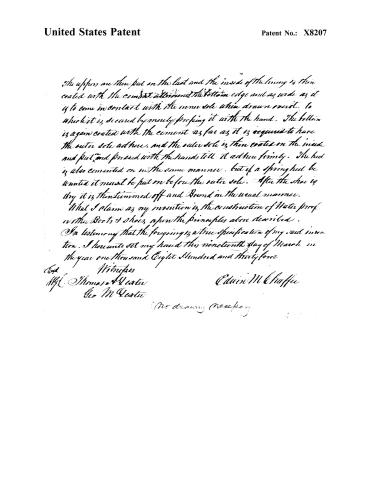
Specification of a patent for an improvement in the mode of making Water Proof Boots and Shoes. Granted to EDWIN M. CHAFFEE, Roxbury, Norfolk county, Massachusetts, May 17th, 1834. To all whom it may concern, be it known, that I, Edwin M. Chaffee, of Roxbury, in the county of Norfolk, and commonwealth of Massachusetts, have invented a new and useful improvement in the mode of making water proof boots and shoes, from India rubber leather, or India rubber cloth, by cementing them together at the seams, thereby dispensing with sewing altogether; and that the following is a full and exact description of my said improvement: In the first place, I take the India rubber leather, or India rubber cloth, and cut out the pattern of the boot or shoe in the usual form, and also the lining, which must likewise be of India rubber leather, or India rubber cloth, so that, when the outside and the lining are put together, the India rubber surface of both outside and lining will come together, and adhere, on being wet with a solution of India rubber in spirits of turpentine, and pressed together with the hands. The seams which close the quarter and the vamp together, are made in the following manner. The lining of the quarters is cut about one-quarter of an inch longer than the outside, and the lining of the vamp is cut as much shorter, so that the lining of the quarter overlaps the joint or seam of the outside, and the joint or seam of the lining is overlapped by the outside of the vamp. In addition to this, a piece of cloth or leather, three-fourths of an inch wide, and as long as the seam, which I call a stay, is cemented between the outside and the lining, and breaks the joint or seams of both. The quarters are closed together in the same manner when they are cut in two pieces, and a HULLMANDEL's Improvement in Calico Printing. stiffener is cemented in between the lining and the outside, in both cases. The inner sole is then fitted to the last in the usual manner, and is then coated with the solution, or cement. The uppers are then put on the last, and the inside of the lining is then coated with the cement around the bottom edge, and as wide as it is to come in contact with the inner sole, when drawn over it, to which it is secured by merely pressing it with the hand. The bottom is again coated with the cement, as far it is required to have the outer sole adhere, and the outer sole is then coated on the inside, and put on, and pressed with the hands, till it adheres firmly. The heel is also cemented on in the same manner; but if a spring heel be wanted, it must be put on before the outer sole. After the shoe is dry, it is then trimmed off, and bound in the usual manner. What I claim as my improvement, is, the construction of water proof, or other boots and shoes, upon the principles above described. EDWIN M. CHAFFEE.
Editor's remarks. On a late visit to Boston, near to which is the manufactory of these shoes, and of other articles rendered water proof by means of India rubber, we had an opportunity of examining them in great variety. They are perfectly neat in their appearance, and we see no reason to doubt their durability; they are not, when on, and scarcely when off, distinguishable from those made in the usual way; and for ladies especially, to whom fashion has assigned a covering for the foot, which affords it but little protection against wet, they are especially desirable. But, although all ought to have them, they are not adapted to general use. Shoes made water proof, in any way, confine the perspiration of the feet, and would soon, even in cool weather, but more especially in summer, produce very unpleasant effects, as has frequently been noticed by those who have persevered in using them. Mr. Samuel D. Breed, of Philadelphia, has a previous patent for attaching soles to shoes by means of India rubber. ENGLISH PATENTS.
Published accounts: journal notice
Notice in the monthly list of patents
Journal of the Franklin Institute, new ser., vol. 14 (1834), p. 401 · View the page
51 30. For Water Proof Boots and Shoes, from India Rubber Leather, or India Rubber Cloth; Edwin M. Chaffee, Roxbury, Norfolk county, Massachusetts, May 17.
About this record
- Patentee
- DATAMP
- Date
- the Name and Date index of patents, DATAMP, USPTO records
- Invention
- DATAMP
- Listed in
- the Name and Date index of patents, DATAMP, USPTO records, Jim Shaw's X-patent list, the Journal of the Franklin Institute, Burke's List of Patents (1847)
- The Franklin Institute's journal spells the name differently.
- in_burke