

Drawings and documents
National Archives restored drawings: drawing
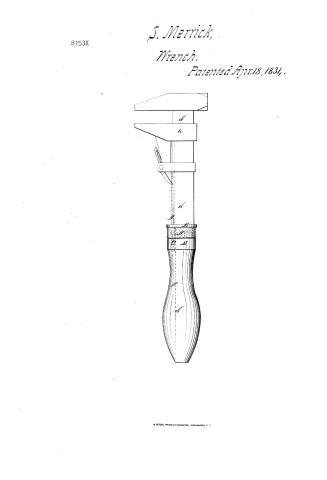
Solvman Merrick's Patent Drawing for a Rack Wrench

National Archives, Restored Patent Drawings (Record Group 241) · Full-size scan at the National Archives · Catalog record
Text on the drawing
Words on the drawing as machine-read by the National Archives; not checked. Useful mainly for searching.
Solvman Merrick / 81. METAL WORKING TOOL3, / Hat and pipé wrenches, / Sliding-jaw, / Rack, / Rack Wrench. / Pivoted-lock. / Pat'd. Apr. 18. 1834, / ASSICICATION / 8153 + / IIV ISION. / no number / Teeth may be at equal or at / graduated distances as shown. / collar. milled mint to pride ther macksB / collar / References. / A B. aa The mam barnith a groove. / The sliding Rack roith / spiral grooves at C / D nut / E.E.Collars / F Wooden handle / 1838 / G The jaw rith the spring click. / Patent office 14 July / Made box under the direction of the C. / of Patents in conformity with act2 / clich 1837. / Md Subrow / Comminipioner Palents of
USPTO scan
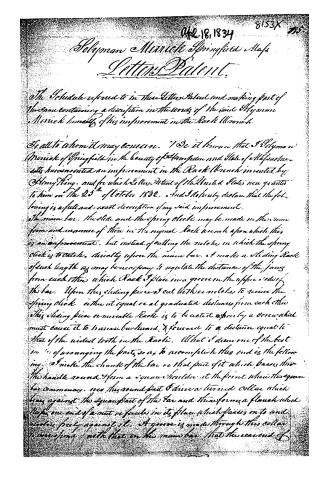
The patent as scanned by the USPTO
-
 Page 1
-
 Page 2
-
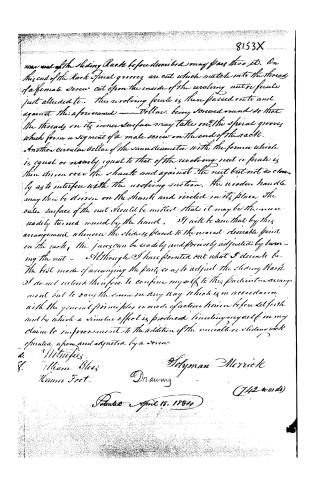 Page 3


U.S. Patent and Trademark Office · Google Patents
Published accounts: specification
Specification printed in the Journal of the Franklin Institute
Journal of the Franklin Institute, new ser., vol. 14 (1834), p. 340 · View the page
Text of the specification as printed in the Journal, from OCR; not proofread.
Specification of a patent for an improvement on the Rack Wrench patented by Henry King. Granted to SOLYMAN MERRICK, Springfield, Hampden county, Massachusetts, April 18, 1834. To all whom it may concern, be it known, that I, Solyman Merrick, of Springfield, in the county of Hampden, and state of Massachusetts, have invented an improvement in the Rack Wrench invented by Henry King, and for which letters patent of the United States were granted unto him, on the 25th of October, 1832; and I do hereby declare that the following is a full and exact description of my said improvement. The main bar, the slide, and the spring click, may be made in the same form and manner as those in the original Rack Wrench upon which this is an improvement; but instead of cutting the notches in which the spring click is to catch, directly upon the main bar, I make a sliding rack, of such length as may be necessary to regulate the distance of the jaws from each other, which rack I place in a groove on the upper side of the bar. Upon this sliding piece I cut teeth, or notches, to receive the spring click, either at equal or at graduated distances from each other. This sliding piece, or movable rack, is to be acted on by a screw, which must cause it to traverse backward and forward to a distance equal to that of the widest tooth in the rack. What I deem one of the best modes of arranging the parts so as to accomplish this end, is the following. I make the shank of the bar, or that part of it which passes through the handle thereof, round, and form a square shoulder at the point where the square bar commences; over this round part I drive a turned collar, which bears against the square part of the bar, and there forms a flanch, which keeps one end of a nut, or ferule, in its place, which passes on to, and revolves freely against it. A groove is made through this collar, to correspond with that on the main bar, that the rear end of the sliding rack, before described, may pass through it. On this end of the rack, spiral grooves are cut, which match into the threads of a female screw cut upon the inside of the revolving nut, or ferule, just alluded to. This revolving ferule is then passed on to, and against, the aforenamed collar, being screwed round so that the threads on its inner surface may take on to spiral grooves, which form a segment of a male screw on the end of the rack. Another circular collar, of the same diameter with the former, which is equal, or nearly equal, to that of the revolving nut or ferule, is then driven over the shank, and against the nut, but not so closely as to interfere with its revolving motion. The wooden handle may then be driven on the shank, and rivetted in its place. The outer surface of the nut should be milled, that it may be the more readily turned round by the hand. It will be seen that, by this arrangement, whenever the slide is placed to the nearest desirable point on the rack, the jaws can be readily and precisely adjusted by turning the nut. CHAFFEE'S Improvement in Water Proof Boots. Although I have pointed out what I deem to be the best mode of arranging the parts so as to adjust the sliding rack, I do not intend thereby to confine myself to this particular arrangement, but to vary the same in any way which is in accordance with the general principle or mode of action hereinbefore set forth, and by which a similar effect is produced; limiting myself, in my claim to improvement, to the addition of the movable or sliding rack, operated upon, and adjusted, by a screw. SOLYMAN MERRICK.
Editor's remarks. We have seen some of these wrenches, and esteem them as not only the neatest, but the best articles of the kind that have ever been manufactured for sale. There are, we are informed, a considerable number of hands employed in making them; but the demand for them is so great, that they have not yet found their way, in numbers, to any great distance from the manufactory, in Springfield, Massachusetts. We have no doubt, that, in point of strength and durability, they excel, in a triplicate proportion, the imported wrenches of the same size; and they equally exceed them in point of workmanship, whilst they are afforded at but a small advance in price.
Published accounts: journal notice
Notice in the monthly list of patents, with remarks
Journal of the Franklin Institute, new ser., vol. 14 (1834), p. 331 · View the page
24. For an improvement on the Rack Wrench, invented by Henry King; Solyman Merrick, Springfield, Hampden county, Massachusetts, April 18.
Remarks. (See the specification.)
DATAMP: illustration
Illustrations from DATAMP
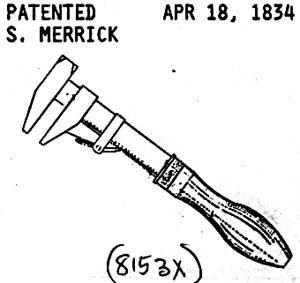

DATAMP (Directory of American Tool and Machinery Patents), via the Internet Archive · Archived DATAMP page
About this record
- Patentee
- DATAMP
- Date
- the Name and Date index of patents, DATAMP, USPTO records
- Invention
- DATAMP
- Listed in
- the Name and Date index of patents, DATAMP, USPTO records, Jim Shaw's X-patent list, the Journal of the Franklin Institute, Burke's List of Patents (1847)
- in_burke