

Drawings and documents
National Archives restored drawings: drawing
Zack Allen's Patent Drawing for Steam Engine Improvements

National Archives, Restored Patent Drawings (Record Group 241) · Full-size scan at the National Archives · Catalog record
Text on the drawing
Words on the drawing as machine-read by the National Archives; not checked. Useful mainly for searching.
121. STEAM-ENGINES / Valve-Gear / DoC 19 383 / Valves- St. Engines / CLASSI FICATION / 50 8114- / Value green / DIVISION / Catented mar, 28-1834 / 11 Voe Records 19-p533 P 533 / Lac of llens / Aeam Engine improvement / Patented 28 march 1834 / WORK / main shift of fengurs / the regulator: / to he / <<00 / 0000 / pully turned the by known serein * redewise / Bearing / ENLOYE abie / the which fuleriam works of the bir / Bearing / the end of their levu works a disk cutoff
USPTO scan
The patent as scanned by the USPTO
-
 Page 1
-
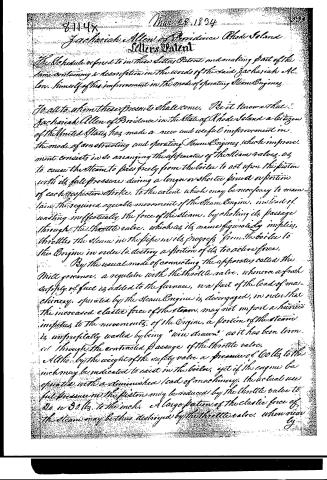 Page 2
-
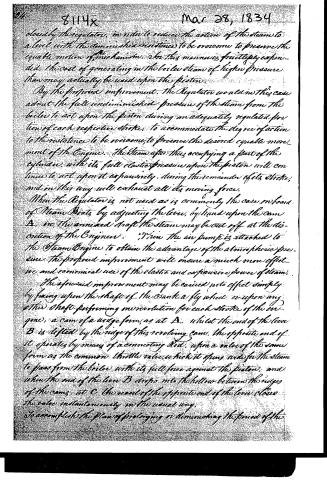 Page 3
-
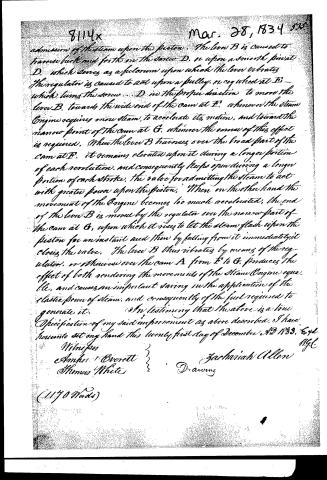 Page 4


U.S. Patent and Trademark Office · Google Patents
Published accounts: journal notice
Notice in the monthly list of patents, with remarks
Journal of the Franklin Institute, new ser., vol. 14 (1834), p. 256 · View the page
78. For an improvement in the Steam Engine; Zechariah Allen, Providence, Rhode Island, March 28.
Remarks. The intention of the improvement proposed in this patent, is the cutting off the steam at any desired part of the stroke, so as to allow it to work expansively during the remainder of it; and were we uninformed respecting what has been done upon this subject, the specification before us would lead to the conclusion that the effecting this was in itself a novelty, whilst those well acquainted with the history of the steam engine, are aware that it was done by Watt, and that at an early period of his career of improvements in the steam engine. Various plans have been devised for effecting this object, and the best engines are now thus worked. The patentee considers the ordinary action of the throttle valve, as operated upon by the regulator, to increase or diminish the supply of steam from the boiler to the cylinder, as destructive of the power of a considerable portion of steam, and says that his " improvement consists in so arranging the apparatus of the steam valves as to cause the steam to pass freely from the boiler to act upon the piston with its full pressure during a longer or shorter period, or portion of each respective stroke, instead of wasting ineffectually the force of the steam by choaking its passage through the throttle valve, which, as its name figuratively implies, throttles the steam in the pipe, in its progress from the boiler to the engine, in order to destroy a portion of its too active force." "A portion of the steam is unprofitably wasted by being wire drawn, as it has been termed, through the contracted passage of the throttle valve," and more to the same effect. We dissent entirely from this doctrine, being convinced that there is very little, if any, loss of power from the prescribed cause, but merely a diminished quantity expended, the remainder being packed in the boiler for future use. One of the advantages of using steam expansively, results from the accordance of its action with the crank motion, as connected with a reciprocating piston. The stroke is to be gradually stopped, at each end of the cylinder, and the admission of steam during the whole stroke, is necessarily wasteful in the extreme. We, however, must leave the discussion of this point, as occupying more space than can be here afforded to it. The patentee has described and figured a plan for cutting off the steam at different parts of the stroke, but as it appears to be intended as an exemplification of a general principle, he has not claimed it; in this point we think him incorrect, the principle being old, and the particular plan, we believe, new. The lever which is to open and close the valve of the induction pipe, is to be operated upon at its extreme end by a cam, the lifting part of which is wedge-shaped, and the lever being capable of bearing on its wide or its narrow end, opens the valve for a longer or a shorter period. The shaft, or axis, of the lever is a screw, and a whirl upon this shaft, acted upon by a regulator, or governor, causes the lever to traverse upon its shaft, and thus cuts off the steam at an earlier or a later period of the stroke.
DATAMP: illustration
Illustrations from DATAMP


DATAMP (Directory of American Tool and Machinery Patents), via the Internet Archive · Archived DATAMP page
About this record
- Patentee
- DATAMP
- Date
- the Name and Date index of patents, DATAMP, USPTO records
- Invention
- DATAMP
- Listed in
- the Name and Date index of patents, DATAMP, USPTO records, Jim Shaw's X-patent list, the Journal of the Franklin Institute, Burke's List of Patents (1847)
- in_burke