

Drawings and documents
USPTO scan
The patent as scanned by the USPTO
-
 Page 1
-
 Page 2
-
 Page 3


U.S. Patent and Trademark Office · Google Patents
Published accounts: specification
Specification printed in the Journal of the Franklin Institute
Journal of the Franklin Institute, new ser., vol. 14 (1834), p. 264 · View the page
Text of the specification as printed in the Journal, from OCR; not proofread.
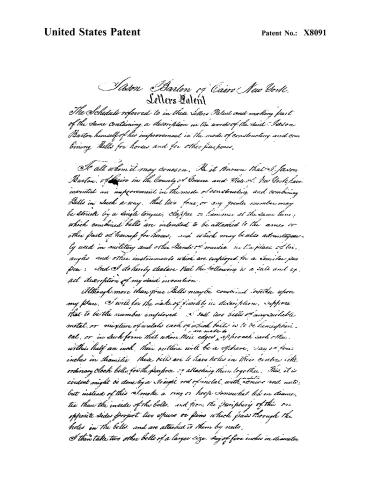
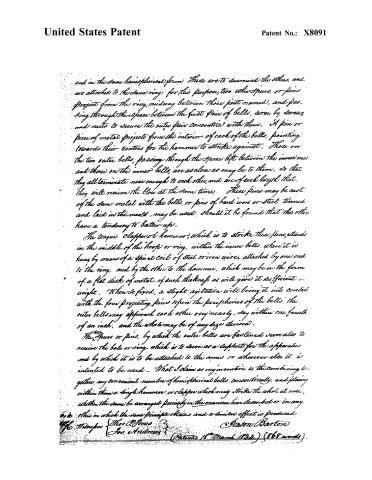
Specification of a patent for improvements in the mode of constructing and combining bells for horses. JASON BARTON, Cairo, Greene county, New York, March 18, 1834. To all whom it may concern, be it known, that I, Jason Barton, of Cairo, in the county of Greene, and state of New York, have invented an improvement in the mode of constructing and combining bells, in such a way that two, four, or a greater number, may be struck by a single tongue, clapper, or hammer, at the same time; which combined bells are intended to be attached to the ames, or other parts of harness for horses; and which may also be advantageously used in military and other bands of music, in the place of triangles, and other instruments which are employed for a similar purpose. And I do hereby declare that the following is a full and exact description of my said invention. Although more than four bells may be combined together upon my plan, I will, for the sake of facility in description, suppose that to be the number employed. I cast two bells, of any suitable metal, or mixture of metals, each of which bells is to be hemispherical, or in such form that when their edges are made to approach each other within half an inch, their outline will be a sphere, say of four inches in diameter; these bells are to have holes in their centres, like ordinary clock bells, for the purpose of attaching them together. This, it is evident, might be done by a straight rod of metal, with suitable screws and nuts; but instead of this, I make a ring, or hoop, somewhat less in diameter than the inside of the bells, and from the periphery of this, on opposite sides, project two spurs, or pins, which pass through the holes in the bells, and are attached to them by nuts. I then take two other bells of a larger size, say of five inches in diameter, and in the same hemispherical form. These are to surround the others, and are attached to the same ring; for this purpose, two other spurs, or pins, project from the ring, midway between those first named, and passing through the space between the first pair of bells, serve by screws and nuts to secure the outer pair concentric with them. A pin, or piece of metal, projects from the interior of each of the bells, pointing towards their centres, for the hammer to strike against. Those on the two outer bells pass through the space left between the inner ones, and those on the inner bells are as close as may be to them, so that they all terminate near enough to each other, and are of such length, that they will receive the blow at the same time. These pins may be cast of the same metal with the bells, or pins of hard iron or steel, tinned and laid in the mould, may be used, should it be found that the others have a tendency to batter up. The tongue, clapper, or hammer, which is to strike these pins, stands in the middle of the hoop, or ring, within the inner bells, where it is hung by means of a spiral coil of steel or iron wire, attached by RANKIN'S Patent for Cleaning Clover Seed. 1 one end to the ring, and by the other to the hammer, which may be in the form of a flat disk of metal, of such thickness as will give it sufficient weight. When so fixed, a slight agitation will bring it into contact with the four projecting pins upon the peripheries of the bells. The outer bells may approach each other very nearly, say within one-fourth of an inch; and the whole may be of any size desired. The two spurs, or pins, by which the outer bells are fastened, serve also to receive the bale, or ring, which is to serve as a support for the apparatus, and by which it is to be attached to the ames, or wherever else it is intended to be used. What I claim as my invention, is the combining together any convenient number of hemispherical bells, concentrically, and placing within them, a single hammer, or clapper, which may strike the whole at once, whether the same be arranged precisely in the manner here described, or in any other in which the same principle obtains, and a similar effect is produced. JASON BARTON.
Published accounts: journal notice
Notice in the monthly list of patents, with remarks
Journal of the Franklin Institute, new ser., vol. 14 (1834), p. 248 · View the page
55. For a mode of Constructing and Combining Bells for Horses; Jason Barton, Cairo, Greene county, New York, March 18.
Remarks. (See the specification.)
Published accounts: journal notice
Notice in the monthly list of patents, with remarks
Journal of the Franklin Institute, new ser., vol. 14 (1834), p. 263 · View the page
I also claim the spiral propelling wheel, constructed and operating in the manner which I have set forth; and likewise the application of the revolving vertical shaft to the turning of a capstan on the deck of a vessel. Not intending, in either of these parts, to confine myself to precise forms or dimensions, but to vary them in such manner as BARTON'S Improvements in Combining Bells. experience or convenience may dictate, whilst the principle of action remains unchanged, and similar results are produced by similar means. JOHN B. EMERSON. Specification of a patent for improvements in the mode of constructing and combining bells for horses. JASON BARTON, Cairo, Greene county, New York, March 18, 1834.
Remarks. To all whom it may concern, be it known, that I, Jason Barton, of Cairo, in the county of Greene, and state of New York, have invented an improvement in the mode of constructing and combining bells, in such a way that two, four, or a greater number, may be struck by a single tongue, clapper, or hammer, at the same time; which combined bells are intended to be attached to the ames, or other parts of harness for horses; and which may also be advantageously used in military and other bands of music, in the place of triangles, and other instruments which are employed for a similar purpose. And I do hereby declare that the following is a full and exact description of my said invention. Although more than four bells may be combined together upon my plan, I will, for the sake of facility in description, suppose that to be the number employed. I cast two bells, of any suitable metal, or mixture of metals, each of which bells is to be hemispherical, or in such form that when their edges are made to approach each other within half an inch, their outline will be a sphere, say of four inches in diameter; these bells are to have holes in their centres, like ordinary clock bells, for the purpose of attaching them together. This, it is evident, might be done by a straight rod of metal, with suitable screws and nuts; but instead of this, I make a ring, or hoop, somewhat less in diameter than the inside of the bells, and from the periphery of this, on opposite sides, project two spurs, or pins, which pass through the holes in the bells, and are attached to them by nuts. I then take two other bells of a larger size, say of five inches in diameter, and in the same hemispherical form. These are to surround the others, and are attached to the same ring; for this purpose, two other spurs, or pins, project from the ring, midway between those first named, and passing through the space between the first pair of bells, serve by screws and nuts to secure the outer pair concentric with them. A pin, or piece of metal, projects from the interior of each of the bells, pointing towards their centres, for the hammer to strike against. Those on the two outer bells pass through the space left between the inner ones, and those on the inner bells are as close as may be to them, so that they all terminate near enough to each other, and are of such length, that they will receive the blow at the same time. These pins may be cast of the same metal with the bells, or pins of hard iron or steel, tinned and laid in the mould, may be used, should it be found that the others have a tendency to batter up. The tongue, clapper, or hammer, which is to strike these pins, stands in the middle of the hoop, or ring, within the inner bells, where it is hung by means of a spiral coil of steel or iron wire, attached by RANKIN'S Patent for Cleaning Clover Seed. 1 one end to the ring, and by the other to the hammer, which may be in the form of a flat disk of metal, of such thickness as will give it sufficient weight. When so fixed, a slight agitation will bring it into contact with the four projecting pins upon the peripheries of the bells.
About this record
- Patentee
- DATAMP
- Date
- the Name and Date index of patents, DATAMP, USPTO records
- Invention
- DATAMP
- Listed in
- the Name and Date index of patents, DATAMP, USPTO records, Jim Shaw's X-patent list, the Journal of the Franklin Institute, Burke's List of Patents (1847)
- in_burke