

Drawings and documents
National Archives restored drawings: drawing
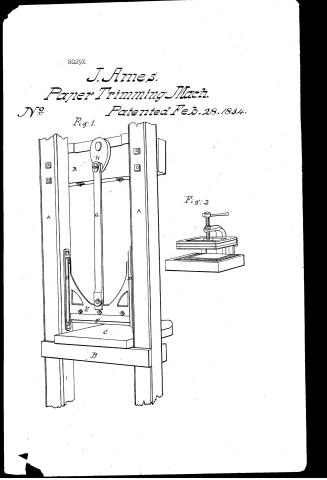
John Ames' Patent Drawing for a Machine for Trimming Paper

National Archives, Restored Patent Drawings (Record Group 241) · Full-size scan at the National Archives · Catalog record
Text on the drawing
Words on the drawing as machine-read by the National Archives; not checked. Useful mainly for searching.
Book Cutting. / CLASSI TICATION / 8029. X / DIVISION. / JOHN AMES / Mchine for trimming / paper. / Patentee 28th February 1834. / 1. / 2 Prels. / 000000 / AA Studs or posts / BB Beams / c platform / DD grooved plates of metal / E Knife carriage. / F Knife. / a Shaft or Sweep / H Crank towhich the shaft is attached. / ON / OF
USPTO scan
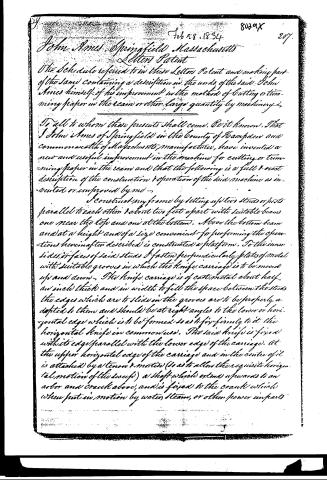
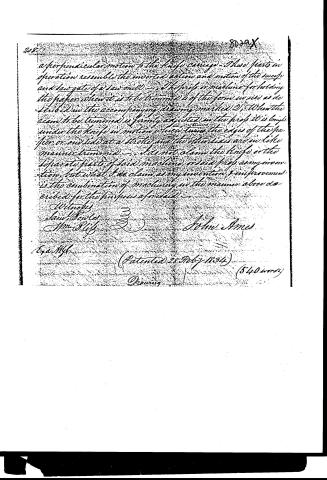
The patent as scanned by the USPTO
-
 Page 1
-
 Page 2
-
 Page 3


U.S. Patent and Trademark Office · Google Patents
Published accounts: journal notice
Notice in the monthly list of patents, with remarks
Journal of the Franklin Institute, new ser., vol. 14 (1834), p. 186 · View the page
"What I claim as my invention," says the patentee, " and for which I ask a patent, is the affixing to frames for cellar windows, and for other purposes, of wire wove with square meshes, when extended so as to form rhombs, or diamond formed openings, which shall stand with their opposite angles in the same vertical and horizontal lines; thereby giving to them an appearance similar to those frames which are covered with wire work prepared by hand, and having the meshes in the form described." American Patents for February, with Remarks 35. For a mode of Preparing Hard Tallow, or Stearine; Carl G. Ritner, Cincinnati, Hamilton county, Ohio, February 18.
Remarks. Fifty pounds of tallow, two of sulphuric or of nitric acid, and twenty-five of rain water, are to be boiled together, and kept constantly stirred for an hour. They are then to be poured into a strong wooden tub, with a close cover, and to remain at rest, gradually cooling for twenty-four hours, in which time the oily and solid parts will separate, the latter being granular. The whole is then to be placed in a suitable case, or tub, to be pressed, the bottom and sides of said tub being perforated, and a cloth sufficiently large to surround and cover the materials being first laid within it; willow hurdles are also to be placed between every layer of three inches. On making pressure, the oil will run out to the amount of twenty-five per cent. of the mass. "The hard tallow, which I now call strahein [qu.] is taken from the cask, and put back into the kettle, with twenty pounds of soft water, four ounces cream tartar, and four ounces allum, which must be boiled and skimmed until clear. As this tallow is brittle, in order to give it the requisite elasticity, add one-eighth pound of bees-wax, to each pound of tallow." Another method proposed is the following:- A clear ley is to be made from four pounds of pearl ash, and four of quick lime; this is to be put into a copper kettle, boiled, and stirred, for three hours "until it becomes a mush, by taking a little of which in a tumbler of cold water, it will dissolve like soap; this, when cold, is cleaned like first process, and pressed." The foregoing is the conclusion of the specification, and it will be seen, therefore, that the patentee has not informed us how much of the foregoing processes he claims as new, nor does he appear to possess any correct knowledge of the nature of the operation which he describes; this latter circumstance, however, would be one of little importance as regards the validity of his patent, were his processes new and useful. The soap maker rarely understands the nature of the chemical changes which take place from the action of the alkalies on the fatty matter which he employs; but if he mixes his ingredients, and treats them correctly, his soap will be just as good as that made by a more scientific manipulator. The two processes are supposed by the patentee to produce analogous results, but in this point he is in error, nor will he by either of them obtain pure stearine, or the hard matter of fat; but this is not all, nor the point of highest importance; the materials which he will obtain will not make good candles, such as will give a clear light, and burn with a clean wick. It is foreign to our present object to enter into a scientific disquisition upon this point, the subject is one of much intricacy even to the well read chemist, and our business here is with practical results. We have before had occasion to notice the difficulty of getting rid of the alkali employed in decomposing fatty matters, as may be seen on turning to our notice of the patent of Mr. Lapham at p. 167 of vol. xii.; and in the latter of the above named processes no attempt is made to do so. American Patents for February, with Remarks.
Published accounts: journal notice
Notice in the monthly list of patents, with remarks
Journal of the Franklin Institute, new ser., vol. 14 (1834), p. 190 · View the page
42. For Machinery for Cutting or Trimming Paper in the Ream; John Ames, Springfield, Massachusetts, February 28.
Remarks. Two upright cheeks are connected together by cross pieces, and between these cheeks is a sliding frame worked in grooves, and having a knife at its lower edge, which extends from cheek to cheek. The paper, in the ream, is to be confined in a suitable press, and its edges successively subjected to the action of the knife. The patentee says, "I do not claim the knife, or the separate parts of said machine, or said press, as my invention and improvement is, the combination of machinery in the manner above described, for the purposes aforesaid.” A claim of the above description is very good, where the combination is essentially new; but there is no magic in it, and it will not therefore change the character of, and give an exclusive right to, what is essentially old, which is the case with the machine before us. It has been many years before the public as a patented invention, and has been extensively used.
About this record
- Patentee
- DATAMP
- Date
- the Name and Date index of patents, DATAMP, USPTO records
- Invention
- DATAMP
- Listed in
- the Name and Date index of patents, DATAMP, USPTO records, Jim Shaw's X-patent list, the Journal of the Franklin Institute, Burke's List of Patents (1847)
- The Franklin Institute's journal spells the name differently.
- The Franklin Institute's journal gives a different date.
- in_burke