

Drawings and documents
National Archives restored drawings: drawing
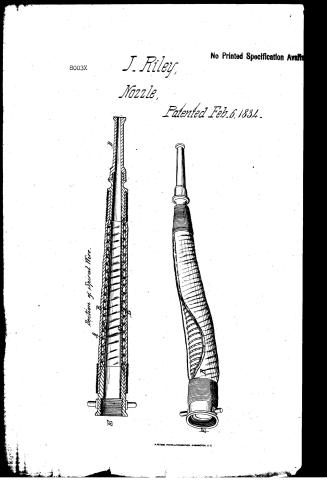
J. Riley's Patent Drawing for a Nozzle

National Archives, Restored Patent Drawings (Record Group 241) · Full-size scan at the National Archives · Catalog record
Text on the drawing
Words on the drawing as machine-read by the National Archives; not checked. Useful mainly for searching.
J. Riley, / Nozzle, / 8003X / Patented Feb_6, 1834. / Section of Spiral Wire. / Baker
USPTO scan
The patent as scanned by the USPTO
-
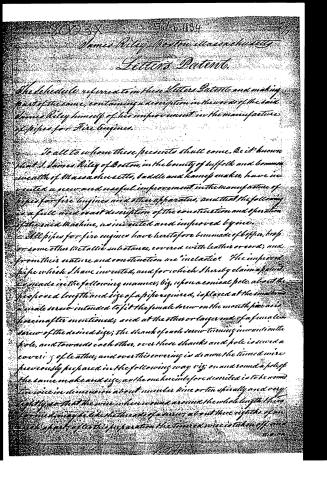
 Page 1
-
 Page 2
-
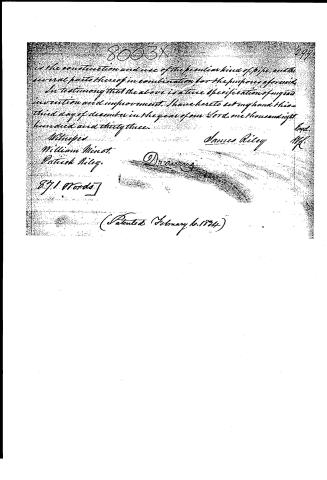 Page 3


U.S. Patent and Trademark Office · Google Patents
Published accounts: journal notice
Notice in the monthly list of patents, with remarks
Journal of the Franklin Institute, new ser., vol. 14 (1834), p. 174 · View the page
8. For Branch Pipes for Fire Engines; James Riley, Boston, Massachusetts, February 6.
Remarks. Branch pipes, the patentee states, are usually made of copper, or other metal, and covered over with leather or cord. Instead of using a metallic tube, he employs one made principally of leather, but enclosing a wire wound spirally. He takes a rod of wood of the proper taper and size for the inside of the pipe, and to the larger end of it adapts a screw, which is to fit the engine, and to the small end one to receive the nozle. He then sews leather round the rod, embracing in it the shanks of the two pipes. A tinned wire is then wound spirally upon this leather, from end to end; the wire may be about number nine or ten, and the coils about three-eighths of an inch apart. The wires are to be united to the leather by back-stitches, and the spaces between the turns filled with a composition of India rubber, spirits of turpentine, linseed oil, and lamp black. When this has been done, another covering of leather is to be put on and firmly sewed. The advantages to be derived from a branch pipe thus formed result from its flexibility, in consequence of which the water can be sent in directions which it could not receive from a straight pipe. When a hole has been cut through a roof, or when a fireman is standing upon a ladder, it is often impossible to direct the straight pipe effectually into the opening, or window. "How difficult the task," says the patentee, "to attend to the fire, his footing, in changing from one side to the other, and his pipe; but these difficulties are completely obviated in this improved pipe; the holder commands every point of the compass, with the simplest ease, and without the necessity of moving his body; 'tis his protection from the raging flame, and though duty should call him to the midst of the furious element, his pipe is his shield," &c. &c. Notwithstanding this eloquent advocacy of a leather branch pipe, we are of opinion that one of copper, altogether inflexible, is to be preferred. We know something of branch pipes, by experience, and therefore speak with some confidence. Their flexibility would generally be a real disadvantage, in an attempt to direct the water to a particular point; and when they were wanted to be used in a curved form, the force of the water in passing through them, would tend to straighten them; for a purpose such as the patentee has indicated, we should prefer to have a curved nozle to screw on, which the engineer might carry in his pocket. The claim is to the construction and use of the peculiar kind of pipes, and the several parts thereof, in combination, for the purposes aforesaid."
About this record
- Patentee
- DATAMP
- Date
- DATAMP, USPTO records
- Invention
- DATAMP
- Listed in
- the Name and Date index of patents, DATAMP, USPTO records, Jim Shaw's X-patent list, the Journal of the Franklin Institute, Burke's List of Patents (1847)
- The sources give different dates; the date shown is the one most of them agree on.
- The Name and Date index lists this patent twice.
- The Franklin Institute's journal confirms the date shown.
- in_burke