

Drawings and documents
USPTO scan
The patent as scanned by the USPTO
-
 Page 1
-
 Page 2
-
 Page 3
-
 Page 4
-
 Page 5


U.S. Patent and Trademark Office · Google Patents
Published accounts: specification
Specification printed in the Journal of the Franklin Institute
Journal of the Franklin Institute, new ser., vol. 13 (1834), p. 339 · View the page
Text of the specification as printed in the Journal, from OCR; not proofread.
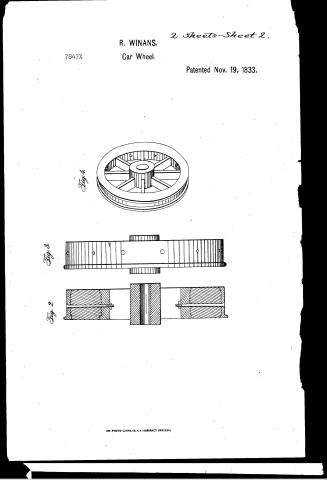
Specification of a patent for an improvement in Wheels for Cars and Locomotive Engines, to be used upon Rail-roads. Granted to Ross WiNANS, Civil Engineer, city of Baltimore, November 19, 1833. To all whom it may concern, be it known, that I, Ross Winans, of the city of Baltimore, in the state of Maryland, Civil Engineer, have invented an improved mode of constructing wheels for cars and locomotive engines, to be used upon rail-roads, and that the following is a full and exact description thereof. The more clearly to exhibit the difference between my improved wheel and those which have been heretofore employed, I will briefly point out the manner in which wheels for this purpose have been most commonly made; not intending, however, as it is not necessary for the purpose in view, to notice all the plans which have been adopted. 1st. Such wheels have been made wholly, or nearly so, of cast iron; the face, or tread of them, being cast within a chill, consisting of a thick rim, or hoop, of iron, which forms a part of the mould. 2nd. The wheels have been cast without being chilled, and afterwards hooped with wrought iron, which then forms the face and flanch of the wheel. 3d. A cast iron nave, or hub, has been made to receive wooden spokes, inserted in wooden felloes, which were hooped with a tire of wrought iron, 4th. The hubs have been of cast iron, with spokes of wrought iron, and a rim of wrought or of cast iron, hooped with wrought iron. These plans have each their respective advantages and disadvantages, but neither of them has fully answered the purpose for which it has been adopted; the wrought iron hoop, or tire, upon the cast iron rims have gradually become loosened; the wooden spokes and felloes have pressed the one into the other, and the tire has ceased to bind them, an evil which wedging will not cure. To remedy these defects, and others incident to some of the wheels, is the object of my improvement. My wheel consists essentially of three parts, namely, an interior wheel, the hub, spokes, and rim of which, are of cast iron; a rim of wood, formed in a way to be presently described, surrounding the WINAN'S Wheels for Locomotives. cast iron wheel; a hoop, or tire, of wrought iron, surrounding the wood, and forming the face, or tread, of the wheel. The inner wheel is made, in some respects, like those first noticed, but the face is not chilled, nor has it the same form with the chilled face. It should be made of the same width on the rim, with the wrought iron tire which is to surround and form the tread of the wheel, say five inches. The face of the cast rim may be cylindrical for the greater part of its width, but it must in this case have a fillet, or edge, projecting up on each side of it, say to the height, and of the thickness, of half an inch, which will then give to it the appearance of a wheel with a double flanch, having a cylindrical tread of four inches in width. Instead of making the face in this form, I intend sometimes to give to it a regular declination from each edge towards the centre. A section of the rim, transversely, would then be somewhat in the form of the letter V, but with the angle obtuse. The inclination will be sufficient if the diameter at the centre of the rim is one inch less than that at the sides, or edges. Other forms may be given to the face of the rim, by which the object in view may be attained, namely, that of retaining the wooden rim in its place, without its allowing it to move out on either side. A rim of wood is to be placed around this wheel, which may consist of any convenient number of pieces, fitted to each other, and to the face of the wheel. The grain of the wood is to cross the rim of the wheel, running parallel with its axis. These pieces may be fitted to the face of the wheel with great facility by driving them into a large hoop, running as a chuck in a lathe, by which means they may be turned to the form required; they may then be fastened on to the rim by wood screws, or otherwise, and turned thereon to receive the iron hoop or tire. The best thickness of this rim will be from two to four inches. The hoop, or tire, of wrought iron, is to be made in the usual form, turned truly, and passed on over the wooden rim when expanded by heating it as highly as may be done without burning the wood. Bolts are then to be passed through the wrought iron, the wood, and the cast iron rims, which are secured by nuts, to confine the whole together. The hub, or nave, in a wheel thus made, may be cast entire, instead of having those divisions, or openings, which are necessary in the chilled wheel, to allow for contraction. Although I have described the spokes and rim as being of cast iron, either or both of them may be of wrought iron, but it would be more costly, without affording any adequate advantages; those of cast iron being perfectly safe in this mode of construction. It will be readily perceived that the wood, thus pressed between two hoops of iron, has an extent of bearing surface which will effectually prevent its being condensed by the force to which it is subjected; whilst, by its elasticity, it will tend to preserve both the road and the vehicles passing over it. If perfectly dried when put on, which may be done by artificial heat, the wood will never shrink, but on the contrary, will expand, and render all the parts the more firm. Such a wheel will have less tendency than any other, where wood On Obtaining Patents in England. is employed, to get out of truth; and should wedging become necessary, it may be done more effectually than with any other. The dimensions of most of the parts of such a wheel need not differ greatly from those of the cast iron wheels with chilled rims, but, like them, must vary according to their diameter, and the load they are to sustain; the following is a good proportion for wheels of three feet in diameter, intended for cars carrying three tons. Cast iron interior wheel, twenty-nine inches diameter; hub seven inches long by six in diameter; spokes, twelve in number, five-eighths of an inch thick, and three and a half or four inches broad; rim five inches broad by five-eighths of an inch thick; wooden rim two and five-eighths inches thick, five inches deep, measuring across the rim; wrought iron tire seven-eighths of an inch thick, five inches broad, flanch one and one-fourth inch deep, one inch thick. Although I have described the rim of wood as placed with its grain crossing the rim of the wheel, and am fully convinced that this is the best manner of placing it, yet it will answer the purpose, to a considerable extent, when running in the direction of the rim, and I do not intend, therefore, to limit myself in this respect, as what I claim as my invention is the interposing a rim or belt of wood between an interior wheel of cast or of wrought iron, and a wrought iron rim or tire, and securing the whole together in the manner, and for the purposes hereinbefore set forth. ROSS WINANS. Further notice respecting the obtaining of Patents in England. The Editor has just received a further communication from W. Serrell, Esq. Engineer, New York, the gentleman referred to in the first article in the present number, in which he has furnished another extract from a letter on the subject of English patents, dated London, 17th February, 1834. As it not only confirms, but gives additional importance to the observations made in the above named article, we hasten to publish it. "By the way, a man has recently arrived from New York, named S-, loaded with patents, none of which are his own; amongst them he has got J. R's, with the specification and drawings. R-knows him, and S- was much surprised to find Rhere, and still more that his patent was secured. "This is another practical evidence of the importance of the caution which I lately sent to you, and which I hope you have had published. The moment a patent worth any thing is taken out at Washington, one of these kidnappers secures the child as his own, and goes away with it to a foreign market. A patent was recently named to an English tradesman, who directly asked if it was not an American invention; on being answered in the affirmative, he rejoined you are too late, my brother saw it in New York, and when he came home had one made.' The plain result of all this is, that when any thing is invented in America which is deemed worthy of being patented in On Obtaining Patents in England. England, it ought to be secured, but not published in America, until time has been given to secure it in England. You may be assured that there are regular traders, or rather regular plunderers of patents, persons who make this a business, and do nothing else. I could furnish some proofs of the fact." Mr. Serrell adds, "the first part of the above refers to a patent for an improvement, the inventor of which went hence by my advice, and applied to my friend in London, by whom he has been placed in a situation to obtain a handsome remuneration for his invention, all of which would have been jeopardized had S- left New York a few weeks earlier. Any unprincipled man, with a small amount of mechanical knowledge, can, by swearing to a communication from a foreigner residing abroad, obtain a patent, unless he is met on the threshold by an opposition which will compel him to show the nature of the communication under which he attempts to procure it. "I forward the preceding extracts and remarks for publication in your Journal, should you think proper so to dispose of them." The writer of the letter from England probably is not aware of the difference between the practice here, and there, in the issuing of patents. In England the patent issues upon the title of the invention being furnished, and several months are allowed, most commonly six, for the enrolling of the specification, so that no individual can learn the nature of the invention at the patent office, for this length of time after it has been secured. In the United States the specification must be furnished before the patent can issue, and the very day that a patentee receives it, any one may obtain a copy of it. The office has no power whatever to refuse such a copy, and no blame therefore, attaches there, this being the fair construction of the law. The only safe procedure, therefore, when an inventor wishes to secure a patent in England, is to send over prior to, or simultaneously with, his application here, furnishing to a proper agent, a copy of his specification and drawings, and the necessary funds, otherwise he is likely to be superseded, in which case he has no remedy. There are but few cases, however, in which an inventor ought to rely upon his own judgment respecting the propriety of obtaining a patent in England; he should obtain the best advice here, and after this be careful that the business goes into the hands of an agent there who has the ability, and the integrity to direct him aright. An english patent costs about six hundred dollars, for that kingdom alone, and if extended to Scotland and Ireland, about three times that amount. Were all inventions as good as their authors think them, this sum would be one of little comparative moment; but, in point of fact, there is not more than one in fifty of the patents obtained here, which would be worth patenting in England, at so great a cost, although what is really new and useful will, in general, be better paid for there, than with us. ENGLISH PATENTS. TO ROBERT W. SIEVER, for an improvement or improvements in the making or manufacturing of Elastic Goods or Fabrics, applicable to various useful purposes. Sealed January 17,1833. This invention is described by the patentee in the following manner:My invention of an improvement or improvements in the making or manufacturing of elastic goods, or fabrics, applicable to various useful purposes, are designed for the production of an elastic web, cloth, or other manufactured fabric, for bandages, and for such articles of dress as the same may be applicable to. The first object which I propose, is to manufacture an article by the ordinary knitting frame, or similar kind of machinery, in which cords or strands of Indian rubber shall be introduced between the loops or stitches of the fabric, for the purpose of forming elastic cords or bands round the margins or other parts of stockings, socks, gloves, nightcaps, drawers, and various other articles of clothing. The second object is to manufacture in the ordinary loom an elastic woollen cloth, by the introduction of cords or strands of India rubber among the longitudinal threads or yarns which constitute the chain or warp, and also among the transverse threads or yarns, which constitute the weft or shoot, and which cloth shall be capable of being afterwards felted and dressed with a nap. The third object is to produce cloth from cotton, flax, or other suitable material not capable of felting, in which shall be interwoven elastic cords or strands of Indian rubber, coated or wound round with a filamentous material. The first of these improvements I effect by preparing knitting frames, or other similar machines, in the usual way for the production of the knitted materials called stocking fabric; and when the same are set to work, and the fabric has been manufactured by the ordinary knitting process up to the part at which I desire to introduce the elastic cord or strands, I then, by the adjusting screws of the machine, provide for the elongation or contraction of the lengths of the loops or stitches of the row next to be produced across the machine, in order to form a channel to receive the said elastic cord or strand; and having prepared fine strips of Indian rubber, which may, if desired, be coated, or covered, with a filamentous material, as described in the specification of my patent, dated the first day of December, 1831, and enrolled in the Office of the Rolls Chapel of the High Court of Chancery, in June, 1832, I conduct such thread, cord, strand, or strip, of Indian rubber by means of a long needle, hook, pincers, or other suitable apparatus answering the purpose of a shuttle, across the machine between the row of stitches or loops which were last made, and those which are then about to be formed; and having drawn the said Indian rubber thread, cord, or strand, straight and smooth, I complete the last mentioned row of loops, or stitches, by the ordinary movements of the machine which encloses the Indian VOL. XIII.-No. 5.-MAY, 1834. 44 SIEVER'S Manufacture of Elastic Fabrics. rubber thread, cord, or strand, and keeps it securely in its place, interwoven with the threads of the fabric. A second thread of Indian rubber is in like manner introduced between the next or other subsequent row of stitches, and is in the same way confined; and any further number of these threads, cords, or strands, may, by the same means, be inserted and interwoven into the fabric at such parts as may be required for the purpose of producing (when the selvages are connected or whipped together) elastic bandages, garters, or bracings round the stocking, sock, glove, nightcap, or other article of wearing apparel. In effecting the second improvement, the production of an elastic woollen cloth, I introduce into the loom among the longitudinal or warp threads or yarns of the intended fabric, longitudinal threads, cords, or strands of Indian rubber, or I constitute the warp entirely of such strands, either covered with a filamentous material or not, as before described; and through, or between the warp threads, cords, or strands of warp, I pass the transverse weft or shoot threads or yarns in the ordinary way of weaving, for the purpose of effecting that intervention which produces the cloth; these transverse weft threads being composed in part of the Indian rubber strands, or of the ordinary threads or yarns of the fabric, according as I may wish to produce a cloth which shall be elastic lengthwise only, or in both directions. If the elastic cloth so produced should be intended for outward garments with a nap upon its surface, I should employ, in connexion with the India rubber strands, yarns spun from short wool, which, after having been woven, I should finish as the woollen cloths are usually finished, that is, felt the wool in the fulling stock, raise the pile by gig machinery, or by hand cards or teazles, and afterwards shear the nap down to a fine smooth surface. In manufacturing an elastic cloth from cotton, flax, or other material which is not intended to be milled or fulled, I introduce into the fabric threads or strands of Indian rubber, which have been previously covered by winding filaments tightly round them through the agency of an ordinary covering machine, or otherwise; these strands of Indian rubber being applied as warp or weft, or as both, according to the direction of the elasticity required. By thus combining the strands of Indian rubber with yarns of cotton, flax, or other non-elastic material, I am enabled to produce a cloth which shall afford any required degree of elastic pressure, according to the proportions of the elastic and nonelastic material. It remains only to add, that the strands of Indian rubber are, in the first instance, stretched to their utmost tension, and rendered nonelastic, as described in my former specification; and being in that state introduced in the fabric, they acquire their elasticity by the application of heat after the fabric is made. Lastly, as my invention consists solely in the employment of strands of Indian rubber in connexion with yarns, in the way described for manufacturing elastic goods or fabrics, I have not deemed it necessary to describe any particular kind of machinery for carryURE'S Evaporation of Sirops. ing the same into effect, as such machinery is well known, and forms no part of my invention. [Lond. Jour. TO JOHN O. N. RUTTER, Wine Merchant, for his invention of an improved process for generating heat, applicable to the heating of boilers and retorts, and to other purposes for which heat is required. Sealed March 30, 1833. The subject of this patent is the employment of bituminous, resinous, or oily matters in connexion with water as a combustible material, which, it is said, will produce a fuel for furnaces, boilers, &c., capable of giving out a very intense heat. Strange as the suggestion of applying water as a combustible material may appear, it is reported to have been found extremely advantageous, economical, and convenient. We, of our own knowledge, can say nothing upon the subject, but merely give the patentee's views and recommendations in reference to the manner in which he proposes to employ those materials for the production of heat. Bituminous, oleaginous, resinous, waxy, or fatty substances are to be employed: as coal tar, which is to be combined with water in certain proportions. It is proposed that a stream of coal tar shall be allowed to flow from a reservoir through a pipe with a stop cock, and likewise a stream of water from another reservoir through a similar pipe; that the two streams shall meet, and fall into one general receiver with a funnel tube, by which they may be together delivered into the furnace. The proportions are recommended to be one gallon of coal tar to one gallon and a half of water, the flow of the two liquors to be regulated by suitable apertures or stop cocks. These quantities of materials are to be slowly discha
Published accounts: journal notice
Notice in the monthly list of patents, with remarks
Journal of the Franklin Institute, new ser., vol. 13 (1834), p. 329 · View the page
68. For Wheels for Rail-road Cars; Ross Winans, Civil Engineer, city of Baltimore, November 19.
Remarks. (See the specification.)
About this record
- Patentee
- DATAMP
- Date
- the Name and Date index of patents, DATAMP, USPTO records
- Invention
- DATAMP
- Listed in
- the Name and Date index of patents, DATAMP, USPTO records, Jim Shaw's X-patent list, the Journal of the Franklin Institute, Burke's List of Patents (1847)
- in_burke