

Drawings and documents
USPTO scan
The patent as scanned by the USPTO
-
 Page 1
-
 Page 2
-
 Page 3


U.S. Patent and Trademark Office · Google Patents
Published accounts: specification
Specification printed in the Journal of the Franklin Institute
Journal of the Franklin Institute, new ser., vol. 13 (1834), p. 271 · View the page
Text of the specification as printed in the Journal, from OCR; not proofread.
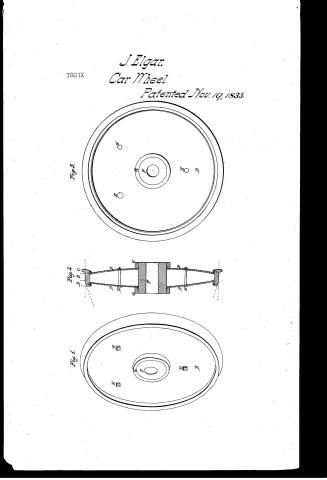
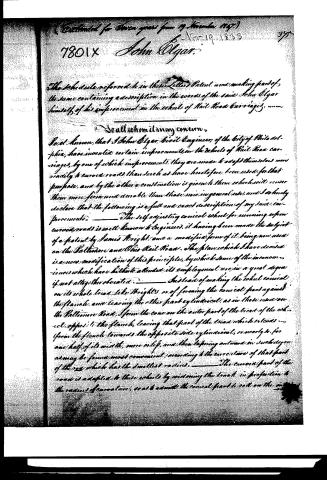
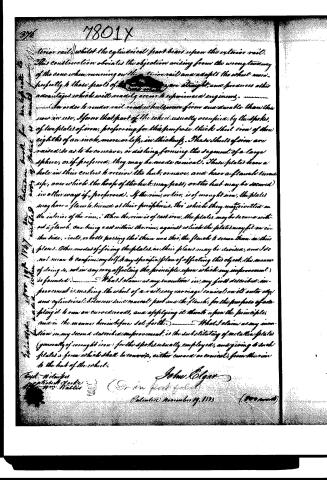
Specification of a patent for improvements in the Wheels of Rail-road Carriages. Granted to JOHN ELGAR, Civil Engineer, city of Philadelphia, November 19, 1833. To all whom it may concern, be it known, that I, John Elgar, Civil Engineer, of the city of Philadelphia, have invented certain improvements in the wheels of rail-road carriages, by one of which improvements they are made to adapt themselves more readily to curved roads, than such as have been heretofore used for that purpose; and by the other a construction is given to them which will render them more firm and durable than those now in general use; and I do declare that the following is a full and exact description of my said improvements. The self-adjusting conical wheel for running upon curved roads is well known to engineers, it having been made the subject of a patent by Mr. James Wright, and a modified form of it being now used on the Baltimore and Ohio rail-road. The plan which I have devised is a new modification of this principle, by which some of the inconveniences which have hitherto attended its employment are in a great degree, if not altogether, obviated. Instead of making the wheel conical on its whole tread, like Wright's, or of forming the conical part against the flanch, and leaving the other part cylindrical, as in those used on the Baltimore road, I form the cone on the outer part of the tread of the wheel, opposite to the flanch, leaving that part of the tread which extends from the flanch towards the opposite side, cylindrical, or nearly so, for one half of its width, more or less, and then tapering outwards in such degree as may be most convenient, according to the curvature of that part of the road which has the smallest radius. The curved part of the road is adapted to these wheels, by widening the track in proportion to the radius of curvature, so as to admit the conical part to roll on the interior rail, whilst the cylindrical part bears upon the exterior rail. This construction obviates the objection arising from the wrong tendency of the cone when running on the exterior rail, and adapts the whole more perfectly to those parts of the road which are straight, and produces other advantages which will readily occur to experienced engineers. In order to render rail-road wheels more firm and durable than those now in use, I form that part of the wheel usually occupied by the spokes, of two plates of iron, preferring for this purpose thick sheet iron of three-eighths of an inch, more or less, in thickness. These sheets of iron are raised so as to be concave, or dishing, forming the segments of a large sphere, or, if preferred, they may be made conical. These plates have a hole in their centres to receive the hub, or nave, and have a flanch turned up over which the hoop of the hub may pass; or, if preferred, the hub may be secured in other ways. If the rim, or tire, is of wrought iron, the plates may have a flanch turned at their peripheries, through which they may be riveted on the interior of the rim. When the rim is of cast iron, the plates may be seCOCHRAN'S Friction Furnace. cured without a flanch, one being cast within the rim, on either side, against which the plates may fit, rivets, or bolts, passing through them, and through the flanch to secure them in their places. Other modes of fixing the plates in their places may be devised, and I do not mean to confine myself to any specific plan of effecting this object, the manner of doing so, not in any way affecting the principle upon which my improvement is founded. This mode of construction is particularly adapted to wheels for locomotive engines, that run either on common roads or on rail-ways. What I claim as my invention in my first described improvement, is the making the wheel of a rail-way carriage conical on its outer edge, and cylindrical between said conical part and the flanch, for the purpose of adapting it to run upon curved roads, and applying it thereto upon the principle, and in the manner, hereinbefore set forth. What I claim as my invention in my second described improvement, is the substituting of metallic plates (generally of wrought iron,) for the spokes usually employed; and the giving to such plates a form which shall be convex, either curved or conical, from the rim to the hub of the wheel. JOHN ELGAR.
Published accounts: journal notice
Notice in the monthly list of patents, with remarks
Journal of the Franklin Institute, new ser., vol. 13 (1834), p. 266 · View the page
18. For an improvement in the Wheels of Rail-road Carriages; John Elgar, Civil Engineer, city of Philadelphia, November 19.
Remarks. (See the specification.)
Published accounts: journal notice
Notice in the monthly list of patents, with remarks
Journal of the Franklin Institute, new ser., vol. 13 (1834), p. 270 · View the page
It would be difficult to magnify the importance of an improvement in the manufacturing of flour, which effectually prevents its souring; as this is not an effect produced upon a solitary barrel or two, but not unfrequently upon whole cargoes, which become sour even during the time of short voyages to the West Indies, or the southern portion of our continent; and, indeed, large quantities arrive at New Orleans in this state, although shipped on the waters of the Ohio, immediately after it is packed in barrels. A large portion of that put up for sea stores, on all long voyages, is thus lost; and but few persons would credit the account, were we able to state the proportionate quantity of that so shipped on board our vessels of war, which is eventually thrown overboard, as totally spoiled. Specification of a patent for improvements in the Wheels of Rail-road Carriages. Granted to JOHN ELGAR, Civil Engineer, city of Philadelphia, November 19, 1833.
Remarks. To all whom it may concern, be it known, that I, John Elgar, Civil Engineer, of the city of Philadelphia, have invented certain improvements in the wheels of rail-road carriages, by one of which improvements they are made to adapt themselves more readily to curved roads, than such as have been heretofore used for that purpose; and by the other a construction is given to them which will render them more firm and durable than those now in general use; and I do declare that the following is a full and exact description of my said improvements. The self-adjusting conical wheel for running upon curved roads is well known to engineers, it having been made the subject of a patent by Mr. James Wright, and a modified form of it being now used on the Baltimore and Ohio rail-road. The plan which I have devised is a new modification of this principle, by which some of the inconveniences which have hitherto attended its employment are in a great degree, if not altogether, obviated. Instead of making the wheel conical on its whole tread, like Wright's, or of forming the conical part against the flanch, and leaving the other part cylindrical, as in those used on the Baltimore road, I form the cone on the outer part of the tread of the wheel, opposite to the flanch, leaving that part of the tread which extends from the flanch towards the opposite side, cylindrical, or nearly so, for one half of its width, more or less, and then tapering outwards in such degree as may be most convenient, according to the curvature of that part of the road which has the smallest radius. The curved part of the road is adapted to these wheels, by widening the track in proportion to the radius of curvature, so as to admit the conical part to roll on the interior rail, whilst the cylindrical part bears upon the exterior rail. This construction obviates the objection arising from the wrong tendency of the cone when running on the exterior rail, and adapts the whole more perfectly to those parts of the road which are straight, and produces other advantages which will readily occur to experienced engineers. In order to render rail-road wheels more firm and durable than those now in use, I form that part of the wheel usually occupied by the spokes, of two plates of iron, preferring for this purpose thick sheet iron of three-eighths of an inch, more or less, in thickness. These sheets of iron are raised so as to be concave, or dishing, forming the segments of a large sphere, or, if preferred, they may be made conical. These plates have a hole in their centres to receive the hub, or nave, and have a flanch turned up over which the hoop of the hub may pass; or, if preferred, the hub may be secured in other ways. If the rim, or tire, is of wrought iron, the plates may have a flanch turned at their peripheries, through which they may be riveted on the interior of the rim. When the rim is of cast iron, the plates may be seCOCHRAN'S Friction Furnace. cured without a flanch, one being cast within the rim, on either side, against which the plates may fit, rivets, or bolts, passing through them, and through the flanch to secure them in their places. Other modes of fixing the plates in their places may be devised, and I do not mean to confine myself to any specific plan of effecting this object, the manner of doing so, not in any way affecting the principle upon which my improvement is founded. This mode of construction is particularly adapted to wheels for locomotive engines, that run either on common roads or on rail-ways. What I claim as my invention in my first described improvement, is the making the wheel of a rail-way carriage conical on its outer edge, and cylindrical between said conical part and the flanch, for the purpose of adapting it to run upon curved roads, and applying it thereto upon the principle, and in the manner, hereinbefore set forth.
About this record
- Patentee
- DATAMP
- Date
- the Name and Date index of patents, DATAMP, USPTO records
- Invention
- DATAMP
- Listed in
- the Name and Date index of patents, DATAMP, USPTO records, Jim Shaw's X-patent list, the Journal of the Franklin Institute, Burke's List of Patents (1847)
- in_burke