

Drawings and documents
National Archives restored drawings: drawing
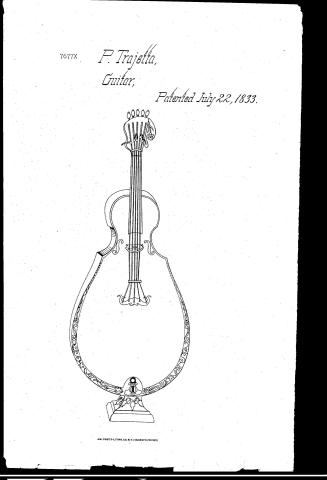
Phillip Trajetta's Patent Drawing for a Plettro Lira

National Archives, Restored Patent Drawings (Record Group 241) · Full-size scan at the National Archives · Catalog record
Text on the drawing
Words on the drawing as machine-read by the National Archives; not checked. Useful mainly for searching.
102 / Violing / Philip Trajetta's / Plettro Lira. / CLASSIFICATION / 7677-x / ..... / Patented July22 1833 / DIVISION. / O/R / ON / 0.0 / & 9.6
USPTO scan
The patent as scanned by the USPTO
-
 Page 1
-
 Page 2
-
 Page 3
-
 Page 4


U.S. Patent and Trademark Office · Google Patents
Published accounts: journal notice
Notice in the monthly list of patents, with remarks
Journal of the Franklin Institute, new ser., vol. 13 (1834), p. 35 · View the page
21. For a New Musical Instrument, called the Plettro Lyra; Phil. Trajetta, city of Philadelphia, July 22.
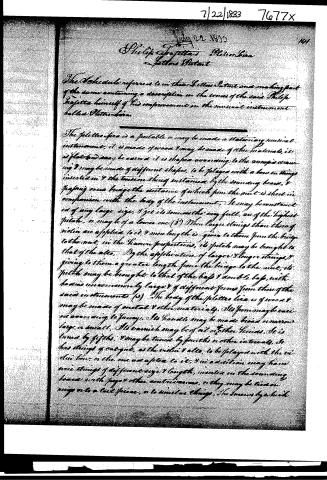
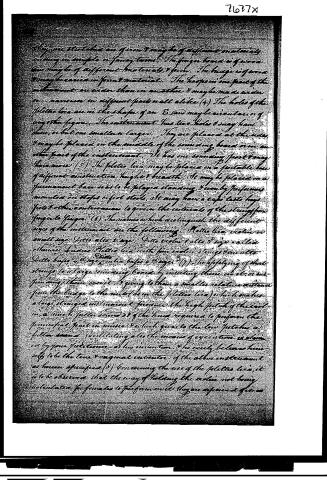
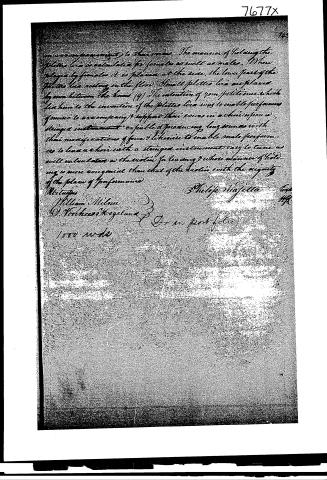
Remarks. The instrument represented in the drawing has the general form of a violin, or viol, and has a foot by means of which it may stand vertically, the foot resting on the floor. The instrument is to be made of various sizes, five different ones being proposed, extending from that of the violin, or small size, to that of the contra basso. The inventor says that one great object of the invention was to provide an instrument to be played with the bow, and which should yet be free from those objections which exist to the violin in the hands of females, from the awkward manner in which it is intended to be held. With the Plettro Lyra, it is said, female performers may accompany and support their voices in a choir, upon a stringed instrument capable of producing long sounds, with their modifications of force. The instrument is easy to tune, and may be used for leading with all the advantages of the violin, and is, from the manner of holding it, more congenial to the dignity of the place of performance than that of the violin, even in the hands of male performers. The strings pass over a bridge, the distance of which from the nut is short, in comparison with the body of the instrument. For larger strings this distance must be proportionably increased, and its pitch may thus be brought to that of the bass, or double bass. "The application of short strings to a large sounding board, by inserting them in it, or suspending them over it, and giving to them a smaller relative distance from the bridge to the nut, which makes a large stringed instrument produce the high pitch of the violin, a much fuller sound, and of the kind required to perform the principal part in music," is claimed as constituting the invention.
About this record
- Patentee
- DATAMP
- Date
- the Name and Date index of patents, DATAMP, USPTO records
- Invention
- DATAMP
- Listed in
- the Name and Date index of patents, DATAMP, USPTO records, Jim Shaw's X-patent list, the Journal of the Franklin Institute, Burke's List of Patents (1847)
- in_burke