

Drawings and documents
USPTO scan
The patent as scanned by the USPTO
-
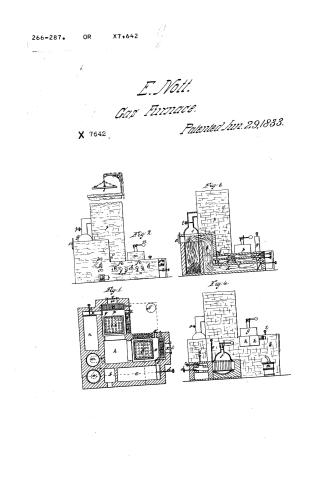 Page 1
-
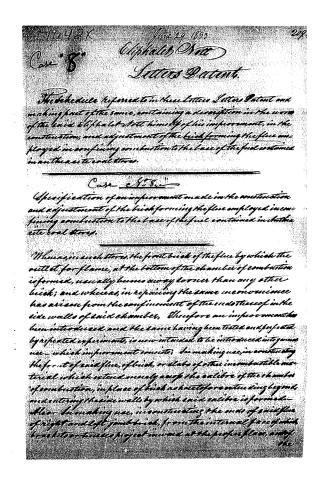 Page 2
-
 Page 3


U.S. Patent and Trademark Office · Google Patents
Published accounts: journal notice
Notice in the monthly list of patents, with remarks
Journal of the Franklin Institute, new ser., vol. 12 (1833), p. 406 · View the page
33. For the Construction and adjustment of the brick forming the flue, and employed in confining the combustion to the base of the fuel, contained in anthracite coal stoves; Eliphalet Nott, Schenectady, New York, June 29.
Remarks. CLAIM. "I therefore claim as my invention and improvement, the providing for removing and restoring the front of flue aforesaid, by shortening the brick or other slabs of which the same is composed, so that they will freely enter the caliber of the chamber, and by projecting from the right and left jamb brick, the requisite truss or other fixtures for sustaining and confining the same in place as aforesaid; together with the uses to which said improvement has been or hereafter may be may be applied in stoves and furnaces."
Published accounts: journal notice
Notice in the monthly list of patents, with remarks
Journal of the Franklin Institute, new ser., vol. 12 (1833), p. 425 · View the page
For further information reference must be had to the drawings and explanations deposited in the patent office. [Summary.] I therefore claim as my invention and improvement the diminishing of the oxidizing of metallic bodies, by treating them, whether in cupolas, forges, or other furnaces, in a chamber distinct from the chamber of combustion; and the economising of the expenditure of heat in the treatment of bodies generally, by concentrating all the processes to which the same heat can conveniently be applied, and arranging the order thereof according to the intensity of the temperature required by each; and the dividing of the bodies to be treated, exclusive of those contained in the cupola, forge, or other furnace, into portions, and arranging the same successively, in successive localities, and of moving the bodies that admit of motion which are under treatment, towards the chamber of combustion, along the same channel through which the flame is passing off from said chamber in an opposite direction; always putting the new material into the locality further from the chamber of combustion, and removing the material sufficiently treated, from the locality nearest the chamber of combustion, by means of a special chamber of treatment, constructed, connected, and managed, as already described; the same being interposed between a cupola, forge, or other furnace, and the boiler, or the chimney, if no boiler be in use; or by any other means, provided the chamber of treatment be separated from the chamber of combustion throughout; and provided the different processes to which the same heat can be applied be concentrated, and the succession ordered according to the degree of temperature required by each; and provided also, the material to be treated be divided into parcels arranged in successive localities; and, if capable of motion, be moved in one direction towards the chamber of combustion along the same channel through which the flame is passing from the chamber of combustion in an opposite direction; together with the uses to which the same has been, or may hereafter be, applied, in the reduction of ores, the manufacture of iron, or other metals, the melting, or heating, of the same, to be cast, or wrought, into different forms, together with the other processes of art, with which the same may be combined. ELIPHALET NOTT. Specification of a patent for a new manufacture of Wheels for Locomotive Engines and Cars, to run upon Rail-roads. Granted to MATTHIAS W. BALDWIN, city of Philadelphia, June 29, 1833.
Remarks. To all whom it may concern, be it known, that I, Matthias W. Baldwin, of the city of Philadelphia, have invented a new and useful manufacture of wheels for locomotive engines and cars, to run upon rail-roads, and that the following is a full and exact description of my said invention. VOL. XII.-No. 6.-DECEMBER, 1833. 54 BREED'S Manufacture of Hose. Instead of making the wheels for the carriages of locomotive engines, and of other cars, or carriages, to be used upon rail-roads, of cast iron, or of a combination of cast and wrought iron, or of wood combined with cast or wrought iron, or with both, as they have been heretofore made, I cast the rims of such wheels, as well as in most instances the spokes and hubs, or naves, in one piece with the rims, of a composition of metal known to workmen under the name of hardened brass, or gun metal. It is not necessary for me to designate the proportions in which the respective metals are mixed which form the hardened brass or gun metal, as these will vary with the degree of hardness desired in the rim, or tread, of the wheel, in a manner well known to those conversant with the casting of brass and its compounds. Where it is desirable to increase the adhesion between the rail and the wheel, it may be found necessary to make the wheel proportionably softer, by decreasing the quantity of tin entering into the composition of them, or even to cast them of soft brass or of copper entirely.
DATAMP: illustration
Illustrations from DATAMP
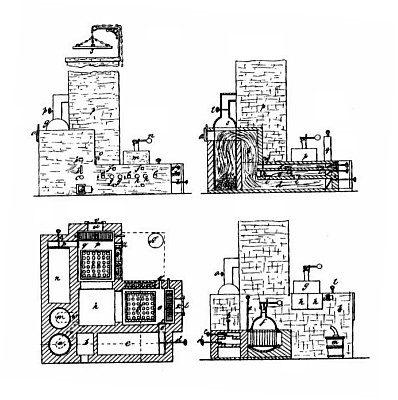
DATAMP (Directory of American Tool and Machinery Patents), via the Internet Archive · Archived DATAMP page
About this record
- Patentee
- DATAMP
- Date
- DATAMP, USPTO records, Burke's List of Patents (1847)
- Invention
- DATAMP
- Listed in
- the Name and Date index of patents, DATAMP, USPTO records, Jim Shaw's X-patent list, the Journal of the Franklin Institute, Burke's List of Patents (1847)
- The sources give different dates; the date shown is the one most of them agree on.
- The Franklin Institute's journal confirms the date shown.
- in_burke