

Drawings and documents
USPTO scan
The patent as scanned by the USPTO
-
 Page 1
-
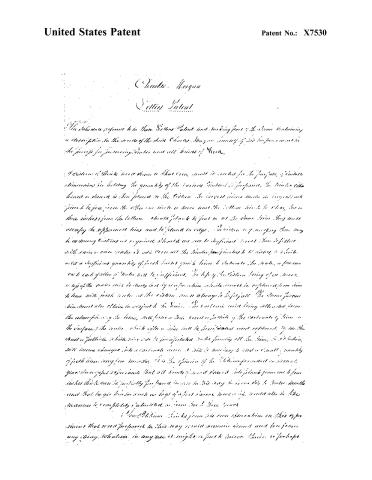 Page 2
-
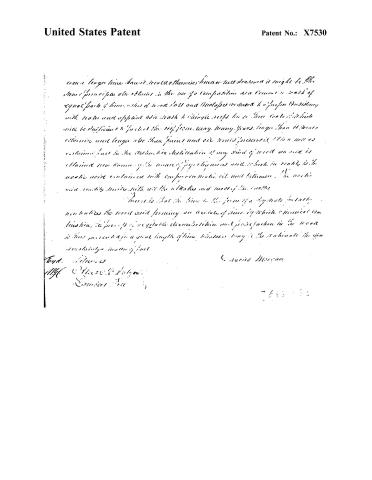 Page 3


U.S. Patent and Trademark Office · Google Patents
Published accounts: journal notice
Notice in the monthly list of patents, with remarks
Journal of the Franklin Institute, new ser., vol. 12 (1833), p. 238 · View the page
The claim is to "all the above," with the right to alter it in position, materials, &c. &c. 16. For a Process for the preservation of Wood; Charles Mor gan, Point Coupee, Louisiana, April 12.
Remarks. The plan here proposed is to saturate the timber with lime. A cistern of sufficient dimensions, and of any material which will hold water, is to be constructed, and in this the timber is to be placed, taking care that there is a space between each of the pieces, and between them and the cistern. Rain, or river, water is then to be poured in, so as to cover the whole of the timber, to which enough quick lime is to be added to saturate the water. As the water evaporates, and as the lime becomes neutralized by carbonic acid, fresh portions of each are to be added. The patentee says that from numerous experiments he has ascertained that timber of from one to four inches in thickness, may be saturated with lime in from six to twelve months; and that logs of a foot square may be prepared in from two to three years; and that the durability of the timber will be such as to cause it to last two, three, or more, times as long as it otherwise would. A wash made of equal parts of lime, wood ashes, salt and molasses, diffused in water, and applied to shingled roofs, two or three coats being put on, will, it is said, preserve them longer than oil paint. There is no claim made, the saturation with lime being, it is presumed, considered as altogether new. Since this patent was issued, the value of the process has been much extolled in the public papers; it is not, however, from these, but from the test of actual experiment, repeatedly tried, and long continued, that we are to learn its real worth. The process has been recommended upon theoretical considerations, it having been asserted that the dry rot is occasioned by an acid contained in the timber, and that this acid is neutralized by the lime; an opinion altogether gratuitous, and not justified by observation. Because the pyroligneous acid is obtained from wood by destructive distillation, it seems to be taken for granted that it existed there ready formed; a conclusion very natural to the uninformed, but very unsatisfactory to the chemist. We wish, more than we hope, that the plan may prove as effectual as the patentee believes it will be; but the known fact that the ends of timbers laid in lime mortar, are more subject to decay than any other part, is at variance, we think, with the doctrines which uphold the anticipations of its advocates. Saturation with mineral poisons, such as the salts of copper, arsenic, and corrosive sublimate, have all been proposed as preservatives of wood, and the former was some years since made the subject of a patent in England, but we have never heard of it since. The corrosive sublimate has recently been much extolled, (see p. 208,) but, as with the lime, we should rely on time alone to teach us its real value. Oils and resins have also been employed for this purpose, but their use has not become established; indeed, from all we know, we are justified in saying that how we may effectually prevent the dry rot, is still a desideratum.
About this record
- Patentee
- DATAMP
- Date
- the Name and Date index of patents, DATAMP, USPTO records
- Invention
- DATAMP
- Listed in
- the Name and Date index of patents, DATAMP, USPTO records, Jim Shaw's X-patent list, the Journal of the Franklin Institute, Burke's List of Patents (1847)
- in_burke