

Drawings and documents
National Archives restored drawings: drawing
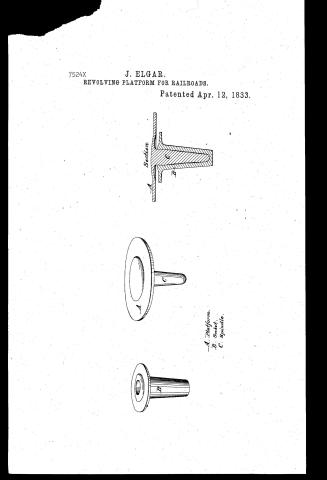
John Elgar's Patent Drawing for a Revolving Platform for Rail Roads

National Archives, Restored Patent Drawings (Record Group 241) · Full-size scan at the National Archives · Catalog record
Text on the drawing
Words on the drawing as machine-read by the National Archives; not checked. Useful mainly for searching.
RAILWAYS. / The "Way." / 120] Turn Tables. / CLASSIFICATION / 4524-+ / DIVISION. / John Elgar d / Revolving Platform for Rail Roads. / Patented: April 12th 1833. / Section / A. Platform / B. Socket. / C. Spindle / Patent Office May 12th 1838. / Made under direction of the commissioner of patents / in containity with the act of 3th March 1537 / M.LSUmorth / of Patents
USPTO scan
The patent as scanned by the USPTO
-
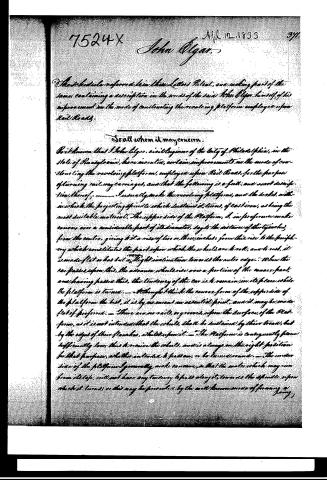
 Page 1
-
 Page 2
-
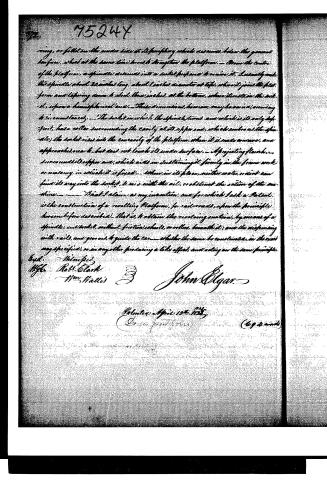 Page 3


U.S. Patent and Trademark Office · Google Patents
Published accounts: specification
Specification printed in the Journal of the Franklin Institute
Journal of the Franklin Institute, new ser., vol. 12 (1833), p. 258 · View the page
Text of the specification as printed in the Journal, from OCR; not proofread.
Specification of a patent for improvements in the Revolving Platform used upon Rail-roads. Granted to JOHN ELGAR, Civil Engineer, city of Philadelphia, April 12, 1833. To all whom it may concern, be it known, that I, John Elgar, Civil Engineer, of the city of Philadelphia, in the state of Pennsylvania, have invented certain improvements in the mode of constructing the revolving platform, employed upon rail-roads for the purpose of turning rail-way carriages, and that the following is a full and exact description thereof. I usually make the revolving platform, and the socket within which the projecting spindle which sustains it turns, of cast iron, as being the most suitable material. The upper side of the platform I, in preference, make convex over a considerable part of its diameter, say to the distance of thirty inches from the centre, giving to it a rise of two or three inches; from this rise to the periphery, which constitutes the part upon which the wheels are to roll and to rest, it is made flat, or has but a very slight inclination towards the outer edge. When the car passes upon this, the advance wheels rise over a portion of the convex part, and having passed this the tendency of the car is to remain in its place whilst the platform is turned. Although I think the convex form of the upper side of the platform the best, it is by no means an essential point, and it may be made flat if preferred. There are no rails, or grooves, upon the surface of the platform, as it is not intended that the wheels shall be sustained by their tread, but by the edges of their flanches whilst upon it. The platform is consequently placed sufficiently low thus to receive the wheels, and is always in the right position for that purpose, whether intended to pass on, or to be turned round. The under side of the platform I generally make concave, so that the water which may run from its top will not have any tendency to pass along it towards the spindle upon which it turns; or this may be prevented by the well known mode of forming a rim, or fillet, on the under side at its periphery which descends below the general surface, which, at the same time, serves to strengthen the platform. From the centre of the platform a spindle descends into a socket prepared to receive it. I usually make the spindle about thirty inches long, about eight inches diameter at top, where it joins the platform, GOUCHER'S Pulp Washer. and tapering down to about three inches at the bottom, where it rests in the socket upon a hemispherical end. These dimensions, however, may be varied according to circumstances. The socket in which the spindle turns, and which is its only support, has a collar surrounding the cavity, at its upper end, which embraces the spindle; the socket rises into the concavity of the platform, when it is made concave, and approaches near to, but does not touch, its under surface. A projecting flanch surrounds its upper end, which aids in sustaining it firmly in the frame work, or masonry, in which it is fixed. When in its place neither water nor dirt can find its way into the socket, to mix with the oil, or obstruct the action of the machine. What I claim as my invention, and for which I ask a patent, is the construction of a revolving platform for rail-roads, upon the principle hereinbefore described; that is, to obtain the revolving motion by means of a spindle and socket, without friction wheels or rollers beneath it; and the dispensing with rails and grooves to guide the car; whether the same be constructed in the exact way specified, or in any other producing a like effect, and acting on the same principle. JOHN ELGAR. A, platform. B, spindle. C, socket. D, collar. E, flanch. D B
Published accounts: journal notice
Notice in the monthly list of patents, with remarks
Journal of the Franklin Institute, new ser., vol. 12 (1833), p. 241 · View the page
23. For an improvement in the Revolving Platform used upon Rail-ways; John Elgar, Civil Engineer, city of Philadelphia, April 12.
Remarks. (See the specification.)
Published accounts: journal notice
Notice in the monthly list of patents, with remarks
Journal of the Franklin Institute, new ser., vol. 12 (1833), p. 258 · View the page
I do not intend to confine myself, in carrying my said plan into operation, to the exact mode which I have here represented; but what I claim as my invention is the constructing the working levers of fire engines, and of similar machinery, by attaching the handles thereto, so that the levers shall work backwards and forwards in the manner of a pendulum, upon the principle herein fully set forth. SAMUEL HUSE. Specification of a patent for improvements in the Revolving Platform used upon Rail-roads. Granted to JOHN ELGAR, Civil Engineer, city of Philadelphia, April 12, 1833.
Remarks. To all whom it may concern, be it known, that I, John Elgar, Civil Engineer, of the city of Philadelphia, in the state of Pennsylvania, have invented certain improvements in the mode of constructing the revolving platform, employed upon rail-roads for the purpose of turning rail-way carriages, and that the following is a full and exact description thereof. I usually make the revolving platform, and the socket within which the projecting spindle which sustains it turns, of cast iron, as being the most suitable material. The upper side of the platform I, in preference, make convex over a considerable part of its diameter, say to the distance of thirty inches from the centre, giving to it a rise of two or three inches; from this rise to the periphery, which constitutes the part upon which the wheels are to roll and to rest, it is made flat, or has but a very slight inclination towards the outer edge. When the car passes upon this, the advance wheels rise over a portion of the convex part, and having passed this the tendency of the car is to remain in its place whilst the platform is turned. Although I think the convex form of the upper side of the platform the best, it is by no means an essential point, and it may be made flat if preferred. There are no rails, or grooves, upon the surface of the platform, as it is not intended that the wheels shall be sustained by their tread, but by the edges of their flanches whilst upon it. The platform is consequently placed sufficiently low thus to receive the wheels, and is always in the right position for that purpose, whether intended to pass on, or to be turned round. The under side of the platform I generally make concave, so that the water which may run from its top will not have any tendency to pass along it towards the spindle upon which it turns; or this may be prevented by the well known mode of forming a rim, or fillet, on the under side at its periphery which descends below the general surface, which, at the same time, serves to strengthen the platform. From the centre of the platform a spindle descends into a socket prepared to receive it. I usually make the spindle about thirty inches long, about eight inches diameter at top, where it joins the platform, GOUCHER'S Pulp Washer. and tapering down to about three inches at the bottom, where it rests in the socket upon a hemispherical end. These dimensions, however, may be varied according to circumstances. The socket in which the spindle turns, and which is its only support, has a collar surrounding the cavity, at its upper end, which embraces the spindle; the socket rises into the concavity of the platform, when it is made concave, and approaches near to, but does not touch, its under surface. A projecting flanch surrounds its upper end, which aids in sustaining it firmly in the frame work, or masonry, in which it is fixed. When in its place neither water nor dirt can find its way into the socket, to mix with the oil, or obstruct the action of the machine.
Published accounts: journal notice
Notice in the monthly list of patents, with remarks
Journal of the Franklin Institute, new ser., vol. 12 (1833), p. 259 · View the page
What I claim as my invention, and for which I ask a patent, is the construction of a revolving platform for rail-roads, upon the principle hereinbefore described; that is, to obtain the revolving motion by means of a spindle and socket, without friction wheels or rollers beneath it; and the dispensing with rails and grooves to guide the car; whether the same be constructed in the exact way specified, or in any other producing a like effect, and acting on the same principle. JOHN ELGAR. A, platform. B, spindle. C, socket. D, collar. E, flanch. D B Specification of a patent for machinery for washing pulp in manufacturing paper. Granted to FRANCIS GOUCHER, Chester county, Pennsylvania, April 12, 1833.
Remarks. To all whom it may concern, be it known, that I, Francis Goucher, of Chester county, in the state of Pennsylvania, have invented an improvement in the machinery for washing the pulp, in the manufacturing of paper, and that the following is a full and exact description thereof. I make an opening in the side, or end, of the washing, or beating, engine, wherever the most convenient or advantageous application of power can be made, and insert a brass or copper vellum of any number to suit the quality of rags to be washed, and sufficiently large, (my present one being fifteen by twenty inches,) to allow a passage for all the water necessary for the operation of washing; and in order to obviate the suction which would arise from having the vellum only in the engine, I attach a box to the outer part of the engine opposite the vellum, and in this box fix a hog, or vertical paddle wheel, the use of GOUCHER'S Pulp Washer. which is to agitate the water against the vellum and drive the rags from contact with it, by which a space is obtained within the engine free from the rags, and an unobstructed passage of the water allowed. The paddles on the wheel are placed at an angle of about forty-five degrees with the arms which pass through the shaft and to which the paddles are attached this position of the paddles capacitates them for throwing the water more forcibly against the vellum within the box, than by having them (as in the common hog for suspending the pulp in vats,) perpendicular to the shaft. The discharge of the water through the vellum is regulated by a gate in the side of the box, fixed near the top so as to prevent the water sinking below the required height in the engine-otherwise the capacity for discharging the water from the box being greater than the means of supplying the engine, suction would ensue, and thus the function of the hog be counteracted-the skill and attention of the workman must be relied on for the performance of this part of the operation. The suspension of the process of washing is effected by closing the aperture in the box by the gate, and allowing the water to remain stationary therein, at the height required in the engine. It is important that the box should be perfectly water-tight, and for the better securing of this it should be composed of metal, (copper for instance,) or if of wood it should be lined with copper or lead, and soldered at the joints; otherwise a leaking would, by lowering the water in the box, cause, more or less, a constant suction at the vellum, and thereby arrest the pulp in the process of beating; but this inconvenience can be remedied by having the vellum so fixed as to slide in and out of the engine, and a brass or copper plate substituted for it when it is required to stop the washing. In this form of the vellum another advantage would be gained-two or more frames of vellum of different numbers to suit the progressive stages of the rags, could be used, and thus by using first the coarser number of vellum, to allow the more free expulsion of large particles of matter that may be to be washed out of the rags, and then the finer vellum as the state of the rags may admit. My present box is two feet in length, one foot six inches in breadth, and one foot six inches in height; the vellum in the engine is fifteen inches wide and twenty inches long; this may be varied to suit the size of the engine, &c.; the number of the vellum is thirty, but may be coarser or finer to answer the first and progressive stages of the rags. The revolutions of the hog are eighteen to twenty per minute, which I consider the best velocity for preventing suction, and producing a smooth current in the discharge of the water through the vellum. The paddles of the hog are thirteen inches long, and four inches wide, and the diameter of the hog, from the extent of the paddles, thirteen inches. To prevent the agitation of the water at the aperture of the gate, by which its free discharge would be somewhat affected, I have constructed a box immediately around the hog inside of the other box, leaving a space between the two boxes of three inches wide at the discharging end, and two inches wide at the other extremity, and placed a bottom at three inches depth, being sufficient to carry off all the water which passes through the vellum. The water GOUCHER'S Pulp Washer. rises and flows over the top of the inner box into the box or trough which surrounds it, and thus a smooth stream passes through the gateway. Two or more of these boxes and hogs may be used at different parts of the engine when there is a greater supply of water than can be discharged through one, or the one may be extended in size at pleasure. The driving power may be obtained from the main works (as mine is at present) by small straps and pulleys, and when it is required to stop the hog, a loose pulley is the most convenient means. The bottom of the box should be three or four inches below that of the engine, to allow the settling of the discharged particles of dirt, &c. from the engine, and prevent their running again into the engine, when the hog is stopped-the dirt thus accumulated may be discharged from the box through a plug-hole in the bottom.
About this record
- Patentee
- DATAMP
- Date
- the Name and Date index of patents, DATAMP, USPTO records
- Invention
- DATAMP
- Listed in
- the Name and Date index of patents, DATAMP, USPTO records, Jim Shaw's X-patent list, the Journal of the Franklin Institute, Burke's List of Patents (1847)
- in_burke