

Drawings and documents
National Archives restored drawings: drawing
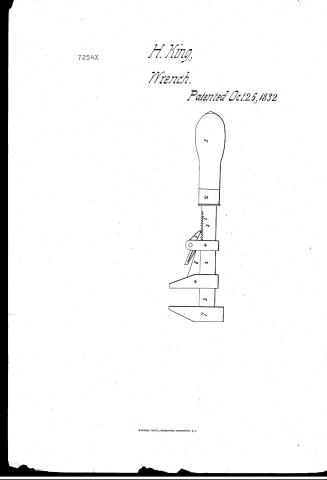
Henry King's Patent Drawing for a Rack Wrench

National Archives, Restored Patent Drawings (Record Group 241) · Full-size scan at the National Archives · Catalog record
Text on the drawing
Words on the drawing as machine-read by the National Archives; not checked. Useful mainly for searching.
8t. METAL WORKING TOOLS, / Not and nipe wrenches / 50d / Sliding-jaw, / (6) Nut Wrenches, / METAL WORKING-TOOL / Rack, / Pivoted-lock. / Sliding Jaw. / HE / HENRY KING'S / coassipication / 7254.4 DIVISION. / Patented 25th Oct. Oct. 1832. / Rack Thench. / EXPLANATION. / 5 Is Spring & ratchet. Barof the slide 7 Hammer. / 1. Handle 2.Ferule 3. Main bar. - 4 Upright parts of slide.
USPTO scan
The patent as scanned by the USPTO
-
 Page 1
-
 Page 2


U.S. Patent and Trademark Office · Google Patents
Published accounts: journal notice
Notice in the monthly list of patents, with remarks
Journal of the Franklin Institute, new ser., vol. 11 (1833), p. 227 · View the page
14. For an improvement in the Churn; Anthony W. Carrol, Granville, Licking county, Ohio, October 25.
Remarks. The claim in this churn is to the formation of the dasher, and the manner in which it is made to revolve, and we believe that there is really something new in it, which is rarely the case with patented churns. Whether the novelty will produce advantages which will compensate for the complexity of the machine, we are not prepared to say. The dasher consists of two distinct parts, which are made to revolve in reversed directions in a vertical churn. One part of the dasher is in the form of a frame, which nearly fits the sides of the tub. Slats, set into this frame, project from it towards the centre. The frame is attached to a hollow shaft which passes up through the cover of the tub. A cylindrical shaft passes through this hollow shaft, rising above it, and its lower end occupying the centre of the tub; this has slats upon it which pass between those on the frame. Upon the hollow shaft, just above the lid of the tub, there are cogs which form a pinion, and upon the cylindrical shaft, at its upper end, there is also a pinion. A vertical crown wheel, taking into these two pinions, causes the two parts composing the dasher, to revolve in opposite directions.
Published accounts: journal notice
Notice in the monthly list of patents, with remarks
Journal of the Franklin Institute, new ser., vol. 11 (1833), p. 234 · View the page
28. For Machinery for Propelling Boats; James King, Ogden, Monroe county, New York, October 28.
Remarks. There are some endless things which soon come to an end, and such we apprehend will be the case with the endless chain of buckets by means of which the present patentee proposes to propel canal and other boats. The boat is to be of the kind called a twin boat, having two keels, with a space between them along which the buckets are to pass. Two drums, one at the stem and the other at the stern, are to have endless chains, composed of flat links, passing round them, and to these the buckets are to be attached, and properly braced. Those buckets which are out of the water pass through a trunk above the deck. Motion is to be given to the chain by applying the power of steam to the drum at the stern. The same apparatus is to be applied to current mills, &c.; there, however, is no claim made to it for either use, that having been previously done, on more than one occasion.
Published accounts: journal notice
Notice in the monthly list of patents, with remarks
Journal of the Franklin Institute, new ser., vol. 11 (1833), p. 240 · View the page
44. For a Rack Wrench, for turning the nuts of screws; Henry King, Springfield, Hampden county, Massachusetts, October 25.
Remarks. This is intended as a substitute for the screw wrench, to which we think it superior in all respects. The main bar of the wrench is square, and the upper side of it is notched across, to receive a click. The sliding cheek of the wrench is supported by a piece projecting from the back of it which rests upon the bar. This carries a spring and click, and when the wrench is to be used, all that is necessary is to push the sliding piece against the nut, the spring forcing the click into one of the notches on the bar, and thus holding it in its proper place.
Published accounts: journal notice
Notice in the monthly list of patents, with remarks
Journal of the Franklin Institute, new ser., vol. 11 (1833), p. 242 · View the page
We intend, in some cases, to make the concave of cast iron, furnished with flutes from end to end, or with fine teeth, or points upon its surface, which will answer the same purpose. Instead of using cast iron, we shall, sometimes, bend sheet iron into the proper form, punching it all over, so as to convert its inner surface into a grater, by the asperities which will be thus raised. We also design to use sand stone made into the proper form, or to mould a mixture of plaster of Paris, or other cement, with sand, emery, pulverized glass, or other hard substance; or to attach such substances to wood, or other articles, by means of glue, paint, or otherwise; not intending, however, to claim either of these as making any part of our invention; the whole, or the greater part of them, having been before employed for the same, or for similar purposes. The feeding may be effected by means of a hopper, in the usual way, and a fan may be added to separate the chaff from the seed. What we claim as our invention, and for which we ask a patent, is the covering of the cylinder, or the concave, with stiff hair or bristles, so as to form the same into a brush, between which and a surface made rough by any suitable means, the seed and the hull of clover, or other grass, are separated from each other, in the manner, and upon the principle hereinbefore described. GEORGE FABER. EDWARD FABER. Specification of a patent for an improved mode of manufacturing oval and other Axes. Granted to ASAHEL COLLINS, Winstead, Litchfield county, Connecticut, October 25, 1832.
Remarks. To all whom it may concern, be it known, that I, Asahel Collins, of Winstead, in the county of Litchfield, and state of Connecticut, COLLINS' Manufacture of Axes. have invented an improvement in the mode of manufacturing oval, or felling, and other axes, by the aid of rollers, and that the following is a full and exact description of the same. Rollers have been heretofore employed for the making of axes, and of many other articles of iron, which are usually forged out on the anvil by the hammer; I do not therefore claim to be the inventor of rollers, or of their application to the object in view, but only to such a construction or form of them as shall obviate the difficulties which have been hitherto experienced in the use of them. As heretofore employed, the rollers have been indented in such a way that when made to revolve, and properly geared, a bar of heated iron passed beetwen them might receive the desired form, so far as it could be effected by them; it, however, has not been found possible to give to their sides, or edges, that precise shape which the axe should have when finished, in consequence of the tendency of the metal to spread laterally, the rollers, as constructed, not confining the iron at the sides or edges, but on the faces only. In my improved mode of forming the rollers, I make two grooves in one of them, surrounding the roller, and at such a distance apart as shall correspond with the width of the axe, or axes, to be formed; and on the other roller, I make two projecting rims, or fillets, which fit into these grooves. The inner edges of each of these rims, or fillets, are so curved or indented as to correspond with the swells, or indentations to be formed on the edges of the axe; such a shape being likewise given to the inner edges of the grooves, or, (which is the same thing,) to the exterior edges of the projecting part between the grooves, by which one face of the axe is moulded, as shall likewise correspond with the curvatures, or indentations, on the inner edges of the rims, or fillets. The rollers may be so excavated, or indented, as to form two or more axes, in one revolution, according to the diameter given to them; and they are to be so shaped as to deliver the axes ready for doubling over, with the edges and points so formed as to be ready to receive the steel, so that the final welding may be at once performed. The bar from which the axes are to be rolled may be of any convenient length, and will not require to be divided or cut into lengths, previously to rolling. Rollers, as above constructed, may be varied in their form so as to suit all the different kinds of axes made; and the steel for the axes I likewise prepare by rolling in the same way. For the purpose of finishing so as to give a more smooth surface and a more precise form to the axes than will be afforded by the rolling and subsequent welding, I prepare dies of steel which may be fastened upon rollers by screws, or otherwise, and between these the axe is rolled by a vibratory motion, carrying it from end to end of the dies. Although I have named rollers, it is manifest that segments of rollers only are requisite for this purpose. A weighted lever, or other power, may be used to press the rollers together. A powerful press, with dies adapted thereto, may be made to answer a similar end. The forms given to such dies, must necessarily be governed by the nature of the work which they have to perform. DAVIS' Improvement in Ploughs. What I claim as my invention is the use of the rims, or fillets, and the corresponding grooves by which the metal is confined laterally, and the eye, the oval, and other parts, are made to assume their proper forms in the manner hereinbefore described. I also claim the using of steel dies fixed upon rollers, or segments of rollers, for the purposes set forth. ASHAEL COLLINS. Collins' Axe Machine. A A A A, rollers. BB, grooves. CC, projecting rims in the other. Abstract of the specification of a patent for im
DATAMP: illustration
Illustrations from DATAMP


DATAMP (Directory of American Tool and Machinery Patents), via the Internet Archive · Archived DATAMP page
About this record
- Patentee
- DATAMP
- Date
- the Name and Date index of patents, DATAMP, USPTO records
- Invention
- DATAMP
- Listed in
- the Name and Date index of patents, DATAMP, USPTO records, Jim Shaw's X-patent list, the Journal of the Franklin Institute, Burke's List of Patents (1847)
- in_burke