

Drawings and documents
National Archives restored drawings: drawing
John Ames' Patent Drawing for a Machine for Sizing Paper

National Archives, Restored Patent Drawings (Record Group 241) · Full-size scan at the National Archives · Catalog record
Text on the drawing
Words on the drawing as machine-read by the National Archives; not checked. Useful mainly for searching.
DIV, 16 / $350 / 350 / John Ames / 7218-X / Siring Paper. / DIVISION. / Vol. is pg.545. / Patented Tept. /. 1832. / 1011 / 1111 / 40 / Preferences. / a.a.a.a.a.a wooden 02 metal cylinders. / b.b fixed boxes. / c.e.e.e mooeable boxes. / USA / d.d trough 02 pipes with sizing. / e.ee.e an endless web. / f cogwheel. / Aig.,A. Lideview. / Jig.2. Topview. / Sig. I Front view. / Sign / Sheels of p apr not pulla / are incaud. / shot / sty.3. / Intent office Decem her / made under the direction of the Commissioner / D/00c0 / of Patento inconformity with actof Sharah 183% / M.L.Summ / facit / Comminioner of Patints.
USPTO scan
The patent as scanned by the USPTO
-
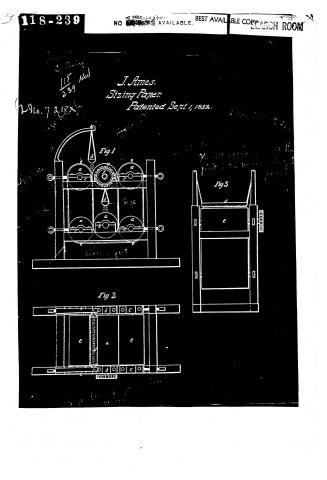 Page 1
-
 Page 2


U.S. Patent and Trademark Office · Google Patents
Published accounts: specification
Specification printed in the Journal of the Franklin Institute
Journal of the Franklin Institute, new ser., vol. 11 (1833), p. 180 · View the page
Text of the specification as printed in the Journal, from OCR; not proofread.
Specification of a patent for a pulp dresser, for dressing pulp in the manufacture of paper. Granted to JOHN AMES, Springfield, Massachusetts, September 1, 1832. Know all men by these presents, that I, John Ames, have made a new and useful improvement in the method of dressing pulp for the manufacture of paper by machinery, set forth and specified in the words following, viz:I construct a vat of convenient size, and insert therein a wirewound, hollow cylinder, constructed as follows; the skeleton, or frame work of the cylinder, is formed like the common wire cloth cylinder, with no more arms or interior work than are necessary to give strength and form to the cylinder. Instead of the wire cloth, a covering is formed by winding wire of a suitable size over the frame work, with interstices between the wires, of sufficient width for retaining knots, and allowing the dressed pulp to pass through. The cylinder is closed at one end and open at the other, with the open end closely adjusted to the side of the vat for conducting off the pulp, as is described in my patent method of " washing rags." I communicate to the cylinder a rotary motion. The pulp is admitted to the vat, and is dressed, or strained, by the wire covering. The knots, knobs, and other crude matter being retained, and the dressed pulp passing off through the open end of the cylinder to the vats, ready for use. In some cases it may be convenient to reverse the process by passing the undressed pulp into the cylinder, straining it so that the dressed pulp shall pass from the exterior of the cylinder, leaving the knots within. It may also be more convenient to conduct off the dressed pulp in the first described process, or to introduce the undressed pulp in the last, by means of a hollow arbor, with both ends of the cylinder closed, than by adjusting it as above described. An agitator of any sort may be inserted in the vat, for stirring up the pulp, (in the first described process,) if the action of the cylinder be not sufficient for that purpose. The improvement or invention that I claim specifically as mine, is the process or method of dressing pulp for the manufacture of paper, by using the wire-wound, hollow cylinder, or any hollow body, of any other figure, covered, or wound with wire, as above described, for that purpose. JOHN AMES.
Published accounts: journal notice
Notice in the monthly list of patents, with remarks
Journal of the Franklin Institute, new ser., vol. 11 (1833), p. 169 · View the page
2. For a Pulp Dresser, for dressing pulp in the manufacture of paper; John Ames, Springfield, Hampden county, Massachusetts, September 1.
Remarks. (See the specification.)
Published accounts: journal notice
Notice in the monthly list of patents
Journal of the Franklin Institute, new ser., vol. 11 (1833), p. 179 · View the page
The moving power is applied to the middle cylinder, which communicates motion, by friction, to the other parts of the machine connected by the endless felt. The same result may be produced by a different position and arrangement of parts. I do not claim the cylinders, endless felt web, or other parts of the machine, separately, as my invention; all that I claim specifically as mine, is the several parts of said machine in combination, with the use of the endless felt web, for the purpose of sizing paper. JOHN AMES. Specification of a patent for a pulp dresser, for dressing pulp in the manufacture of paper. Granted to JOHN AMES, Springfield, Massachusetts, September 1, 1832.
About this record
- Patentee
- DATAMP
- Date
- the Name and Date index of patents, DATAMP, USPTO records
- Invention
- DATAMP
- Listed in
- the Name and Date index of patents, DATAMP, USPTO records, Jim Shaw's X-patent list, the Journal of the Franklin Institute, Burke's List of Patents (1847)
- in_burke