

Drawings and documents
National Archives restored drawings: drawing
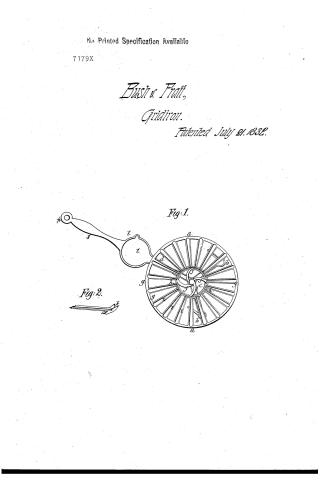
F. Bush and L. Pratt's Patent Drawing for a Grid Iron

National Archives, Restored Patent Drawings (Record Group 241) · Full-size scan at the National Archives · Catalog record
Text on the drawing
Words on the drawing as machine-read by the National Archives; not checked. Useful mainly for searching.
5/3 / 126. stoves.& FORNACES / [154] Gridirons. / #1- / CLASETTICATION / F.BUSH & L.PRATTS / 7/79X / GRID IRON. / Patented Sept.17"1851 puly D. 1802 / July 21-1-332 / Refered Sept.17 1834 / Reipued Sept The / to / Fige1 / cro / Fig. 2
USPTO scan
The patent as scanned by the USPTO
-
 Page 1
-
 Page 2


U.S. Patent and Trademark Office · Google Patents
Published accounts: journal notice
Notice in the monthly list of patents, with remarks
Journal of the Franklin Institute, new ser., vol. 11 (1833), p. 101 · View the page
27. For an improvement in the form and construction of Gridirons; Fenner Bush, Meriden, New Haven county, and Linus Pratt, Middletown, Middlesex county, Connectictut, July 21.
Remarks. In the first part of the specification of this patent we are informed that the improvement consists in so constructing and arranging the parts of the gridiron as to preserve the pieces of meat which may be broiled on them; so shaping them as that the whole may be made of cast iron, or composition metal; and that the principle is equally applicable to the instrument whether made round or square. The square gridiron is to be cast in one piece, with the bars fluted, and leading into a trough which runs along the front, or handle end, of the gridiron, which trough is to receive the gravy that runs along the flutes of the bars. The round gridiron has the bars radiating from the centre, towards which they descend, the upper surface being dishing, or concave. This revolves upon a pin projecting from the lower piece, or stand, of the gridiron, which is cast so as to catch and retain the gravy. We have before had occasion to notice gridirons upon this principle, and have known them for upwards of forty years. The patentees are aware that the general plan is not new, but state that they have heretofore been made wholly, or in part, of wrought iron, and that although gridirons have been sometimes made of cast iron, yet these have not received the form requisite to preserve the gravy. They claim, therefore, the casting the square gridiron in one piece, and the round one in two pieces, in the way which they have specified. To us it appears, from the evidence of the patentees themselves, that there is nothing new in the principle, or general plan of the instrument, nor in the material of which it is formed, but that they are the first who have made patterns to cast such gridirons as have heretofore been made of wrought iron, giving them, of necessity, such a form as would enable them to deliver from the mould. We have repeatedly expressed the opinion that a claim of this description does not include such an amount of novelty either of invention or discovery as is requisite to become the secure foundation of an exclusive right.
Published accounts: journal notice
Notice in the monthly list of patents
Journal of the Franklin Institute, new ser., vol. 15 (1835), p. 256 · View the page
21. For an improvement in the form and construction of Gridirons; Fenner Bush, and Linus Pratt, Meriden, New Haven county, Connecticut. First patented July 21st, 1832.
About this record
- Patentee
- DATAMP
- Date
- the Name and Date index of patents, DATAMP, USPTO records
- Invention
- DATAMP
- Listed in
- the Name and Date index of patents, DATAMP, USPTO records, Jim Shaw's X-patent list, the Journal of the Franklin Institute, Burke's List of Patents (1847)
- The X number was worked out from the patent’s place in the date sequence.
- in_burke