

Drawings and documents
National Archives restored drawings: drawing
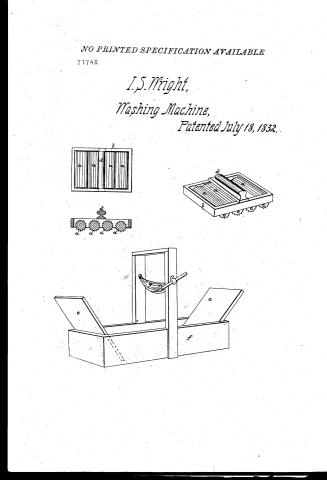
Isaac J. Wright's Patent Drawing for a Washing Machine

National Archives, Restored Patent Drawings (Record Group 241) · Full-size scan at the National Archives · Catalog record
Text on the drawing
Words on the drawing as machine-read by the National Archives; not checked. Useful mainly for searching.
1.50 / 68. LAUNDRY. / +91] M Mach's / Isaac I Wright / RECIPRUCATING RUBBER. / $150 / Washing Machine. / Topview. / Nol. in pg. 115. / CUBATION / Patented July is. 1832 / 7174-X / LIVISION. / Perspective view. / section / Preferences. / aaaa fluted. collers. / b the frame / c.cee wires or gudgeons. / d the handle. / ee the washing boards / f the trough / I the wringing apparatus. / Patent affice July 31. 1851. / del. / made under the direction of the leommissioner / of Patents in conformity with act of 3 marching / HL elloworth / Commissioner of Patents.
USPTO scan
The patent as scanned by the USPTO
-
 Page 1
-
 Page 2
-
 Page 3


U.S. Patent and Trademark Office · Google Patents
Published accounts: specification
Specification printed in the Journal of the Franklin Institute
Journal of the Franklin Institute, new ser., vol. 11 (1833), p. 110 · View the page
Text of the specification as printed in the Journal, from OCR; not proofread.
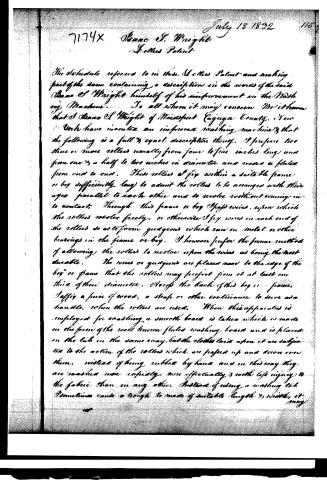
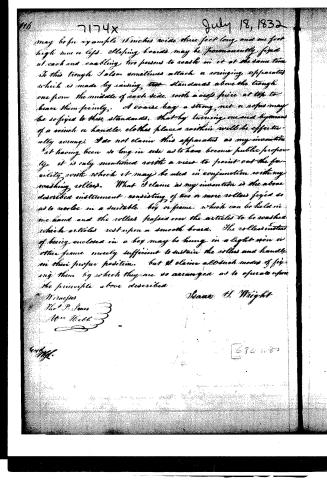
Specification of a patent for an improved washing machine. Granted to ISAAC S. WRIGHT, Weedsport, Cayuga county, New York, July 18, 1832. To all whom it may concern, be it known, that I, Isaac S. Wright, of Weedsport, Cayuga county, New York, have invented an improved washing machine, and that the following is a full and exact description thereof. I prepare two, three, or more rollers, usually from four to five inches long, and from one and a half to two inches in diameter, and reeded, or fluted, from end to end. These rollers I fix within a suitable frame, or box, sufficiently long to admit the rollers to be arranged with their axes parallel to each other, and to revolve without coming in contact. Through this frame, or box, I pass wires, upon which the rollers revolve freely; or, otherwise, I fix wires in each end of the rollers, so as to form gudgeons, which run in metal, or other bearings, in the frame, or box. I, however, prefer the former method of allowing the rollers to revolve upon the wires, as being the most durable. The wires, or gudgeons, are placed near to the edge of the box, or frame, that the rollers may project from it at least one-third of their diameter. Across the back of this box, or frame, I affix a piece of wood, a strap, or other contrivance, to serve as a handle when the rollers are used. When this apparatus is employed for washing, a smooth board is taken, which is made in the form of the well known fluted washing board, and is placed in the tubin the same way; but the clothes laid upon it are subjected to the action of the rollers, which are passed up and down over them, instead of being rubbed by hand, and in this way they are washed more rapidly, more effectually, and with less injury to the fabric than in any other. Instead of using a washing tub, I sometimes cause a trough to be made of suitable length and width; it may, for example, be sixteen inches wide, and three feet long, and one foot high, more or less. Sloping boards may be permanently fixed at each end, enabling two persons to wash in it at the same time. To this trough I also sometimes attach a wringing apparatus, which is made by raising two standards above the trough, one from the middle of each side, with a cross piece at top to brace them firmly. A coarse bag, a strong net, or ropes, may be so fixed to these standards that by turning one end DEWEES' Improvements in Canals. by means of a winch, or handle, clothes placed within will be effectually wrung. I do not claim this apparatus as my invention, it having been so long in use as to have become public property; it is only mentioned with a view to point out the facility with which it may be used in conjunction with my washing rollers. What I claim as my invention is the above described instrument, consisting of two or more rollers, fixed so as to revolve in a suitable box, or frame, which can be held in one hand, and the rollers passed over the articles to be washed, which articles rest upon a smooth board. The rollers, instead of being enclosed in a box, may be hung in a light iron, or other frame, merely sufficient to sustain the rollers and handle in their proper positions; but I claim all such modes of fixing them by which they are so arranged as to operate upon the principle above described. ISAAC S. WRIGHT.
Published accounts: journal notice
Notice in the monthly list of patents, with remarks
Journal of the Franklin Institute, new ser., vol. 11 (1833), p. 98 · View the page
20. For a Washing Machine; Isaac S. Wright, Weedsport, Cayuga county, New York, July 18.
Remarks. (See the specification.)
Published accounts: journal notice
Notice in the monthly list of patents, with remarks
Journal of the Franklin Institute, new ser., vol. 11 (1833), p. 109 · View the page
It is manifest that instead of forming a perfect socket, straps, emWRIGHT'S Washing Machine. bracing a portion of the handle only, may be continued up from the flanch, and receive the handle in the ordinary way; but this mode of procedure, whilst it would be inferior to the socket, would still be an invasion of one of the essential parts of our right, the securing of the apparatus to receive the handle to the front of the blade only. CHARLES RICHMOND, SAMUEL CASWELL, jr. Specification of a patent for an improved washing machine. Granted to ISAAC S. WRIGHT, Weedsport, Cayuga county, New York, July 18, 1832.
Remarks. To all whom it may concern, be it known, that I, Isaac S. Wright, of Weedsport, Cayuga county, New York, have invented an improved washing machine, and that the following is a full and exact description thereof. I prepare two, three, or more rollers, usually from four to five inches long, and from one and a half to two inches in diameter, and reeded, or fluted, from end to end. These rollers I fix within a suitable frame, or box, sufficiently long to admit the rollers to be arranged with their axes parallel to each other, and to revolve without coming in contact. Through this frame, or box, I pass wires, upon which the rollers revolve freely; or, otherwise, I fix wires in each end of the rollers, so as to form gudgeons, which run in metal, or other bearings, in the frame, or box. I, however, prefer the former method of allowing the rollers to revolve upon the wires, as being the most durable. The wires, or gudgeons, are placed near to the edge of the box, or frame, that the rollers may project from it at least one-third of their diameter. Across the back of this box, or frame, I affix a piece of wood, a strap, or other contrivance, to serve as a handle when the rollers are used. When this apparatus is employed for washing, a smooth board is taken, which is made in the form of the well known fluted washing board, and is placed in the tubin the same way; but the clothes laid upon it are subjected to the action of the rollers, which are passed up and down over them, instead of being rubbed by hand, and in this way they are washed more rapidly, more effectually, and with less injury to the fabric than in any other. Instead of using a washing tub, I sometimes cause a trough to be made of suitable length and width; it may, for example, be sixteen inches wide, and three feet long, and one foot high, more or less. Sloping boards may be permanently fixed at each end, enabling two persons to wash in it at the same time. To this trough I also sometimes attach a wringing apparatus, which is made by raising two standards above the trough, one from the middle of each side, with a cross piece at top to brace them firmly. A coarse bag, a strong net, or ropes, may be so fixed to these standards that by turning one end DEWEES' Improvements in Canals. by means of a winch, or handle, clothes placed within will be effectually wrung. I do not claim this apparatus as my invention, it having been so long in use as to have become public property; it is only mentioned with a view to point out the facility with which it may be used in conjunction with my washing rollers.
About this record
- Patentee
- DATAMP
- Date
- the Name and Date index of patents, DATAMP, USPTO records
- Invention
- DATAMP
- Listed in
- the Name and Date index of patents, DATAMP, USPTO records, Jim Shaw's X-patent list, the Journal of the Franklin Institute, Burke's List of Patents (1847)
- The X number was worked out from the patent’s place in the date sequence.
- in_burke