

Drawings and documents
National Archives restored drawings: drawing
Philo C. Curtis' Patent Drawing for a Back for a Forge

National Archives, Restored Patent Drawings (Record Group 241) · Full-size scan at the National Archives · Catalog record
Text on the drawing
Words on the drawing as machine-read by the National Archives; not checked. Useful mainly for searching.
75. METALLUEGY, / Purnaces, Forge: / Tuyeres. / 6976 / DIVISION. / Philo Curtis / Bach for a Forge / Vol. 14 pg. 407 / Pateral Marry. 1832. / dio / Patent office beary. 1841, / Puferinces. a box of cart Iron. b the centre plate. c.cex. mall holes. / made under the direction of the Commipion / d large hole e. hole in front plate. f wrought iron tuber Tuyere. / of Patents in conformity with act of 3' march 1837. / g. third or back plate h. hole for the bellows. / ch.L. / Commifioner of Patents.
USPTO scan
The patent as scanned by the USPTO
-
 Page 1
-
 Page 2
-
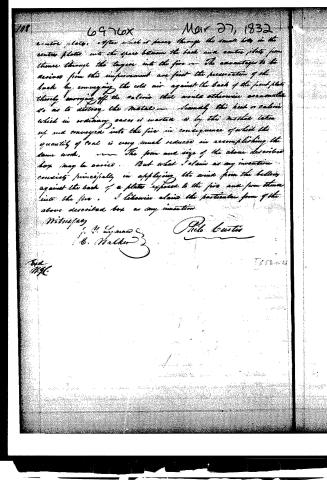 Page 3


U.S. Patent and Trademark Office · Google Patents
Published accounts: journal notice
Notice in the monthly list of patents, with remarks
Journal of the Franklin Institute, new ser., vol. 10 (1832), p. 165 · View the page
27. For an improvement in the construction of Backs for Forges and other fires; Philo C. Curtis, Utica, Oneida county, New York, March 27.
Remarks. This forge back is a box made of cast iron, about twelve inches long and ten high, and it has a depth from the fire back of about six inches. The object proposed is to supply this box with wind in such a way as to blow heated air into the fire, whilst that side of it which is in contact with the fire shall be preserved from burning out. The box is cast in two parts, capable of being put together so as to be air tight. The wind from the bellows passes in at one end of it, and escapes into the fire through a hole in the front plate, which forms the forge back. There is a centre plate, twelve inches long and ten high, which is put into the box, dividing it into two chambers; this centre plate is perforated with numerous small holes, and has one of a larger size corresponding with the hole in the front plate; the tube, or tuyere, which conducts the wind to the fire, fits into both these holes, so that all the wind must come from the posterior chamber, whilst the wind from the bellows passes into the anterior chamber. The operation will now be readily understood. The wind which passes into the anterior chamber, having to pass through the small holes in the centre plate, before it can arrive at the tuyere, and coming into contact with the heated plate which forms the forge back, becomes itself heated, and in becoming so cools the front plate. The patentee says that a considerable portion of coal is saved by thus using heated air. On this subject we refer our readers to p. 339 1 of the last volume, where the advantage of supplying a furnace with heated air is particularly noticed. The claim in the present case is to applying wind from the bellows against the back of a plate exposed to the fire, and also to the particular mode of so doing, as explained in the specification.
About this record
- Patentee
- DATAMP
- Date
- the Name and Date index of patents, DATAMP, USPTO records
- Invention
- DATAMP
- Listed in
- the Name and Date index of patents, DATAMP, USPTO records, Jim Shaw's X-patent list, the Journal of the Franklin Institute, Burke's List of Patents (1847)
- in_burke