

Drawings and documents
National Archives restored drawings: drawing
Nathan Tyson's Patent Drawing for a Machine for Drying Flour


National Archives, Restored Patent Drawings (Record Group 241) · Full-size scan at the National Archives · Catalog record
Text on the drawing
Words on the drawing as machine-read by the National Archives; not checked. Useful mainly for searching.
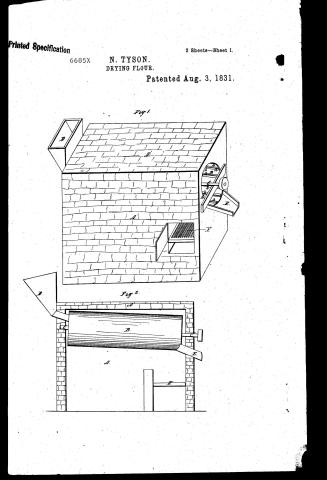
Sheet 1. $4- Oalmfics Gragon Dryens / L,13,7,783, / 34. DRIERS. / Cyllader-i CF-1 ernal, / Rotary Inclined. - / KA Ince / Nathan Tyson / U.Evans -Milins Millwrights / his hat 11508 22°.) / Drying Hour, / Claim The drying of Flour, either Bolted / ELASSIFICATION / 66862X / or unbreted, Are means of an hir amnuratus application Patented / a steam usy health an in / 6685-X / Cons inito in the manner and upon the / References, / Fight. Perspective of kim having the ends / minciple nevembetors des outro / DI ISION. / of cylinder open. / Patent Office Deeg 18 / Fir.2 section of kiln with cylinder inclosed. / Fif,3, cylinder hea ted by steam. / Made under the direction of the Commisioner of Patents / Fig1 / Fid.4. section of ditto, Fight, Vibrating box. / A.° kilm B. cylinder. C, shaft onwhich. B. turns, b.ledges. / in conformity with act of bougrep 3 March 1837 / D.hopper. En spout for delivering flour. F.fire place, / afiame. A' outer cylinder of steam dryer, B / C hollow shaft. D' hollow armsfor admitting steam to cylinders. / H. pinon which / Irod to vibrate bon. / Commisioner / Figh2, / BB / La / Mhe fioni is Takm "giltin as is leaves the mil tones, or / after the process of thing and caused to the pass achin imove h Entindus, / Where The flom or, meal is amjected Lo of sham / Or hea
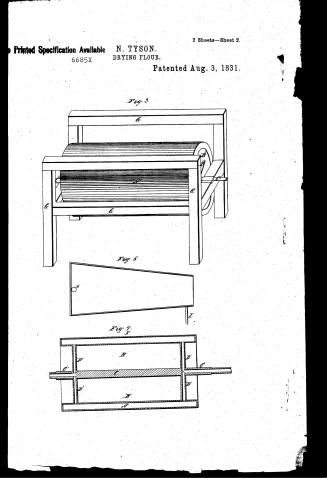
Sheet 2. CLASSIFICATION / 34, DRIERS. / 6685-X / Cy nternal / Rotary Inclined. / DIV ISION / 6685-X / Fig.5, / Fid 3, / Fight A' / B' / D' / B' / D' / D' / A' / C' / at / 11 / D' / D' / B'
USPTO scan
The patent as scanned by the USPTO
-
 Page 1
-
 Page 2
-
 Page 3
-
 Page 4
-
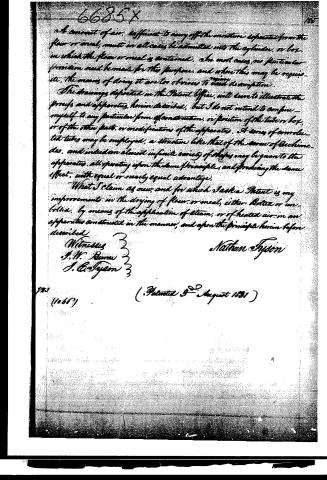 Page 5


U.S. Patent and Trademark Office · Google Patents
Published accounts: specification
Specification printed in the Journal of the Franklin Institute
Journal of the Franklin Institute, new ser., vol. 13 (1834), p. 267 · View the page
Text of the specification as printed in the Journal, from OCR; not proofread.
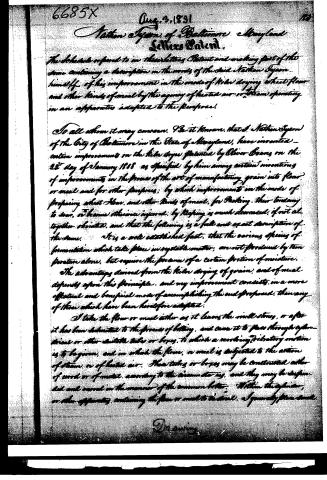
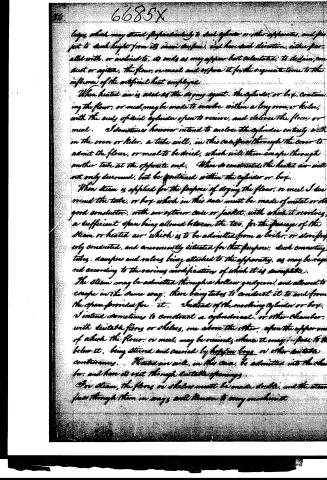
Specification of a patent for improvements in the mode of Kiln Drying Wheat Flour. Granted to NATHAN TYSON, city of Baltimore, August 8, 1831. To all whom it may concern, be it known, that I, Nathan Tyson, of the city of Baltimore, in the state of Maryland, have invented certain improvements in the kiln dryer, patented by Oliver Evans, on the 22nd day of January, 1808, as specified by him among certain "inventions of improvements in the process of the art of manufacturing grain into flour or meal, and for other purposes;" by which improvements in the mode of preparing wheat flour and other kinds of meal for packing, their tendency to sour, or to become otherwise injured by keeping, if not altogether obviated, is much decreased; and that the following is a full and exact description of the same. It is a well established fact, that the various species of fermentation which take place in vegetable matter, are not produced by temperature alone, but require the presence of a certain portion of moisture. The advantage derived from the kiln drying of grain and of meal, depends upon this principle; and my improvement consists in a more effectual and beneficial mode of accomplishing the end proposed, than any of those which have been heretofore adopted. I take the flour, or meal, either as it leaves the mill stones, or after it has been submitted to the process of bolting, and cause it to pass through cylindrical or other suitable tubes, or boxes, to which a revolving or vibratory motion is to be given, and in which the flour, or meal, is subjected to the action of steam or of heated air. The tubes, or boxes, may be constructed either of wood or of metal, according to circumstances, and they may be suspended and moved in the manner of the common bolter. Within the cylinder, or other apparatus, containing the flour, or meal, to be dried, I generally place small ledges, which may stand perpendicular to such cylinder or other apparatus, and project to such height from its inner surface, and have such direction, either parallel with or inclined to its ends, as may appear best calculated to detain, conduct, or agitate the flour, or meal, and expose it for the requisite time to the influence of the artificial heat employed. When heated air is used as the drying agent, the cylinder, or box, containing the flour, or meal, may be made to revolve within a long oven, or kiln, with the ends of said cylinder open to receive and deliver the flour, or meal. I sometimes, however, intend to enclose the cylinder entirely within the oven, or kiln; a tube will, in this case, TYSON'S Flour Drying Apparatus. pass through the cover to admit the flour, or meal, to be dried, which will then escape through another tube at the opposite end. When so constructed, the heated air will not only surround, but be contained within, the cylinder, or box. When steam is applied for the purpose of drying the flour, or meal, I surround the tube, or box, which in this case must be made of metal, or other good conductor, with an exterior case, or jacket, within which it revolves; a sufficient space being allowed between the two for the passage of the steam or heated air, which is to be admitted from a boiler, or stove, properly constructed, and conveniently situated for that purpose; such connecting tubes, dampers, and valves, being attached to the apparatus as may be required, according to the various modifications of which it is susceptible. The steam may be admitted through a hollow gudgeon, and allowed to escape in the same way, there being tubes to conduct it to and from the space provided for it. Instead of the revolving cylinder, or box, I intend sometimes to construct a cylindrical, or other, chamber, with suitable floors or shelves, one above the other, upon the upper one of which the flour, or meal, may be received, whence it may pass to those below it, being stirred and carried by hopper boys, or other suitable contrivances. Heated air will, in this case, be admitted into the chamber, and have its exit through suitable openings. For steam, the floors, or shelves, must be made double, and the steam pass through them, in ways well known to every mechanist. A current of air, sufficient to carry off the moisture, separated from the flour, or meal, must in all cases be admitted into the cylinder, or box, in which the flour, or meal, is contained. In most cases, no particular provision need be made for this purpose; and where this may be requisite, the means of doing it are too obvious to require description. The drawings deposited in the patent office, will serve to illustrate the process and apparatus herein described; but I do not intend to confine myself to any particular form, construction, or position, of the tube, or box, or of the other parts or modifications of the apparatus. A series of convoluted tubes may be employed, forming a structure like that of the screw of Archimedes, and, indeed, an almost infinite variety of shapes may be given to the apparatus, all operating upon the same principle, and producing the same effect, with equal, or nearly equal, advantage. What I claim as new, and for which I ask a patent, is my improvement in the drying of flour, or meal, either bolted or unbolted, by means of the application of steam, or of heated air, in an apparatus constructed in the manner, and upon the principle herein before described. NATHAN TYSON. Experimental Results of Kiln Drying Wheat Flour, and other kinds of Meal, for which a patent was obtained by NATHAN TYSON, of the city of Baltimore, August, 1831. In our list of patents for August 1831, vol. ix. p. 102, we inserted TYSON'S Flour Drying Apparatus. the title of the above named patent, with a remark that it was intended to publish the specification when the result of some experiments, then in progress, should be ascertained. The delay in redeeming this pledge, has resulted from the urgent desire of the patentee, that public attention might not be called to his plan until he should have had an opportunity of exporting his flour to places the least favourable to the preservation of that article, and of keeping it there a sufficient length of time to give the utmost certainty to the result of these tests This has now been accomplished, and in several instances, a barrel of the flour so exported has been retained when the ship's cargo was sold, and brought back on the return voyage. The subjoined extract of a letter from the patentee, written at the request of the editor, must be perfectly satisfactory on these points. Numerous certificates might have been obtained had they been deemed necessary, but the individual most interested in procuring them was not desirous of doing so, and where he is known, at least, it is altogether unnecessary. When the plan was first made known to the editor, he had no hesitation in declaring that it must prove perfectly successful; as, without the presence of moisture, that fermentation which produces souring cannot take place. It is not a little remarkable, that a plan so simple, and so rational, should not have been adopted long since. The kiln drying of grain is a well known process, and modes of cooling and drying the flour after it has left the stones, have been universally employed, and, indeed, every step, excepting this last and most important one, had been previously taken. We published in vol. vii. p. 102, a communication from one conversant with the subject, on the souring of American flour, and more especially of that from the western country. It was there recommended to employ a wind fan to blow cool, fresh air, among the meal as it issues from the stones, and in other parts of its manufacture, for the purpose of drying it. Now to effect this object fully, it is manifest that instead of cool air, that which is warm and dry, is the most proper agent.. It appears that from eight to twelve pounds of moisture, may be expelled from a barrel of flour, when in the state in which it is usually packed. The greater part, if not the whole, of this moisture, might undoubtedly be discharged in carefully kiln drying the grain; but the consequence of this would be that superfine flour could not be made from it, as nearly the whole of the bran would be chopped up by the stones. It is probable, too, that a much higher degree of heat would be required to separate the moisture from the grain than from the flour. Extract of a letter, dated Baltimore 3 mo., 1st, 1834. "In accordance with thy request, I now inform thee that my flour drying apparatus has been in successful operation for upwards of two years, during which time I have prepared many thousand barrels of flour, which has been shipped to every quarter of the globe, and has TYSON'S Flour Drying Apparatus stood the test of all climates for from six to twelve months, without any deterioration whatever. Advices from Gibralter and the West Indies inform me that after laying eight or ten months, my flour was found to be quite as 'perfect as though just from the mill." Within a few days past I have received the amount of the sales of a lot which I shipped in December, 1832, to Liberia, in Africa, with instructions to keep it twelve months, when it was sold, and proved to be perfectly sound. "Amongst the many to whom I have sold largely of the kiln dried flour, is the very respectable house of Wm. Patterson and Sons, of this city, a copy of whose certificate is annexed. In no instance whatever have I had a complaint of the dried flour not keeping perfectly; in several instances, a few barrels have been brought back from the East Indies and the Pacific ocean, and always in as perfect a state as when first made." CERTIFICATES. " I do hereby certify, that I have purchased from time to time a considerable quantity of dried flour, which I shipped to the West Indies and South America-say Brazils, and round Cape Horn. That in every instance this flour kept perfectly sweet, and that I believe it would keep sweet for years in almost any climate. (Signed,) Baltimore, February 15th, 1834. WM. PATTERSON. "I have visited Mr. Nathan Tyson's mills, and seen his flour drying machinery in operation, and have no hesitation in pronouncing it an important discovery, and that flour thus prepared must necessarily keep perfectly for a long time. (Signed,) Baltimore, February 15, 1834. SAML. STUMP, General Inspector of Flour. It would be difficult to magnify the importance of an improvement in the manufacturing of flour, which effectually prevents its souring; as this is not an effect produced upon a solitary barrel or two, but not unfrequently upon whole cargoes, which become sour even during the time of short voyages to the West Indies, or the southern portion of our continent; and, indeed, large quantities arrive at New Orleans in this state, although shipped on the waters of the Ohio, immediately after it is packed in barrels. A large portion of that put up for sea stores, on all long voyages, is thus lost; and but few persons would credit the account, were we able to state the proportionate quantity of that so shipped on board our vessels of war, which is eventually thrown overboard, as totally spoiled.
Published accounts: journal notice
Notice in the monthly list of patents, with remarks
Journal of the Franklin Institute, new ser., vol. 9 (1832), p. 112 · View the page
6. For improvements in the Mode of Kiln Drying Wheat Flour, and other kinds of Meal, by the agency of heated air, or of steam, operating in an apparatus adapted to the purpose; Nathan Tyson, city of Baltimore, August 8.
Remarks. We are waiting the result of some experiments now in progress by the patentee, which when completed will be published with the specification and an engraving of the apparatus.
Published accounts: journal notice
Notice in the monthly list of patents, with remarks
Journal of the Franklin Institute, new ser., vol. 13 (1834), p. 266 · View the page
A box, or trough, is made to contain the articles to be washed, or fulled, and three, four, or any convenient number of beaters or hammers, are made to vibrate within it; the vertical levers to which these hammers are attached, are hung upon pins, and worked backward and TYSON'S Flour Drying Apparatus. forward by pitmen on a crank shaft. The claim is to the "applying of the lever power to the hammer." This we think a very insecure kind of claim, but should be unable, in the present instance, to suggest one which would be otherwise. [TO BE CONTINUED.] SPECIFICATIons of AMERICAN PATENTS. Specification of a patent for improvements in the mode of Kiln Drying Wheat Flour. Granted to NATHAN TYSON, city of Baltimore, August 8, 1831.
Remarks. To all whom it may concern, be it known, that I, Nathan Tyson, of the city of Baltimore, in the state of Maryland, have invented certain improvements in the kiln dryer, patented by Oliver Evans, on the 22nd day of January, 1808, as specified by him among certain "inventions of improvements in the process of the art of manufacturing grain into flour or meal, and for other purposes;" by which improvements in the mode of preparing wheat flour and other kinds of meal for packing, their tendency to sour, or to become otherwise injured by keeping, if not altogether obviated, is much decreased; and that the following is a full and exact description of the same. It is a well established fact, that the various species of fermentation which take place in vegetable matter, are not produced by temperature alone, but require the presence of a certain portion of moisture. The advantage derived from the kiln drying of grain and of meal, depends upon this principle; and my improvement consists in a more effectual and beneficial mode of accomplishing the end proposed, than any of those which have been heretofore adopted. I take the flour, or meal, either as it leaves the mill stones, or after it has been submitted to the process of bolting, and cause it to pass through cylindrical or other suitable tubes, or boxes, to which a revolving or vibratory motion is to be given, and in which the flour, or meal, is subjected to the action of steam or of heated air. The tubes, or boxes, may be constructed either of wood or of metal, according to circumstances, and they may be suspended and moved in the manner of the common bolter. Within the cylinder, or other apparatus, containing the flour, or meal, to be dried, I generally place small ledges, which may stand perpendicular to such cylinder or other apparatus, and project to such height from its inner surface, and have such direction, either parallel with or inclined to its ends, as may appear best calculated to detain, conduct, or agitate the flour, or meal, and expose it for the requisite time to the influence of the artificial heat employed. When heated air is used as the drying agent, the cylinder, or box, containing the flour, or meal, may be made to revolve within a long oven, or kiln, with the ends of said cylinder open to receive and deliver the flour, or meal. I sometimes, however, intend to enclose the cylinder entirely within the oven, or kiln; a tube will, in this case, TYSON'S Flour Drying Apparatus. pass through the cover to admit the flour, or meal, to be dried, which will then escape through another tube at the opposite end. When so constructed, the heated air will not only surround, but be contained within, the cylinder, or box. When steam is applied for the purpose of drying the flour, or meal, I surround the tube, or box, which in this case must be made of metal, or other good conductor, with an exterior case, or jacket, within which it revolves; a sufficient space being allowed between the two for the passage of the steam or heated air, which is to be admitted from a boiler, or stove, properly constructed, and conveniently situated for that purpose; such connecting tubes, dampers, and valves, being attached to the apparatus as may be required, according to the various modifications of which it is susceptible. The steam may be admitted through a hollow gudgeon, and allowed to escape in the same way, there being tubes to conduct it to and from the space provided for it. Instead of the revolving cylinder, or box, I intend sometimes to construct a cylindrical, or other, chamber, with suitable floors or shelves, one above the other, upon the upper one of which the flour, or meal, may be received, whence it may pass to those below it, being stirred and carried by hopper boys, or other suitable contrivances. Heated air will, in this case, be admitted into the chamber, and have its exit through suitable openings. For steam, the floors, or shelves, must be made double, and the steam pass through them, in ways well known to every mechanist. A current of air, sufficient to carry off the moisture, separated from the flour, or meal, must in all cases be admitted into the cylinder, or box, in which the flour, or meal, is contained. In most cases, no particular provision need be made for this purpose; and where this may be requisite, the means of doing it are too obvious to require description. The drawings deposited in the patent office, will serve to illustrate the process and apparatus herein described; but I do not intend to confine myself to any particular form, construction, or position, of the tube, or box, or of the other parts or modifications of the apparatus. A series of convoluted tubes may be employed, forming a structure like that of the screw of Archimedes, and, indeed, an almost infinite variety of shapes may be given to the apparatus, all operating upon the same principle, and producing the same effect, with equal, or nearly equal, advantage. What I claim as new, and for which I ask a patent, is my improvement in the drying of flour, or meal, either bolted or unbolted, by means of the application of steam, or of heated air, in an apparatus constructed in the manner, and upon the principle herein before described. NATHAN TYSON. Experimental Results of Kiln Drying Wheat Flour, and other kinds of Meal, for which a patent was obtained by NATHAN TYSON, of the city of Baltimore, August, 1831. In our list of patents for August 1831, vol. ix. p. 102, we inserted TYSON'S Flour Drying Apparatus. the title of the above named patent, with a remark that it was intended to publish the specification when the result of some experiments, then in progress, should be ascertained. The delay in redeeming this pledge, has resulted from the urgent desire of the patentee, that public attention might not be called to his plan until he should have had an opportunity of exporting his flour to places the least favourable to the preservation of that article, and of keeping it there a sufficient length of time to give the utmost certainty to the result of these tests This has now been accomplished, and in several instances, a barrel of the flour so exported has been retained when the ship's cargo was sold, and brought back on the return voyage. The subjoined extract of a letter from the patentee, written at the request of the editor, must be perfectly satisfactory on these points. Numerous certificates might have been obtained had they been deemed necessary, but the individual most interested in procuring them was not desirous of doing so, and where he is known, at least, it is altogether unnecessary. When the plan was first made known to the editor, he had no hesitation in declaring that it must prove perfectly successful; as, without the presence of moisture, that fermentation which produces souring cannot take place. It is not a little remarkable, that a plan so simple, and so rational, should not have been adopted long since. The kiln drying of grain is a well known process, and modes of cooling and drying the flour after it has left the stones, have been universally employed, and, indeed, every step, excepting this last and most important one, had been previously taken. We published in vol. vii. p. 102, a communication from one conversant with the subject, on the souring of American flour, and more especially of that from the western country. It was there recommended to employ a wind fan to blow cool, fresh air, among the meal as it issues from the stones, and in other parts of its manufacture, for the purpose of drying it. Now to effect this object fully, it is manifest that instead of cool air, that which is warm and dry, is the most proper agent.. It appears that from eight to twelve pounds of moisture, may be expelled from a barrel of flour, when in the state in which it is usually packed. The greater part, if not the whole, of this moisture, might undoubtedly be discharged in carefully kiln drying the grain; but the consequence of this would be that superfine flour could not be made from it, as nearly the whole of the bran would be chopped up by the stones. It is probable, too, that a much higher degree of heat would be required to separate the moisture from the grain than from the flour. Extract of a letter, dated Baltimore 3 mo., 1st, 1834. "In accordance with thy request, I now inform thee that my flour drying apparatus has been in successful operation for upwards of two years, during which time I have prepared many thousand barrels of flour, which has been shipped to every quarter of the globe, and has TYSON'S Flour Drying Apparatus stood the test of all climates for from six to twelve months, without any deterioration whatever. Advices from Gibralter and the West Indies inform me that after laying eight or ten months, my flour was found to be quite as 'perfect as though just from the mill." Within a few days past I have received the amount of the sales of a lot which I shipped in December, 1832, to Liberia, in Africa, with instructions to keep it twelve months, when it was sold, and proved to be perfectly sound.
About this record
- Patentee
- DATAMP
- Date
- the Name and Date index of patents, DATAMP, USPTO records
- Invention
- DATAMP
- Listed in
- the Name and Date index of patents, DATAMP, USPTO records, Jim Shaw's X-patent list, the Journal of the Franklin Institute, Burke's List of Patents (1847)
- The Franklin Institute's journal gives a different date.
- in_burke