

Drawings and documents
USPTO scan
The patent as scanned by the USPTO
-
 Page 1
-
 Page 2
-
 Page 3


U.S. Patent and Trademark Office · Google Patents
Published accounts: specification
Specification printed in the Journal of the Franklin Institute
Journal of the Franklin Institute, new ser., vol. 9 (1832), p. 69 · View the page
Text of the specification as printed in the Journal, from OCR; not proofread.
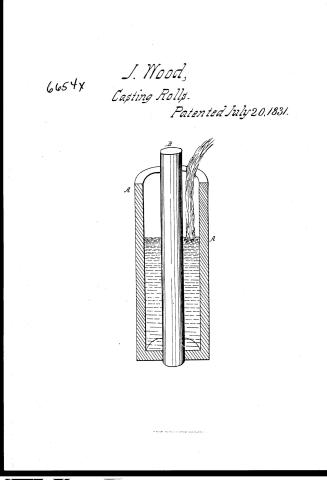
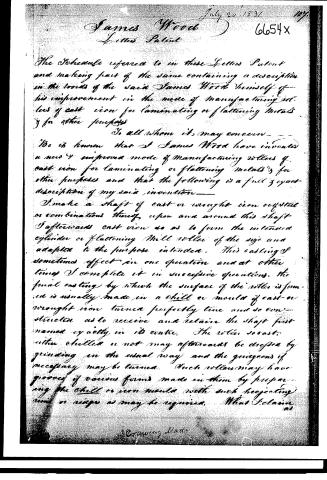
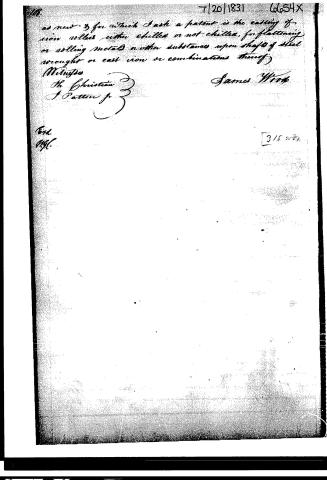
Specification of a patent for a mode of manufacturing Rollers of Cast Iron for laminating or flattening of metals, and for other purposes. Granted to JAMES WOOD, of the city of Philadelphia, July 20, 1831. I MAKE a shaft of cast or wrought iron, or of steel, or combinations thereof; upon and around this shaft I afterwards cast iron, so as to form the intended cylinder, or flatting mill roller, of the size, and Engraving Machine. adapted to the purpose intended. This casting I sometimes effect in one operation, and at other times I complete it in successive operations. The final casting, by which the surface of the roller is formed, is usually made in a chill, or mould, of cast or wrought iron, turned perfectly true, and so constructed as to receive and retain the shaft, first named, exactly in its centre. The roller so cast, either chilled or not, may afterwards be dressed by grinding in the usual way, and the gudgeons, if necessary, may be turned. Such rollers may have grooves of various forms made in them, by preparing the chill, or iron mould, with such projecting rims, or ridges, as may be required. What I claim as new, and for which I ask a patent, is the casting of iron rollers, either chilled or not chilled, for flattening or rolling metals, or other substances, upon shafts of steel, wrought or cast iron, or combinations thereof. JAMES WOOD. Engraving Machine. Invented by Mr. Jobard. M T G 0 E FO A B N THE experimental results of the above invention obtained for Mr. Jobard the large gold medal from the society for the encouragement of arts in Paris, in 1828. It is composed of a brass rule, A, one metre long, upon which slides a socket B, its internal divisions being furnished with flat steel springs. A very fine and closely wormed screw C, provided with a button D, and containing divisions E, is used to space out the lines according to the required distances. It plays in a bed F, which opens, in order that the screw may be returned without loss of time when it has gone its whole length; Gis a steel graver, armed with a finely pointed diamond: a small vice H, fastens the point. A button I, furnished at the base with an inclined plane that moves upon a fixed appendix K, serves to keep the point raised when not required for use. A small square bar to which is fixed a cup M, receives leaden weights that communicate delicacy or force to the point of the graver. The piece N is intended to reFire Engine Suction Pipes. lieve friction of the compartment C; it is attached to the socket or slider B. Every one knows that it is next to impossible, with manual skill, to cover a somewhat extended surface with parallel lines, preserving a uniform space and consistency. The above instrument we conceive will be found essentially valuable to an engraver; for the only fault with which we can charge the old masters in this branch of art, lies in the inequalities that necessarily exist in the tracing of their grounds, skies, and, above all, in the field of their medals, which, otherwise, were admirably executed. The machine under consideration will remedy this imperfection, and impart to engravings of this class, a precision and velvet-like character extremely agreeable to the eye. It materially lightens the labour of the artist, and, moreover, some descriptions of drawings may be entirely executed by its means. The following is the mode of laying down a sky upon a plate with this instrument. The first line nearest to the horizon is traced with the cup empty; before commencing a second line, a small shot of about a line in diameter is dropped into the cup: this is continued to the close of the operation by adding a shot to every line. The point being thus each time more weighted, the stroke necessarily becomes broader and deeper.-Recueil Industriel. * For machine, architectural, and other drawings of the same character, as well as of still life, the graver of Mr. Jobard will doubtless be found not only available, but useful. For the poetry, however, of this branch of the art, (if the reader will allow the expression,) no machinery can convey that enchanting effect of which the hand alone seems capable. We strongly suspect that if all the surfaces in a landscape of Claude, or Gaspar Poussin, to express which this instrument might be rendered available, were to be laid down with it, the result would be flat, hard and brassy. The lines, with all their proportions and graduations would doubtless be found mathematically correct; still we believe that that indescribable charm, that vivid effect, the soul of the art, and which seems to be communicable only by the immediate contact of the hand, would be found wanting. For laying down and shading architectural designs, and mechanical diagrams, we repeat that it may be found eminently serviceable. Editor Rep. Pat. Inv. Fire Engine Suction Pipes. SIR,-In some towns in Belgium, the suction hose of the fire engines are made without any internal metal spiral to support them against the pressure of the atmosphere. They are formed, in the manner represented in the following sketch, by winding a broad leather strap round a mandril in a spiral direction, overlapping sufficiently at each coil to allow of a line of copper rivets being inserted. When the rivets are set very close, and the coils are not above two Meteorological Observations. inches broad, such hose appear to have sufficient stiffness to answer the purpose intended, and to possess some advantages over those generally used in England. 0 Therm. Barometer. Dew Moon. Days. Sung 2 Meteorological Observations for December, 1831. rise. P.M. rise. Sun 2 P.M. point Direction. Inches Inches. 1 230 29 29.65 29.70 12 NW. 2 24 35 29.90 29.80 18 W. 3 24 32 29.60 29.60 25 N. 4 24 31 29.50 29.40 26 NW. SE. 5 10 22 29.60 29.80 5 NW. 6 10 22 30.10 30.10 5 W. 7 14 22 30.10 30.10 10 w. 8 17 32 29.95 30.00 12 SW 9 26 31 30.00 30.00 15 SW. 10 20 30 30.20 30.20 15 NE. 11 14 32 30.30 30.30 13 NW. D 12 20 20 30.10 30.10 10 W. 13 15 24 30.5 30.00 5 W. 14 16 24 30.20 30.24 4 W. 15 16 19 30.20 30.20 8 NW. 16 4 22 30.10 29.80 6 Sw. 17 26 18 29.30 29.40 4 W. 18 6 12 30.10 31.20 3 W. 19 16 34 29.90 29.80 11 SE. 20 14 22 30.5 30.5 6 SW. W. Blustering. 21 22 24 29.60 29.50 14 SW. 22 16 20 29.90 30.10 1 W. 23 5 25 30.30 30 30 2 W. 24 33 36 29.14 29.14 28 NE. SW. 25 31 35 29.90 29.35 11 SW. W. C 26 21 32 29.73 29.70 15 W. 27 19 22 29.70 29.72 6 W. 28 26 23 29.50 29.40 18 E. W. 29 26 32 29.44 29.44 19 W. 30 12 20 29.80 29.90 2 W. 31 14 30 29.50 29.30 22 Ν. ΝΕ. Mean 18.19 26.19 29.83 29.81 11.32 Wind. Water State of the weather, and Force. fallen in Remarks. rain. Inches. Moderate. do. do. do. Blustering. Moderate. do. do. do. do. Clear-overcast. Cloudy do. Cloudy do. 4 Cloudy do. snow in the Cloudy do. [evening. Cloudy do. Cloudy do. Cloudy-clear. .14 Snow-cloudy. Cloudy-clear. do. Clear day. do. Clear day. Calm. Light snow-clear. do. Cloudy day-snow in the do. .15 Cloudy-clear. [night. Blustering. Cloudy-clear. do. Slight snow-clear-very Moderate. Clear day. [blustering. do. Cloudy-clear. Clear day. do. do. Moderate. do. do. do. do. do. do. do. do. Clear day. Clear day. Clear-cloudy-snow in .40 Cloudy-clear. [the night. Cloudy-clear. Clear-cloudy. Clear-cloudy. .42 Snow-cloudy. Cloudy day. Clear-cloudy. .19 Cloudy-snow. 1.34 Thermometer. Maximum height during the month, 36. on 24th. Minimum Mean do. do. 4. on 16th. 22.19 30.30 on 11th & 23d. 29.14 on 24th. 29.83 Barometer. JOURNAL OF THE FRANKLIN INSTITUTE OF THE State of Pennsylvania, DEVOTED TO THE MECHANIC ARTS, MANUFACTURES, GENERAL SCIENCE, AND THE RECORDING OF AMERICAN AND OTHER PATENTED INVENTIONS. FEBRUARY, 1832. TO THE EDITOR OF THE JOURNAL OF THE FRANKLIN INSTITUTE. NOTES OF AN OBSERVER.-An examination of some remarks upon the application of water to wheels, which appeared in the 4th volume of this Journal. By JAMES P. ESPY. DEAR SIR, In the Journal of the Franklin Institute, vol. 4, p. 166, there are some very judicious "Remarks upon Water Wheels, and upon some prevailing errors respecting the Application of Water as a Motive Power." But upon reading that part of the essay which relates to our works at Fair Mount, I was surprised to find a disparity between the power and the effect so great as three to one. Upon examining the principles on which the writer proceeded to deduce this unexpected result, I could find no inaccuracy sufficient to justify me in the conclusion that the writer was materially wrong, except in the quantity of water actually discharged upon the wheel in twenty-four hours. The method of calculating this quantity is not given by the writer, and the presumption is, that a due allowance has not been made for the "contracted vein." According to the experiments of Venturi, confirmed by experiments of the Franklin Institute, not yet published, the area of the "contracted vein" is to the opening in the forebay through which the water is discharged upon the wheel, as 625 to 1000. Now as the velocity due to the head of pressure is at the "contracted vein," and not at the opening in the forebay, in calculating the quantity of water issuing on the wheel, the area of the "contracted vein" must be used. VOL. IX. No. 2. - FEBRUARY, 1832. 10 Application of Water upon Wheels. In making the calculation on this principle, I find that the quantity of water discharged through gate No. 1, fifteen feet by seven and a half inches, in twenty-four hours, under a one foot three and threefourths inch head, which gives a velocity at the contracted vein of nine feet per second, is about 28,000,000 gallons. Gate No. 3, which is sixteen feet by six and a half inches, gives a little less discharge in twenty-four hours, namely 27,630,000 gallons. Now if one million and one-third gallons are raised into the reservoir ninety-six feet, above the level of the forebay, by each of these wheels, in a day, with a head and fall of eight feet, the power will be to the effect in the first wheel as one to 0.57; and in the other wheel as one to 0.58; whereas, the effect given by the writer mentioned above, is to the power only as 0.33 to 1. The writer has also estimated too high the retarding influence of the inertia of the water put in motion by the buckets with a velocity equal to the difference of the velocity of the bucket, which is twelve feet, and the velocity of the water in the direction of the circumference of the wheel. This difference, on the supposition that the water comes on the wheel one foot from the surface, at an angle of 45°, is 6 feet. The whole loss of power, he says, may be estimated thus: "The velocity of the water in the required direction, is that which is due to a fall of 53 inches. Immediately on striking the wheel, it receives a velocity due to a fall of 27 inches. The difference indicates the power expended by the wheel in giving it that velocity, The water comes on the wheel below the surface of the dam, Total loss, 21 inches. 12 inches. 33 inches. It appears to me that the following method of calculating is the true one. The velocity of the water in the required direction, is 5 feet. Immediately on striking the wheel, it receives an additional velocity of 6 feet, due to a head of The water comes on the wheel below the surface of the dam, Total loss, 8 inches. 12 inches. 20 inches. It may appear paradoxical, and to a hasty examination of the subject, inconsistent with the laws of hydrodynamics, to say that a wheel can move under any circumstances, with a velocity of twelve feet a second, without losing twenty-seven inches of power, which is the head due to this velocity; more especially if the water issues obliquely upon the wheel, as in the present case. But if it is recollected that water produces a greater mechanical effect by gravity than by impulse, the paradox will vanish: for in the case we are now considering, the water, by lying on the buckets while descending eight Application of Water upon Wheels. inches, will, by its gravity, produce as great an action on the wheel, as the reaction had been by impulse. Thus it appears that there is an actual gain by letting the water on the wheel under a head of less than 27 inches, even at the expense of having to overcome its inertia by impulse: for if the water is let on the wheel under a head of 27 inches, it is acknowledged there would be a loss of 27 inches of the power, even if it could be let on in the required direction. It becomes then a problem worth investigating, at what point it is best to let the water on the wheel, provided the wheel must move with a velocity of 12 feet a second. I find by making the calculation, that the difference of the loss of power will not amount to two inches in the different heads from three to fifteen inches, and that the maximum is when the water is let on under a head of about nine inches, when the whole loss of power would be 22 inches. If it were possible to let the water on in the direction of the tangent, the maximum would be under a head of 64 inches; for under this head it would issue with a velocity, in the required direction, of six feet a second, and immediately upon striking the wheel, it would receive an additional velocity of six feet, which is due to a head of 64 inches; and in this case the whole loss of power would be only 13 inches, when there would be a loss of 27 inches if it should be let on under a head of 27. These calculations are made on the supposition of the writer, that the water is received on the wheel at the instant of passing through the gate, which, however, is not the fact; for the lower part of gate No. 1, is 19 inches below the head, and the water cannot be said to be on the wheel above this point so as to operate on it by gravity. The middle of the gate is 15 inches below the head, which gives a velocity of 9 feet per second, or about 6 in the direction of the tangent; therefore the water on striking the wheel immediately receives an additional velocity of 5 feet, which is due to a head of 5 inches, which being added to 19 gives the whole power lost 25 inches. This is nearly 26 per cent. of the whole power, and this being added to the 57 per cent. effect before calculated, gives 83 per cent. of the power accounted for; therefore there remains 17 per cent. of the power for waste, friction, and inertia. By inertia I mean the force necessary to put the water in motion when it is retarded at the bends of the tube. If we suppose that all the retardations which it experiences amount to one complete stop, the loss of power is to be calculated from the velocity of the water in the tube; this velocity is two feet and one-sixth per second, which is due to a head of one inch, or nearly one per cent. of the whole power. If the velocity in the tube were double, the loss of power would be four times as great for one stoppage, and in general the loss of power from inertia is directly as the number of stoppages multiplied by the square of the velocity. J. P. ESPY. FOR THE JOURNAL OF THE FRANKLIN INSTITUTE. An inquiry into the probable influence of the Dew Point upon Health. BY JAMES P. Espy. Ir appears by the meteorological journal for December, that the "dew point" has been very low, its mean for the whole month, being 10° Fah. ranging from 4º below zero to 28º above. Whether the influenza, which has prevailed during that period was caused by the extreme dryness of the air, and consequent rapid abstraction of moisture from the lungs, can only be determined by numerous observations. It is not unreasonable to suppose that some effect is produced on the human system by the great difference in the quantity of vapour exhaled from the lungs at different "dew points." It is the prerogative, and I may add, the duty, of the physician, to investigate what that effect is. Having the subject before me only as a meteorologist, I shall not encroach upon that prerogative; yet as "the sciences are of a sociable disposition, and flourish best in the neighbourhood of each other," I hope what I have to say, will aid, as well as stimulate, the physician, to investigate the phenomenon, as connected with health and disease. I shall proceed to show that 5446 grains, (about three-quarters of a pound avoirdupois,) of water, are evaporated from our lungs in twenty-four hours, when the dew point is 0°, more than when it is 74°, the highest it rose during the summer. According to the latest and most approved experiments, a man, at a mean, makes twenty inspirations in a minute, drawing in forty cubic inches of air each time, therefore the number of cubic inches inspired in a day will be 1152000. Now, when the dew point is zero, according to the experiments of Gay Lussac and Dalton, 1152000 cubic inches of air, contain 518 grains of vapour. This, therefore, is the quantity that enters the lungs in a day with the air inspired. If this quantity be subtracted from the whole quantity expired, the remainder will be the quantity actually evaporated from the lungs. The dew point of the breath at all seasons, as any one may know by breathing on a tumbler of water, is 94° of Fah. and the number of grains of vapour in 1152000 cubic inches of air, when the dew point is 94°, is 10828. Subtract the 518 grains which are inspired from the 10828 expired, and the remainder, 10310 grains is the quantity actually turned into vapour in the lungs, when the dew point of the atmosphere is zero; equal to 1.473 pounds avoirdupois. Again, when the dew point in the summer is 74°, the 1152000 cubic inches of air, which are inhaled in a day, contain 6004 grains of vapour; but as the dew point of the breath in summer is the same as in winter, namely 94°, if we subtract the 6004 grains inspired, from the 10828 expired, there will be left 4824 grains, the actual quantity turned into vapour in the lungs when the dew point of the atmosphere is 74°, and this, as was mentioned above, is 5446 grains less than the quantity evaporated when the dew point is zero, and is a little more than three quarters of a pound avoirdupois. Influence of the Dew Point upon Health. It will be seen also, by examining the calculation made above, that the quantity of moisture taken into the lungs in a day by inspiration is nearly twelve times more when the dew point is zero, than when it is 74°. The exsiccating power of respiration in the former case must be very great. The refrigerating power of respiration due to vaporization alone in the lungs, may be thus estimated. It is known by experiment that water, at all temperatures, absorbs one thousand degrees of Fah. in turning to vapour, and that ice, at thirty-two, absorbs in melting one hundred and forty degrees; therefore if the 1.473 pounds of water which are evaporated from the lungs when the dew point is zero, be multiplied by one thousand, and the product be divided by one hundred and forty, the quotient will be ten, the number of pounds of ice at thirty-two which would be melted in day, by the caloric given out by the lungs employed in vaporization alone; a quantity which would be sufficient to raise 15 pounds of iron from zero to 800 of Fah. a If to this be added the quantity of caloric given out by the lungs in heating 1152000 cubic inches, or fifty two pounds of air, employed in respiration per day, from 55 to 98, supposing the capacity of the air expired the same as of that inspired, viz. 0.26 of that of
Published accounts: journal notice
Notice in the monthly list of patents, with remarks
Journal of the Franklin Institute, new ser., vol. 9 (1832), p. 47 · View the page
24. For Manufacturing Rollers of Cast Iron; James Wood, city of Philadelphia, July 20.
Remarks. (See the specification.)
Published accounts: journal notice
Notice in the monthly list of patents
Journal of the Franklin Institute, new ser., vol. 9 (1832), p. 69 · View the page
THOS. EWBANK. Specification of a patent for a mode of manufacturing Rollers of Cast Iron for laminating or flattening of metals, and for other purposes. Granted to JAMES WOOD, of the city of Philadelphia, July 20, 1831.
About this record
- Patentee
- DATAMP
- Date
- the Name and Date index of patents, DATAMP, USPTO records
- Invention
- DATAMP
- Listed in
- the Name and Date index of patents, DATAMP, USPTO records, Jim Shaw's X-patent list, the Journal of the Franklin Institute, Burke's List of Patents (1847)
- in_burke