

Drawings and documents
USPTO scan
The patent as scanned by the USPTO
-
 Page 1
-
 Page 2
-
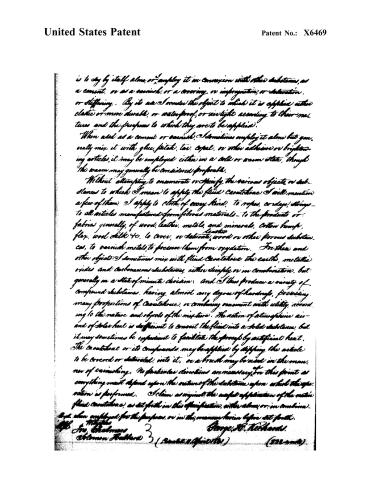 Page 3


U.S. Patent and Trademark Office · Google Patents
Published accounts: journal notice
Notice in the monthly list of patents, with remarks
Journal of the Franklin Institute, new ser., vol. 8 (1831), p. 117 · View the page
28. For a new and useful mode of rendering a variety of articles water proof, by means of fluid caoutchouc; George H. Richards, city of Washington, D. C., April 11.
Remarks. (See the specification.)
Published accounts: journal notice
Notice in the monthly list of patents, with remarks
Journal of the Franklin Institute, new ser., vol. 8 (1831), p. 130 · View the page
This press may be inverted, in which case the wheel will, by its own weight, rest upon the rollers. It may also, if desired, be made to press in a lateral direction. It is applicable to the purposes of cutting; of raising by means of dies; of printing; pressing bricks, or cheese; and, in fine, to any purpose where great power, and a moderate range, are required. Cutters, dies, a platten, or follower, &c. may be attached to the end of the shaft, which passes through the intermediate piece above described. What I claim as my invention, and for which I ask a patent, is the application of friction rollers on the indented edge of a wheel, in the manner, and for the purposes above described. LUTHER CARMAN. : Carman's Press. f a. The wheel on the rim of which the pressure is exerted. b, b. Friction rollers bearing against the rim. c, c. Springs by which the weight of a may be sustained. d. The shaft conveying the pressure by its descent. e. Pinion, turned by a lever and act ing on the teeth of the wheel a. f. A weight which may be substituted for the springs c, c. Specification of a patent for a mode of rendering a variety of articles water proof, by means of Fluid Caoutchouc, and of otherwise using that substance so as to produce new and valuable results. Granted to George H. RICHARDS, Washington, District of Columbia, April 11, 1831.
Remarks. It is well known that the substance commonly called gum elastic, or India rubber, but more correctly Caoutchouc, is produced by the desiccation of the sap or juice of several plants, and particularly of the Haevia Caoutchouc, and Jatropha Elastica, growing in the southern part of this continent, and from the Urceola Elastica of Asia. This substance, in the fluid form, has never been applied to the purposes of manufacturing or preparing of many things to which it is peculiarly applicable, although bottles, shoes, boots, balls, and sheets, have been formed thereof in the places where the above named and similar plants grow. It is true, that for the purposes of philosophical experiment, small portions of the juice have been taken to Europe, and brought to this country, but it has never been advantageously employed for purposes of utility, until the same was done by me. Solutions of the indurated substance, as usually imported, have been made in ether, naphtha, oil of sassafras, spirits of turpentine, the spirits of coal tar, and in other liquids, and a varnish has been thus made which has been occasionally applied to useful purposes. I therefore except from my application and use of caoutchouc, the aforesaid or other solutions, made from the solid material. In my application of caoutchouc, I obtain it in its original fluid state, and I use it either substantively, that is to say, by itself alone, or I employ it in connexion with other substances, as a cement, or as a varnish, for covering, impregnation, saturation, or stiffening. By its use I render the objects to which it is applied either elastic, durable, water proof, or air tight, according to their natures, and the purposes to which they are to be applied. When used as a cement I sometimes employ it alone, and someDEMING'S mode of constructing Ships or Vessels. times I mix it with glue, pitch, tar, or other adhesive articles, and employ it either in a cold or warm state, the latter, or warm state, being in most instances the best. Without attempting to enumerate, or specify the various objects, or substances, to which I mean to apply the fluid caoutchouc, I will mention a few of them. I intend to apply it to cloth of every kind, to silk, cotton, ropes, cordage, strings, and all other articles manufactured from fibrous materials. As a varnish to leather, wood, or other porous substances, so as to cover or saturate the same. As a varnish to protect metals from oxidation. I sometimes mix with the fluid caoutchouc, the metals, metallic oxides, earths, or other solid substances, either simply, or in combination, but generally in a state of minute division, and I thus produce a variety of compound substances, possessing any desired degree of hardness, or combining ornament with utility, according to the nature and objects of the mixture.
About this record
- Patentee
- DATAMP
- Date
- the Name and Date index of patents, DATAMP, USPTO records
- Invention
- DATAMP
- Listed in
- the Name and Date index of patents, DATAMP, USPTO records, Jim Shaw's X-patent list, the Journal of the Franklin Institute, Burke's List of Patents (1847)
- in_burke