

Drawings and documents
USPTO scan
The patent as scanned by the USPTO
-
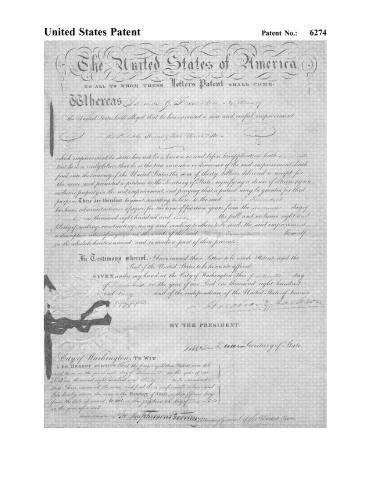 Page 1

U.S. Patent and Trademark Office · Google Patents
Published accounts: journal notice
Notice in the monthly list of patents, with remarks
Journal of the Franklin Institute, new ser., vol. 7 (1831), p. 242 · View the page
6. For an improvement in the art of heating or warming rooms, dwelling houses, offices, hot houses, churches, or any other public or private building of any description, or size, by means of a machine, apparatus, or implement, which he denominates a "Portable Steam and Hot Water Stove;" Thomas Green Fessenden, Attorney at Law, Charlestown, Middlesex county, Massachusetts, December 14.
Remarks. (See the specification.)
Published accounts: journal notice
Notice in the monthly list of patents, with remarks
Journal of the Franklin Institute, new ser., vol. 7 (1831), p. 257 · View the page
Conclusion." It is to be understood that although I have in my plans, and the explanation thereof, mentioned a cylinder prepared with points or teazles, for teazing cloth, yet, I do not claim as a part of my invention, such a cylinder, either separately, or in combination, nor the raising of naps on cloth by means thereof; and although I have mentioned stretching rollers, which ought to be the stretching rollers now used for stretching the cloth widthwise, yet I do not claim the same, either separately or in combination, as a part of my invention, nor the stretching of cloth widthwise. And, as to the rest of the machinery described, none of it is claimed separately, and only so much of it in combination as is adapted to give motion to, and regulate and change the motion of, the feeding rollers, so as to regulate and change alternately the motion of the cloth, and draw it tight and smooth over the cylinder prepared for raising the nap upon it." VOL. VII.-No. 4.-APRIL, 1831. 33 SPECIFICATIONS OF AMERICAN PATENTS. Specification of a patent for an improvement in the art of heating or warming rooms, dwelling houses, offices, hot houses, churches, or any other public or private building, of any description or size, by means of a machine, apparatus, or implement, which he denominates a "Portable Steam and Hot Water Stove." Granted to TноMAS GREEN FESSENDEN, Attorney at Law, Charlestown, Middlesex county, Massachusetts, December 14, 1830.
Remarks. My improvement consists in a portable steam and hot water stove, which may be constructed as follows, viz. the case, or outside, may be made of cast iron, sheet iron, wrought iron, or any materials which will withstand fire; including all those which are or may be used for fabricating stoves or fire places. This case may be a hollow cylinder, or of an elliptical shape, a square, a parallelogram, or any other shape which taste, convenience, or fancy may dictate. Its dimensions should be of a size proportioned to the size of the room which it is wished to warm. À cylinder, 24 inches in length and 12 inches in diameter, fitted with boilers and tubes, as hereafter mentioned, has been found by experiment sufficient to heat about 3000 cubic feet of space in a room finished in the common style, and as well adapted as usual for the exclusion of external air. The case of the stove may be placed in a perpendicular position, elevated on legs or otherwise, so as to stand about two inches above the hearth or floor of the apartment. The lower end of the cylinder being closed with a plate of iron, or other suitable substance, serving for the bottom of the ash pit, which may occupy about 6 inches of the lower end of the cylinder. This plate may also extend several inches in front of the stove, and its exterior extremity being properly supported by legs or otherwise, answer the same purpose as a hearth for a fire place, and a footstool, or stand, on which the feet may be placed for warming. An aperture closed by a door near the bottom of the cylinder is used for taking away the ashes. This door may be fitted with a register to admit more or less air, as in common stoves. Immediately above the ash pit, within the cylinder, is placed one or more boilers. The first, or lower boiler, is hollow sided, and consists of two concentric tubes of equal lengths, but of different diameters; the length about five inches, and the diameter of the outside tube just equal to the interior diameter of the case; so that the sides of the case and the boiler may sit close, and no air admitted between them can make its way over the fire place and carry off the heat. The tube which constitutes the inner part of the boiler, is about two inches less in diameter than the outside tube, which forms the exterior part of the boiler. Circular end pieces are soldered between the tubes at both ends; the upper end piece being perforatFESSENDEN's method of Heating Rooms, &c. ed with several holes to admit two, or more tubes, leading to a second boiler; and, likewise, there is an advantage in having two, or more tubes, leading to the first steam receiver, as well as two, or more tubes, of about an inch in diameter, placed on the same level, and crossing the interior of the boiler, near its bottom. Within the hollow sided boiler, is placed a grate, on which is a hollow, cylindrical vessel of cast iron, or other suitable metal, or substance, for a fire pot. These should be so shaped and placed, as not to touch any part of the boiler, or tubes, before mentioned, lest, when heated to a red heat, they should burn out, or unsolder the tin with which they come in contact. Within the cylinder, or case, and about six inches above the top of the first boiler, is placed a second boiler, set perpendicularly over the fire bed. The second boiler communicates with the first boiler by two, or more, tubes, placed at opposite sides, of about an inch diameter; and if there are enough of them to extend quite round the periphery of the boilers when placed an inch apart, except at the doorway, where the fuel is introduced, there will be an advantage arising from their exposing a large surface of metal and water to the action of the heat. The second boiler need only be about an inch think on the inside, and its circumference, or horizontal diameter, should be such as to leave a space of about an inch between the sides of the case of the stove, and the sides of the boiler. Between the hollow sided boiler and the boiler last described, an aperture is cut in the front part of the case, to which a door is adapted for introducing the fuel. This aperture may extend nearly half round the stove, its bottom being about on a level with the top of the lower boiler; and the top of the door way should be about two inches beneath the bottom of the second boiler. When the stove is in use, the door may be kept open, and thus give at once a sight of the fire and the advantage of its radient heat. Between the second boiler and the top of the cylinder, and as near the top as is practicable, the smoke is delivered by a pipe leading into a chimney, or other avenue for its escape, as in common stoves. The top of the case, or cylinder, may be closed by a lid of sheet iron, through which a tube, or several tubes, leading from the top of the second boiler, into the first steam receiver, ascend. Or the first steam receiver may rest upon and close the top of the cylinder. It will be well to have three, four, or more tubes, of about an inch in diameter, leading from the top of the second boiler into the lower steam receiver. These tubes may be placed at equal distances, near the periphery of the second boiler, and lead in a perpendicular direction into the first steam receiver. Or a single tube, of from two to four inches in diameter, may lead from the centre of the second boiler to the centre of the first steam receiver. A short tube, of about one inch in diameter, enters the lower boiler about an inch from the bottom; projects, horizontally, through the case about three inches, and is fitted with a cock for drawing off the water when it is wished to empty the boiler. A similar, but smaller tube, enters the steam receiver just above the fire line of the stove, \ FESSENDEN'S method of Heating Rooms, &c. and near the bottom of said receiver, for the purpose of ascertaining when there is water in the stove in sufficient quantity for putting it in operation, without danger of unsoldering the tin, and for drawing off that water which is not necessary to prevent the tin work from being burned or unsoldered. The steam receivers consist of several vessels of tin, or other suitable substance, (not copper, for the effluvia of that metal when heated is unwholesome,) placed perpendicularly over the boilers before described, with which, and also with each other, they communicate by steam tubes. The number and dimensions of the steam receivers should be proportioned to the size of the fire pot, boilers, and the cubic space which it is intended to warm. From actual experiment, I am induced to believe, that a cylinder, fire pot and boilers, fitted as above, would require about fifteen superficial feet of steam receivers to condense the steam generated in a cylinder, twelve inches in diameter and two feet in length, fitted with boilers and tubes as mentioned above; and this apparatus will be sufficient to warm about 3000 cubic feet of space, as stated above. The steam receivers may be of any shape which convenience, or fancy, may dictate, but it will be expedient to have them so placed and shaped that they may present a large surface in proportion to their capacity. The form which I have adopted, and which may perhaps be as eligible as any, is that of flat, circular vessels, each about inch thick, or perpendicular depth, and placed about three inches perpendicular height, one above the other, with a gradual decrease of horizontal diameter from the lowest upwards. For instance, suppose the lowest steam receiver to be about 15 inches horizontal diameter, and to rest on the top of the cylinder, or case, of the stove. The next steam receiver may be 14 inches horizontal diameter, placed three inches above the first, with which it communicates by three or more tubes, of about 1½ inch diameter, placed about equi-distant, near the outside of the receivers. The next steam receiver may be placed 3 inches higher, and be 13 inches horizontal diameter, and so on until they are six in the whole, and the upper one is ten inches in horizontal diameter. These flat, circular vessels, are surmounted by a vessel resembling the frustrum of a hollow cone, placed three inches above the upper steam receiver, with which it communicates by a tube or tubes. This vessel may be large enough to hold about three quarts, and into this, water is poured to fill the boilers. It has a lid, or cover, similar to that of a common tea kettle, which is made to sit somewhat loosely in its place, so as to admit air by its sides, and thus prevent the steam receivers from collapsing by the pressure of the atmosphere when the steam condenses, and to admit a portion of the steam to escape when there is more generated than can be condensed by the steam receivers. A damper should be fitted to the smoke pipe, as in common stoves. Although I have adopted the above mentioned form of construction in the steam stove, yet this may be varied indefinitely; and as the statute declares, that simply changing the form and proportions of FESSENDEN's method of Heating Rooms, &c. any machine shall not be deemed a discovery, I shall hold the unlicensed adoption of the principles of my stove, under any possible form or modification, to be a violation of my patent right. The novelty of the invention consists in an easily portable apparatus, which presents a convenient mode of arresting the heat produced from combustion on its passage from the interior of the stove to the chimney, by exposing as large surfaces of water as is conveniently practicable to the action of the caloric, and distributing the latent heat of the steam thus created, where it is most wanted; and condensing and bringing it back to the boilers without the apparatus of valves, syphons, &c. heretofore thought necessary in heating apartments by steam. Observations by the Patentee. THE heat which is generated by the combustion of fuel, is either combined or radiant. Combined caloric is united with the smoke vapour and heated air which rise from the burning fuel; and in common stoves and fire places, nearly the whole of the combined caloric escapes by the smoke-pipe, or chimney, and is lost. Count Rumford asserted that the quantity of combined heat which thus escapes, is much more considerable, perhaps three times greater at least, than that which is sent off in rays. And yet, small as is the quantity of this radiant heat, it is the only part of the heat generated by the combustion of fuel burnt in an open fire place which is ever employed, or which can ever be employed, in heating a room. The metal and water contained in the apparatus above described, intercept and form reservoirs for this combined heat; a part of it is detained, and distributed from the lower part of the apparatus, and a part entering the steam receivers, presents extensive heated surfaces to the air of the room, by which it is speedily and effectually warmed. Water possesses the greatest capacity for heat of any known substance, whether it be compared with equal bulks, or weights. A gallon of water, heated to 212 degrees, contains at least 500 times as much heat as a gallon of air at the same temperature. Hence, a bottle of hot air for warming the feet, &c. would not be more than one five-hundredth part so efficacious as a bottle of hot water, of the same bulk and temperature. Besides, air, when heated, becomes specifically lighter than the air in its neighbourhood; of course has a tendency to ascend and carry its caloric with it to a higher position, where its heat is diffused without answering any good purpose in economy. And in common stoves, the air of the room which is warmed is vitiated by coming in contact with a surface of hot iron, often heated red hot, by which its mass is rendered less fit for respiration, and head ache and languor are induced. But in my steam and hot water stove no part of the apparatus is heated much, if any, above the temperature of boiling water, the small particles of dust which float in the air not being burnt, it remains fresh and uncontaminated. That an apparatus for heating rooms by hot water and steam, which is portable, and requires but little care or skill in its attendance, is new, as well as useful, may be made evident from the following passages quoted from the British writers who have published works on warming and ventilating rooms, &c. In a work entitled "Practical and Descriptive Essays on the Economy of Fuel and the Management of Heat," by Robert Buchanan, p. 240, it is stated that "although in situations in which there is a steam-engine, or a regular supply of steam kept up for other purposes, it may be proper to use steam for warming buildings, yet, when that is not the case, unless a person can be appropriated to the sole purpose of attending on the boiler, I should hesitate to recommend it." It is likewise observed in Tredgold's "Treatise on Warming and Ventilating Rooms," &c. p. 19, "Wherever steam is employed, it should be under the direction of a person competent and willing to attend to it. For though, in such hands, it is perfectly safe and easily managed, it is by far too complicated to be trusted in the hands of careless and ignorant people." It is also observed in a treatise entitled "The Theory and Practice of Warming and Ventilating Public Buildings, Dwelling Houses, &c. by an Engineer," published in London, in 1825, that "it will seldom be found adviseable to use steam in warming dwelling houses, unless the establishment of servants is very numerous." My steam stove requires less attention than a common fire place. A small quantity of water (eight or ten quarts,) will answer for a whole winter, as the steam is condensed and brought back into the boiler. The apparatus is perfectly free from any danger of bursting or exploding, as the steam is not confined, nor its passage obstructed until it reaches the upper steam receiver, which is closed closed only by a lid, sitting as loosely as that of a common saucepan. Among the advantages which a portable steam stove possesses over a common stove, may be numbered its security from communicating fire to the apartment in which it is placed, as the fire place is surrounded and surmounted by water. Moreover, the steam receivers furnish a series of shelves, standing one above another, on which plates, dishes of meat, &c. may be kept hot; or linen, vegetables, &c. &c. may be dried. THOMAS G. FESSENDEN. A, A, A, A, the cylinder enclosing the fire place. B, B, the first side boiler. C, fire pot. D, D, tubes leading from the side boiler to the steam receiver. E, second boiler. F, F, tubes leading from the second boiler to the first steam receiver. G, G, G, steam receivers. I, I, tubes leading from one receiver to another. K, K, cocks for drawing off the water. L, smoke pipe leading into a chimney. ESSENDEN's method of Heating Rooms, &c. Fig. 1. Perspective view of the stove. Fig. 2. Section.
About this record
- Patentee
- the Journal of the Franklin Institute, Journal
- Date
- the Name and Date index of patents, Jim Shaw's X-patent list, Burke's List of Patents (1847)
- Invention
- the Name and Date index of patents
- Listed in
- the Name and Date index of patents, USPTO records, Jim Shaw's X-patent list, the Journal of the Franklin Institute, Burke's List of Patents (1847)
- The sources give different dates; the date shown is the one most of them agree on.
- The patentee's full name comes from the Franklin Institute's journal.
- The Franklin Institute's journal confirms the date shown.
- in_burke