

Drawings and documents
National Archives restored drawings: drawing
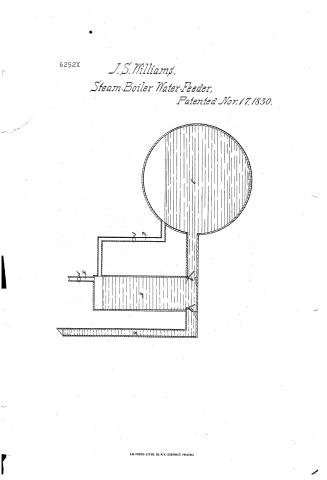
John L. Williams' Patent Drawing for a Means of Supplying Steam Boilers

National Archives, Restored Patent Drawings (Record Group 241) · Full-size scan at the National Archives · Catalog record
Text on the drawing
Words on the drawing as machine-read by the National Archives; not checked. Useful mainly for searching.
122. STEAM. / 2. BOILERS. / [148] / Feeders / John S.Williams blass 31-Feed water Apps. / CLASSIFICATION / Supplying Steam Boilers. / ilers / 6252-+ / Patented Nov. Sig. 1830. / DIVISION. / drawn / of / References. / A water chamber. b.b. the values. B supply pipe. / C. the boiler. D the steam-pipe leading to the water chamber / E pupe opening into the atmosphaire 02 vacuum. f.f. the stopcocks / or values. / Patent affice the 30 November 1839. / made under the direction of the Commipioner of / Patents in conformity with act of 3rd march 1837 / Commisiona of Patents
USPTO scan
The patent as scanned by the USPTO
-
 Page 1
-
 Page 2


U.S. Patent and Trademark Office · Google Patents
Published accounts: specification
Specification printed in the Journal of the Franklin Institute
Journal of the Franklin Institute, new ser., vol. 7 (1831), p. 181 · View the page
Text of the specification as printed in the Journal, from OCR; not proofread.
Specification of a patent for a Labour-saving Tanning Apparatus. Granted to WILLIAM BROWN. City of New York, November 11, 1830. THE improvement herein claimed by the subscriber, is the connecting and concentrating of the various processes through which the hides pass before they become leather, by means of suitable machinery, into one apparatus, the construction of which is as follows. There are four, or more, leatches, or cisterns, for infusing the bark, which are placed contiguous to the handlers, or vats, on the same level, but projecting at the top above them. These leatches, or cisterns, communicate with each other by means of tubes, inserted between them near the tops, and are supplied with false bottoms, which fit loosely, and which are perforated with holes, forming a kind of strainer. In each of the leatches is fixed an aqueduct or tube, which is used to convey the liquor from the bottom to the communicating tubes. By this contrivance the liquor is passed from the bottom of one leatch, into the top of the adjoining one, where it acquires a fresh portion of strength, and is thus propelled through the whole series, by pouring the water or weak liquor into the tops of the leatches, until it being of sufficient strength, arrives at the fourth or strongest leatch. There is also placed in one corner of each of these leatches, what is called an eye, which consists of a trunk projecting below the bottom of the leatch, and connected to a horizontal pipe, which serves to convey the liquor, when of sufficient strength, directly to the handlers, or vats; this trunk is supplied with a plug for regulating the quantity of liquor thus drawn off. At a convenient distance from the leatches, and on the same level with them, is placed a heater, which consists of two or more horizontal copper, or iron, pipes, which are placed one above the other, and have connecting tubes near their ends. These pipes are attached to and communicate with another, of a square form, in which the fire is made. These pipes, or heaters, are secured within a cistern, with their ends projecting at one side, and have caps for the convenience of cleaning. It will be seen that when a fire is kindled in the lower heater or box, the heat passes from it into the tube above at its farthest extremity, and comes forward and enters the next above, and so goes backward and forward until it enters the chimney at the opposite side, thus transmitting all the heat of the fire, to the liquor with which the cistern is constantly filled. There is a tube communicating with the heating cistern for supplying it with weak liquor or water, and communicates at its opposite extremity with a trunk or reservoir, which is furnished with a pump, by which the liquor is raised to the tube and forced into the heating cistern, which is kept constantly full by this means; the heated liquor passing off at a different tube, which communicates directly with the leatches. The leatches are filled with bark by means of a conveying trough communicating with the elevators of the mill. The strong liquor or infusion passes from the bottom of the leatches as before mentioned, into a trunk passing into a horizontal position under them, and rises by a vertical tube inserted in said trunk, from which it is transmitted to another horizontal trunk communicating with the handlers, or vats, and passing along their upper surfaces. By this method the liquor from the leatches is transmitted into the tops of the handlers, or vats. At the bottom of the vertical tube, and within the lower horizontal trunk, is placed a valve moveable by means of a strap extending up through the said tube. This valve is to prevent the stronger liquor from entering the reservoir, and thus mixing with the weaker. The liquor after having passed through the handlers, or vats, is drawn from their tops by means of a hollow plug inserted into the lower trunk before mentioned, and runs into the trunk or cistern, from whence it is again transmitted to the heaters, and so on to the leatches; so that the same liquor is continually in use; the evaporation and waste of which is supplied by water. WILLIAMS' Method of Supplying Steam Boilers. In each of the handlers is a reel, or cylinder, formed by two circular heads secured at the required distance apart by longitudinal bars; and having gudgeons which work in slides, for the convenience of elevating or depressing them at pleasure. The hides are secured on the inside of the reels by means of hoops, which encircle the reels a short distance from their heads, and have pins on their outer surfaces by which the hides are fastened; or they may be thrown loose into the reels. The great saving of labour in this invention consists in the facility with which the hides may be kept in motion when immersed in the liquor. Each of the reels has a rag wheel attached to it, and is turned one notch at a time, by means of a shaft which is geared into a click, to be worked by hand, or may be moved by animal, water, or steam power. The piston of the pump in the trunk or reservoir, is attached to one of the shafts, and may be moved or unshipped at pleasure. There is what is called a beam house connected with this apparatus, where the hides are first limed before they are put on the reels. The water which is necessary to mix the lime, is heated and supplied on the same principle as before mentioned for the leatches; and the piston of the pump attaches in a similar manner to the shaft. In laying away hides, it is necessary to have the ground bark which is put between them, moistened or damped, to prevent waste and dust. The contrivance for this purpose consists of a small cistern, elevated at a convenient height, and supplied with a spout perforated with holes, and a cock for regulating the quantity of water required to wet the bark, which is placed under it. The subscriber claims the privilege of using his improved labour-saving tanning apparatus, on as large or small a scale as he may require, and with any number of leatches and handlers. WM. BROWN.
Published accounts: specification
Specification printed in the Journal of the Franklin Institute
Journal of the Franklin Institute, new ser., vol. 7 (1831), p. 183 · View the page
Text of the specification as printed in the Journal, from OCR; not proofread.
Specification of a patent for a new and useful method of supplying the Boilers of Steam Engines with Water. Granted to JOHN S. WILLIAMS, Maysville, Mason county, Kentucky, November 17, 1830. 1. THERE must be a water chamber placed at the horizontal level, with the height the water is intended to maintain in the boiler, or boilers, intended to be supplied. 2. The water chamber must open into the supply water by a communication furnished with a valve opening toward the water chamber. The supply water must be higher than the water chamber, so as to run in of itself, or be forced in by a pump, or be drawn in by a vacuum. 3. The water chamber must open into the boiler intended to be supplied, below the height of the water it is intended to maintain in the boiler, by a communication furnished with a valve opening into, or towards the boilers. 4. The steam in the boiler above the water must open into the WILLIAMS' Method of Supplying Steam Boilers. water chamber above mentioned, by a communication which can be opened or shut at pleasure. 5. The water chamber must open upwards into the atmospheric air, or a vacuum, by a communication that can be opened or shut at pleasure. It is evident from the principles of hydrostatics, that if the steam of the boiler be shut out of the water chamber, and the communication be opened upwards from the water chamber into the atmospheric air, or a vacuum, that the supply water will flow through the communication described in the second head, above, and fill the water chamber. It is equally evident that if that communication described in the 5th head above, be then closed, and the steam in the boiler be let into the water chamber, by the communication described in the 4th head above, that the water in the water chamber will flow into the boiler through the communication described in the 3d head above, until the water in the water chamber, and that in the boiler, shall maintain one level. It is also evident that by alternately opening and shutting the two communications described in the 4th and 5th heads above, that the water chamber will be alternately filled with supply water, and emptied into the boiler, as long as the alternate opening and shutting are continued. Hence it appears that the supply of water in the boiler will not only be kept up from without, but that it can never rise higher nor sink lower in the boiler than a line above the level of which the water chamber shall have sufficient capacity to supply the water in the boiler during one operation of alternately filling and emptying the water chamber. JOHN S. WILLIAMS. Explanation of the drawing illustrative of the apparatus. E F D A, boiler. B, water chamber. C, supply water. D, D, valves. E, F, cocks. When the cock, E, is open, and F closed, the pressure in the boiler will close the valve between it and B, and the supply water will flow into the water chamber, through the valve between it and C. Shut E, and open F, and the steam from the boiler will pass into B, its pressure will close the outer, and allow the inner valve to open, when the water will flow into the boiler, and stand at the same level in it and in the water chamber. The capacity of the water chamber above the water line, must be equal to the waste of the water in the boiler during the filling and emptying of the water chamber. And if the operation of alternately opening and shutting E and F, be kept up, the water in the boiler will never rise higher nor sink lower than the water line, while the supply water continues in C.
Published accounts: journal notice
Notice in the monthly list of patents, with remarks
Journal of the Franklin Institute, new ser., vol. 7 (1831), p. 166 · View the page
41. For a mode or manner of Supplying the Boilers of Steam Engines with water; John S. Williams, Maysville, Mason county, Kentucky, November 17.
Remarks. (See the specification.)
Published accounts: journal notice
Notice in the monthly list of patents
Journal of the Franklin Institute, new ser., vol. 7 (1831), p. 183 · View the page
The water which is necessary to mix the lime, is heated and supplied on the same principle as before mentioned for the leatches; and the piston of the pump attaches in a similar manner to the shaft. In laying away hides, it is necessary to have the ground bark which is put between them, moistened or damped, to prevent waste and dust. The contrivance for this purpose consists of a small cistern, elevated at a convenient height, and supplied with a spout perforated with holes, and a cock for regulating the quantity of water required to wet the bark, which is placed under it. The subscriber claims the privilege of using his improved labour-saving tanning apparatus, on as large or small a scale as he may require, and with any number of leatches and handlers. WM. BROWN. Specification of a patent for a new and useful method of supplying the Boilers of Steam Engines with Water. Granted to JOHN S. WILLIAMS, Maysville, Mason county, Kentucky, November 17, 1830.
About this record
- Patentee
- DATAMP
- Date
- the Name and Date index of patents, DATAMP, USPTO records
- Invention
- DATAMP
- Listed in
- the Name and Date index of patents, DATAMP, USPTO records, Jim Shaw's X-patent list, the Journal of the Franklin Institute, Burke's List of Patents (1847)
- in_burke