

Drawings and documents
Published accounts: journal notice
Notice in the monthly list of patents, with remarks
Journal of the Franklin Institute, new ser., vol. 7 (1831), p. 75 · View the page
97. For an improvement in the Saw Set; Ebenezer Whiting, Berkshire, Tioga county, New York, October 15.
Remarks. (See the specification.)
Published accounts: journal notice
Notice in the monthly list of patents, with remarks
Journal of the Franklin Institute, new ser., vol. 7 (1831), p. 171 · View the page
The anticipations of the patentee are, as is frequently the case, of a character somewhat too magnificent; they are manifestly theoretical, as we are very certain that a practical essay would have subtracted much from the sum entered on the credit side. The boiler described is 3 feet in diameter, and 10 feet in length, and we are told that "this engine is capable of producing 200 horse power, as is calculated at present, and can be practically used in all cases where steam power may be required, for boats, carriages, factories, mills, and in all other places." "The use of this engine and boiler, will render the use of steam full fifty centum less expensive than those now in general use." Perhaps so, but we "have little hope, and no confidence." SPECIFICATIONS OF AMERICAN PATENTS. Specification of a patent for improvements in the Saw Set. Granted to EBENEZER WHITING, Berkshire, Tioga county, New York, October 15, 1830.
Remarks. To all whom it may concern, be it known, that I, Ebenezer Whiting, have invented certain improvements in the saw set, which improvements are applicable to saws of all descriptions, and that the following is a full and exact description of the same. The saw set which I use operates upon the principle of punching, and is represented in the drawings which accompany this specification. Fig. 1, exhibits a convenient form for the saw set when used for hand, panel, or other similar saws. It has a shank by which it may be firmly fixed in a vice, or in a hole made in a bench for that purpose. The punch is sustained by a spring attached to the iron support, which is usually cast in one piece with the shank. A piece of tempered steel is let into the iron, immediately under the punch, and forms the bed between which and the punch the saw WHITING'S Saw Set. tooth stands when it is to be set. There are two pins, or wires, which serve as guides to the saw teeth as they are successively set. The punch is filed so that its two sides which meet between the pins, form an acute angle, so as to be adapted to the form of a saw tooth. A plate of brass, or other metal, upon which the blade of the saw is to rest, is made to raise, or lower, by means of screws, which are tapped into the iron part of the frame through which they pass, and swivel in the plate above. A bent spring bears upon the heads of the screws, to retain them in their places. (See Fig. 1.) Fig. 1. Fig. 2, is the same principle adapted to saw mill, cross cut, and other large saws. The pins which guide the teeth are not seen in the drawing, as they are hidden by the punch. They rise, however, from a steel bed, as in the former instance, and the punch, instead of being filed to an acute angle, is left square, and has two holes drilled in its face to admit the pins, and allow the punch to play. There are two screws by which to regulate the set of the saw, and also a bent spring. There is, on the back, a mass of cast iron which serves for a handle, and at the same time by its inertia, sustains the stroke of the hammer when a tooth is set. WHITINGS Fig. 2.
DATAMP: illustration
Illustrations from DATAMP
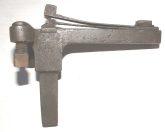
DATAMP (Directory of American Tool and Machinery Patents), via the Internet Archive · Archived DATAMP page
About this record
- Patentee
- DATAMP
- Date
- DATAMP, Burke's List of Patents (1847)
- Invention
- DATAMP
- Listed in
- the Name and Date index of patents, DATAMP, Jim Shaw's X-patent list, the Journal of the Franklin Institute, Burke's List of Patents (1847)
- The sources give different dates; the date shown is the one most of them agree on.
- The Franklin Institute's journal confirms the date shown.
- in_burke